Seeking couples counseling is not a sign of failure, but a sign of courage and investment. Whether you’re navigating a major life transition, working to rebuild trust, or looking for proactive support, knowing how to find a couples therapist is an essential first step.
Finding a couples-specific counselor (rather than one who lists “couples” as one of many specialties in their therapist’s bio) can be difficult. This guide cuts through the traditional search process to help you find the right support.
Looking to get started today?
Below, you’ll find a clear breakdown of the major therapy frameworks and a realistic, step-by-step vetting process to help you find the right therapist and get started with confidence.
Key takeaways
- Couples therapy isn’t just for relationships in crisis—it can also help strengthen communication, deepen connection, and address challenges before they become larger issues.
- Finding the right couples therapist starts with understanding your goals, choosing a provider with specialized training, and asking about their therapeutic approach.
- While insurance may cover couples therapy in some situations, coverage often depends on whether treatment is tied to a diagnosable mental health condition, so it’s important to verify your benefits before scheduling.
- Couples therapy isn’t appropriate in every situation. If a relationship involves ongoing abuse, interpersonal violence, or coercive control, individual therapy and safety planning are generally recommended instead.
What to know before you start: understanding couples therapy
Couples therapy is typically most effective for two people in a committed relationship who want professional support to navigate challenges, improve communication, or strengthen their bond. Before deciding if you’ll benefit from couples counseling, you need to understand the issues it addresses and the widely used models.
Common relationship hurdles addressed in therapy
Couples bring a wide range of concerns to therapy, and they often go well beyond the surface-level issues that tend to dominate conversations. Couples counseling can help partners navigate common relationship issues like:
- Intimacy and connection, including emotional distance, fear of intimacy or vulnerability, and physical disconnection.
- Financial conflict, including differing money philosophies, debt stress, or power imbalances around income and spending.
- Communication and conflict cycles, including persistent arguing patterns, stonewalling, contempt, or the pursuer-distancer dynamic.
- Codependency and enmeshment, including eroded or poorly-defined boundaries.
- Grief from external stressors, a loss, a health crisis, or a family conflict.
- Life transitions, like bringing a new child into a family, relocation, career change, premarital considerations, or retirement.
- Infidelity and trust repair, including abandonment trauma, and rebuilding safety and a secure attachment after a betrayal.
While couples therapy can help with many relationship challenges, it isn’t appropriate in every situation. If there is ongoing interpersonal violence, abuse, or coercive control, individual therapy and safety planning are typically recommended instead. In these situations, couples therapy can increase risk and may not provide a safe environment for both partners.
If you need immediate support
If you or someone you know may be experiencing abuse, contact the National Domestic Violence Hotline at 1-800-799-7233, by texting START to 88788, or through online chat at thehotline.org. If there is immediate danger, call 911.
Core therapy models
Most couples therapists draw from one or more evidence-based therapy frameworks. Knowing the major models (and which you prefer) can help you find a therapist with specialized training.
The three most widely used are:
- The Gottman Method: This model identifies specific behaviors that predict relationship breakdown. Sessions focus on building a “Sound Relationship House” through structured exercises to increase intimacy, manage conflict productively, and create shared meaning.
- Emotionally focused therapy (EFT): EFT is rooted in attachment theory and focuses on reshaping the emotional bond between partners. Rather than addressing surface-level behavior, couples identify the underlying emotional needs and fears that drive patterns.
- Relational life therapy (RLT): Relational therapy examines how patriarchal conditioning, family-of-origin wounds, and power imbalances show up in intimate relationships.
If you’re not sure which framework fits your situation, consider asking a therapist during your consultation which approach they use and how they will tailor it to your specific concerns, goals, values, and relationship dynamics.
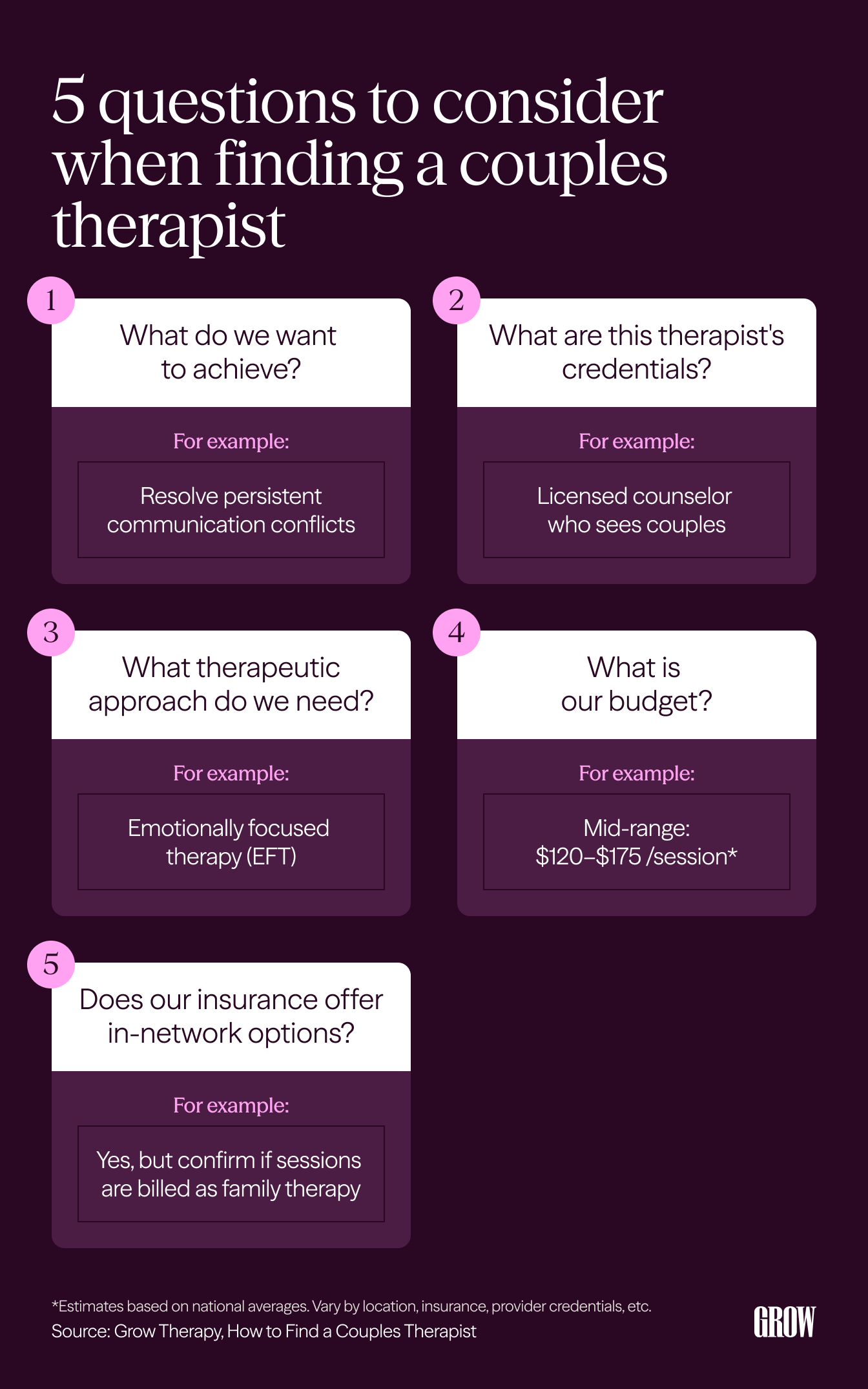
How to find a marriage or couples therapist near you: step-by-step vetting
Finding the right couples therapist takes more than a quick internet search. The steps below provide a structured framework for narrowing your options, so you can invest your time and energy in finding a provider who is genuinely equipped to help — not just available.
Step 1: Align on your collective goals
Before you even open a browser, have an honest conversation with your partner about what you both want from therapy.
Setting clear therapy goals and preferences together gives your therapist (and you) an immediate map for the work ahead. Consider setting SMART therapeutic goals as a framework, and ask yourselves:
- What made us start looking for couples therapy now?
- Is there a specific issue we want help with, or are we feeling stuck in a larger pattern?
- What do we hope will feel different between us after therapy?
- Are we trying to repair something, make a decision, communicate better, or strengthen our relationship?
- What would help each of us feel safe enough to participate honestly?
Step 2: Know what credentials to look for
Not every licensed therapist specializes in couples counseling. When evaluating a potential provider, here’s a quick guide to the most relevant credentials:
| Provider | Acronym | Training |
|---|---|---|
| Licensed marriage and family therapist | LMFT | Trained to understand relationship patterns, family systems, communication dynamics, and how each partner’s experiences shape the relationship. |
| Licensed clinical social worker | LCSW | Brings a clinical social work lens to relationship concerns, often considering how each partner’s mental health, family history, stressors, identities, communication patterns, and broader life context affect the relationship. |
| Psychologist | PhD/PsyD | Brings doctoral-level clinical training in assessment, diagnosis, and psychotherapy. They may help couples understand how individual mental health concerns, personality patterns, trauma histories, attachment styles, and emotional regulation affect the relationship. |
| Licensed professional counselor | LPC or LPCC | Supports clients with mental health, emotional, behavioral, and relational concerns. LPCCs may help partners understand how communication patterns, conflict, attachment, stress, identity, and individual mental health needs affect the relationship. |
Any clinician you’re considering should be able to clearly describe their specific framework, the rationale behind it, and the training they have received. Always ask about their specific couples training during your initial consultation.
Step 3: Use a smart, targeted directory filter
Once you know what you’re looking for, choose a specialized directory, such as Grow Therapy’s couples therapy directory. Grow Therapy lets you choose detailed filters to see a real-time list of licensed relationship, marriage or couples therapists, that match your needs and are actively accepting new clients.
Plus, using a online therapy resource built specifically for insurance-covered care means you can search for couples counseling near you with confidence, with matching filters for:
- Insurance
- Location
- Availability
- Speciality
Find a couples therapist today
How much does couples counseling cost?
While insurance may provide some financial support for partners pursuing couples counseling, out-of-pocket rates for couples therapy typically range from $75 to $300 per session.
For some couples, sliding-scale fee structures may be available through independent clinicians and community mental health settings. Additionally, insurance plans may cover part or all of your counseling expenses.
Even though the cost of couples counseling can be high, many couples find it to be a worthwhile investment in their relationship. Consider your budget at the start of your search so you can make a sustainable financial decision while investing in your relationship’s health.
Does insurance cover couples therapy?
Most insurance plans do not cover standard couples or marriage counseling, but coverage may be available under specific circumstances.
Since health insurance operates on a medical model, a diagnosable mental health condition (like anxiety or PTSD) for one of the partners is required to activate coverage. Because of this, couples therapy focused primarily on communication, connection, prevention, or strengthening an already good relationship may not be covered, even when the work is meaningful and worthwhile.
Before scheduling a counseling session, reach out to your insurer and ask the following questions. You don’t need to understand the billing codes—simply use the language below when speaking with your insurer:
- Does my policy cover outpatient behavioral health family therapy under CPT code 90847?
- If a session is billed under code 90847 with a mental health diagnosis, does my standard outpatient mental health copay apply?
Note that not all plans, even with a qualifying diagnosis, will cover couples therapy, and some plans exclude family therapy entirely. Always verify directly with your carrier and your therapist’s billing team before booking.
Core benefits of couples counseling
Couples therapy isn’t just for crisis management, but can be a proactive investment for partners. Many couples choose to start counseling before problems become overwhelming, using it to strengthen communication, deepen connection, and address small issues before they grow into larger ones. Here are a few of the most meaningful ways consistent counseling supports relationships over time.
Breaking unhealthy communication cycles
One of the most valuable early-stage breakthroughs in couples therapy is learning to identify the repetitive, exhausting loops driving conflict, including:
- Pursuer-distancer dynamics, which occur when one partner seeks closeness while the other pulls away.
- Criticism-defensiveness cycles, in which a partner criticizes the other’s character or personality and the defender responds with excuses or deflection.
- Silent treatment or emotional withdrawal, where a partner shuts down and disengages from a conversation.
A skilled therapist helps both partners notice patterns, slow down conflict, communicate more clearly, and understand what each person is trying to express or protect.
Gaining an objective, neutral perspective
Friends and family can be supportive, but they may have loyalties, histories, or opinions that make it hard to see the relationship clearly. A couples therapist offers a more balanced, professional perspective. Rather than simply taking sides, the therapist helps both partners recognize issues and take responsibility for improving their part in the dynamic.
Restoring emotional safety and intimacy
Over time, unresolved conflict builds walls of resentment, hypervigilance around certain topics, and a growing sense of emotional distance. Couples therapy creates a structured, safe container to dismantle those barriers and voice the vulnerabilities underneath them while rebuilding emotional intimacy and secure attachments between partners.
Developing an actionable toolkit for the future
Emotional health requires consistent practice, especially for partners hoping to build long-lasting change. Rather than just processing an argument, evidence-based approaches teach couples concrete repair skills, like:
- De-escalation techniques
- Structured conversation frameworks
- Repair language
The goal of couples therapy isn’t to make partners dependent on it, but to send them home with the tools to maintain rebuilt relationships.
Find a specialized couples therapist today with Grow Therapy
Knowing what to look for, what questions to ask, and how to assess fit can help you find a couples therapist who is appropriate for your needs.
Grow Therapy makes it easy to find licensed couples counselors and online therapy that takes insurance, with no ongoing commitment required. Plus, many of our providers offer evening and weekend availability to simplify scheduling.