
Awareness of perimenopause is high among many women, yet meaningful conversations about it remain rare. Grow Therapy surveyed 1,007 U.S. women ages 18 and older to understand this disconnect. The data shows that while women are familiar with this natural life transition, the subject often goes unaddressed in doctors’ offices. This leaves emotional and mental shifts of this life stage unspoken.
This silence leads many women to look for answers on their own. Without guidance, some may blame themselves for symptoms that are actually psychological.
Perimenopause is the time before menopause when a woman’s body prepares to stop having periods. According to the Mayo Clinic, it typically starts in a person’s 40s, though it can begin as early as the 30s or as late as their 50s. We’d like to note that, while we use the term “women” throughout this report for brevity, we acknowledge that this transition impacts the majority of people assigned female at birth (AFAB), regardless of gender identity.
Pop culture often treats this phase as just “hot flashes.” The reality is different. For many, it is a mix of challenging physical symptoms and a deep psychological transition. Our data shows that symptoms like anxiety, mood swings, and “brain fog” are just as common as physical symptoms.
In this report, we examine the often-unaddressed mental and emotional toll of perimenopause. We explore the barriers to care and how different generations are handling this major life change.
Key takeaways
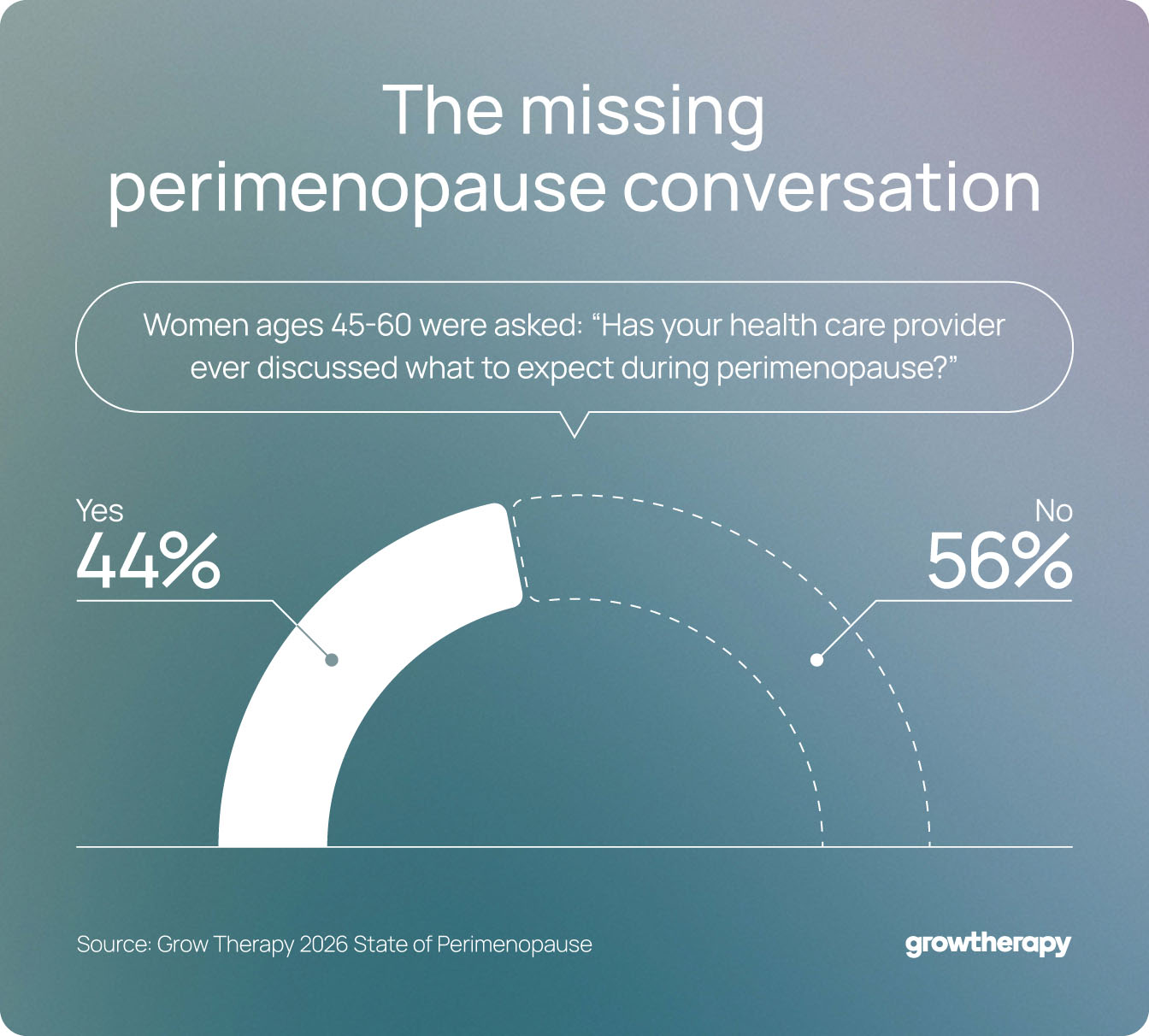
- Most (94%) of the women surveyed know about perimenopause, but 56% of those aged 45-60 have never discussed it with a health care provider.
- Respondents recognize the mental toll, with 74% citing mood swings as a symptom and 51% citing anxiety.
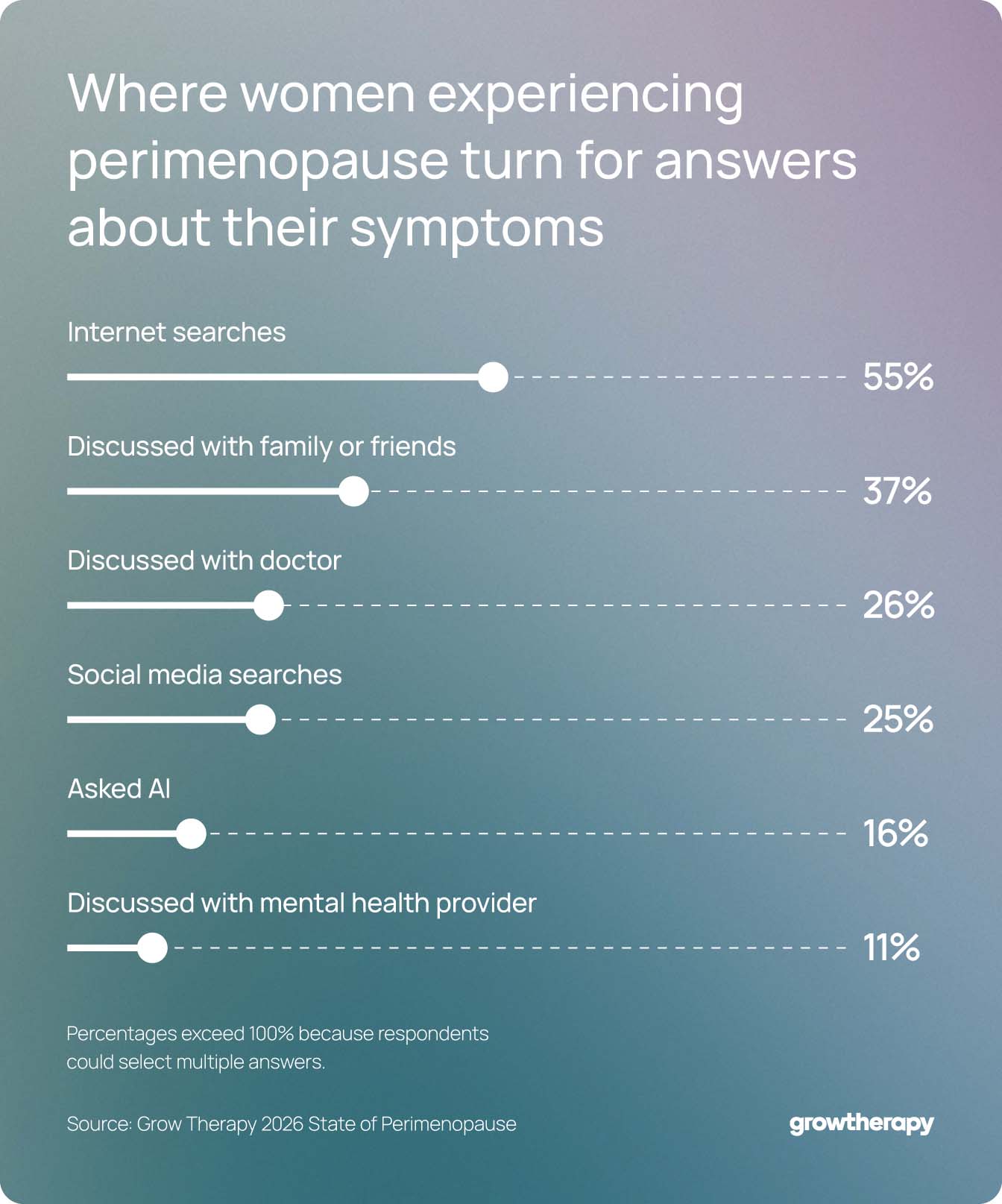
- 55% of respondents searched online for answers about symptoms, but only 11% discussed them with a mental health therapist.
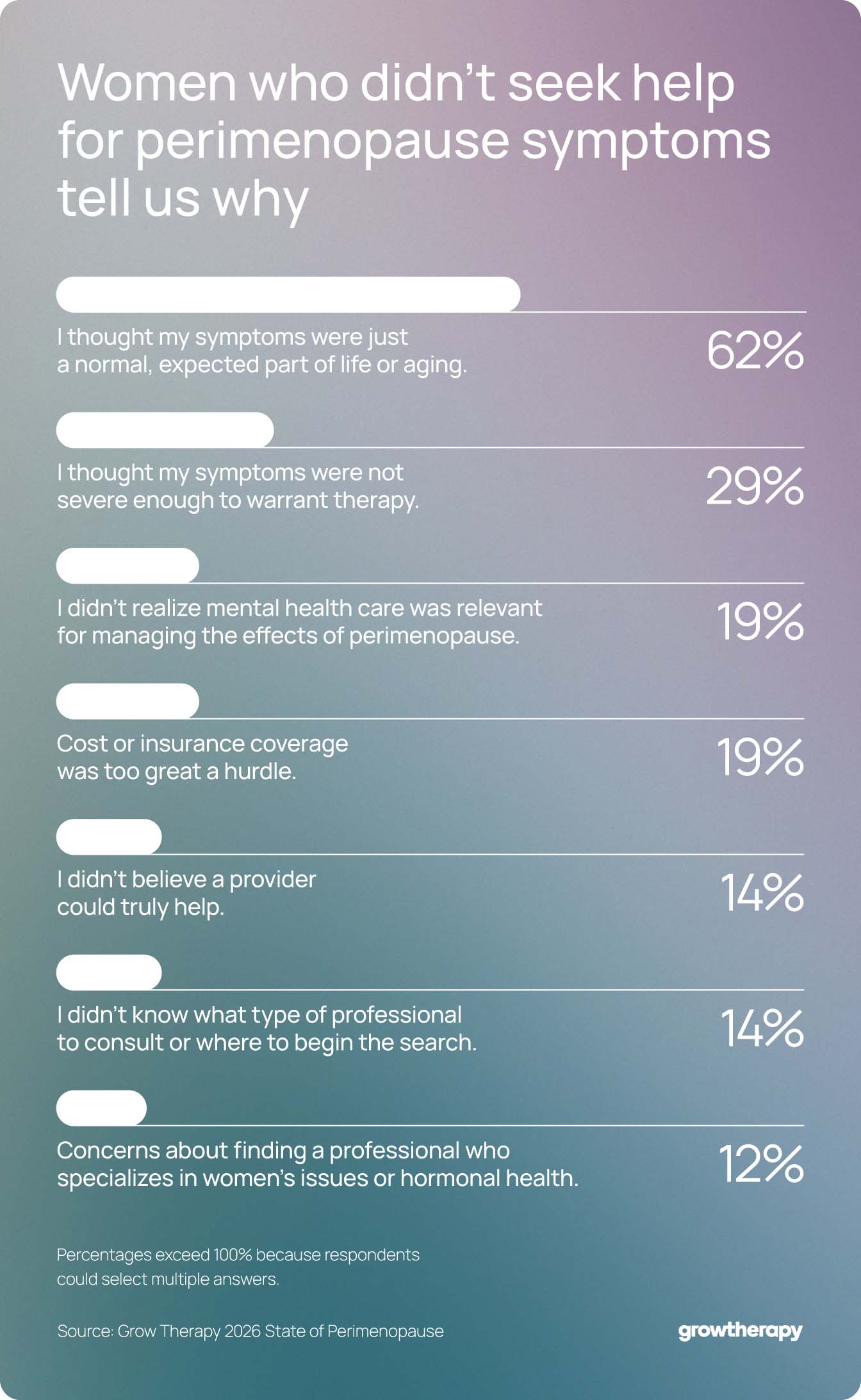
- Beliefs that symptoms are “normal” or “not severe enough” prevent many respondents (62% and 29%, respectively) from consulting a doctor or therapist.
The “silence gap” between awareness and care
Perimenopause is a natural part of a woman’s life. Yet we discovered a big gap between knowing about it and getting professional help. While our survey shows that 94% of our survey respondents are familiar with the term perimenopause, discussions about what to expect from it are not happening where it matters most — in the exam room.
Many women in the prime window for symptoms revealed they are missing out on this guidance. In fact, 56% of respondents ages 45-60 report that their health care provider has never discussed what to expect with them.
The silence is consistent across every age group of the women we surveyed:
- Ages 18-29: 73% have never discussed it
- Ages 30-44: 58% have never discussed it
- Ages 45-60: 56% have never discussed it
- Ages 60+: 63% have never discussed it
Without clear advice from a doctor, many women have to figure out sudden physical and emotional changes alone.
This isolation is often compounded by social conditioning. In fact, Lauren Jones, a Licensed Independent Clinical Social Worker (LICSW) and Grow Therapy provider, explains that many women “have spent decades caring for others and are not accustomed to asking for help or even acknowledging their own needs.” She notes that the silence leaves “so many feeling isolated and afraid.”
The consequences of this disconnect are clear in how few patients actually reach out. Our data reveals that less than half (45%) of the women surveyed who have experienced symptoms consulted a primary care doctor or OB-GYN. And only 13% discussed them with a mental health professional.
These numbers reveal a critical breakdown in the health care pipeline, leaving many patients to manage their symptoms without a professional safety net.
The mental toll of anxiety and mood swings takes center stage
Historically, medical research defined perimenopause by physical symptoms, like hot flashes. This focus often overlooked the mental toll, largely because women were largely left out of clinical trials until 1993.
Fortunately, the tide is turning. Driven by a booming “FemTech” market projected to reach $103 billion by 2030 and celebrity advocates breaking the taboo, a new cultural conversation is encouraging the medical system to catch up.
Our survey findings confirm that, for patients, the mental load is just as visible as the physical one. Seventy-four percent of survey respondents associate mood swings or irritability with perimenopause, while 51% identify increased anxiety.
The perceived impact runs deep. Forty-six percent associate depression with the transition. Thirty-six percent link it to a diminished self-image. Another 30% believe it affects family relationships.
Cognitive symptoms are also commonly recognized. Fifty-one percent of respondents associate “brain fog” (difficulty focusing) with the transition. However, awareness varies by age.
While 60% of Gen X respondents recognize brain fog as a symptom, only 39% of Gen Z make the connection. Without medical discussion, younger women may remain largely unprepared for these cognitive shifts until they experience them firsthand.
Generational attitudes are also shifting which symptoms respondents identify. Millennial women (ages 29-44) report mood swings (26%) and anxiety as the top symptoms affecting their well-being. By comparison, respondents ages 45-60 point to hot flashes (31%) as the biggest negative impact, with only 10% citing anxiety as their primary struggle.
This pattern may reflect increased mental health awareness among younger cohorts, whereas older generations may be more accustomed to focusing on physical symptoms.
Dr. Google is filling the therapist gap, but at a risky cost
With professional conversations often missing, the internet has become the default second opinion. Our data shows that 55% of survey respondents who have experienced perimenopause symptoms turn to internet searches (like Google or WebMD) to understand what is happening to their bodies, while 37% rely on family and friends.
Going online for help is not always bad. Forums and social media offer connection. They provide the shared experience that is often missing from doctor visits. For many, these spaces offer belonging in an otherwise lonely journey.
However, validation is not the same as clinical care.
To navigate that journey, Lauren Jones, LICSW, emphasizes that professional support offers something a search engine cannot. She identifies “anger, exhaustion, anxiety, and isolation” as the most common struggles she sees in women going through perimenopause. Jones noted that therapy provides the necessary space to “learn how to identify and express what they are feeling and ask for what they need.”
However, there remains a disconnect between this clinical ideal and where patients actually go for help. While 49% of respondents who have or have had perimenopause symptoms report learning the most about them online, the quality of that information is often suspect.
In fact, 59% of those who turn to the web admit they trust the information “with caution” or frequently encounter conflicting results.
Trust levels also show a sharp age gap. Millennial respondents are far more willing to accept digital advice, with 56% trusting online health information “completely.” Baby boomers are more skeptical, with only 12% sharing that level of confidence.
This highlights a major difference in how generations use health info. It likely shapes where and how they look for mental health support.
The “normal” becomes a barrier to care
Among respondents we surveyed who did not seek help for their perimenopause symptoms, 62% believed their symptoms were simply a “normal, expected part of life.” Others felt they could not justify the visit, with 29% feeling their symptoms were “not severe enough” for a professional.
This mindset keeps some people from accessing support that could improve their daily lives. It prevents many from accessing tools — like therapy — that help with major life changes, not just emergencies.
Rugiatu Bahr, PMHNP and a Grow Therapy provider, challenges this mentality. She asserts that “struggling in silence is not a requirement,” explaining that “normal doesn’t mean you have to suffer.” Bahr notes that seeking support is not about weakness, but rather about “giving yourself tools, understanding, and care during a real and meaningful life transition.”
Because of this, many women do not get the help they need. About 29% of our survey respondents said they navigate these symptoms without seeing a health care professional. Shifting this perspective is key to making sure that “normal” doesn’t have to mean “unsupported.”
What this means for navigating perimenopause
When it comes to selecting a therapist, objectivity is the top priority. Many partners are now exploring The physical changes that come with perimenopause may be inevitable, but you don’t have to face the isolation, anxiety, and confusion alone.
Grow Therapy can help bridge the disconnect between symptoms and support. We provide a space where experiences like brain fog and depression are met with professional support rather than dismissal.
Our network includes therapists who understand that perimenopause can affect both your physical and emotional well-being. They are here to support you through this change with care and perspective.
You do not need to reach a breaking point to ask for help. You can prioritize your mental health right now. Find a Grow Therapy provider today who specializes in women’s health and hormonal transitions for all AFAB individuals, and take the first step toward a more supported journey.
Methodology
The survey was conducted by SurveyMonkey Audience for Grow Therapy. The survey was fielded between November 20 and 21, 2025. The results are based on 1,007 completed surveys from U.S. adults assigned female at birth. Data is unweighted, and the margin of error is approximately +/-3% for the overall sample with a 95% confidence level.