
It’s impossible to talk about Gen Z without talking about mental health. For many people born between 1997 and 2012, the years following the pandemic have seen a rise in reports of anxiety, depression, and serious thoughts of suicide, with disproportionate impacts on youth of color, LGBTQ+ youth, and girls. While these numbers are tough to see, they also tell a story of a generation that refuses to stay silent about their struggles.
If you are a parent, teacher, or advocate, these Gen Z mental health statistics are more than just points on a graph. They are a guide for how to help. When we understand what is actually driving these trends, we can build better ways to support the young adults in our lives.
The following data explores key Gen Z mental health statistics for 2026, ranging from the impact of social media to the ongoing struggle to normalize care in the face of stigma.
Key statistics for 2026
- Grief support is being normalized by younger adults: Nearly a third of Gen Z (32%) seek professional therapy when navigating loss and grief, compared to just 23% of Baby Boomers. (Grow Therapy, 2026)
- Social isolation is a significant factor: Gen Z experiences regular loneliness at nearly twice the rate of older generations like Baby Boomers. (GWI, 2024)
- Social media remains a double-edged sword: While many find community online, 32% of Gen Z women and 16% of men say social platforms negatively impact their body image. (McKinsey, 2023)
- Support remains difficult to access: Half of all LGBTQ+ youth who sought mental health care in the past year were unable to receive the services they needed. (The Trevor Project, 2024)
- Holiday stress impacts treatment consistency: Gen Z is twice as likely as Baby Boomers to put therapy on the back burner during the end-of-year holiday season. (Grow Therapy, 2025)
Gen Z’s mental health in 2026
Mental health challenges are a widespread, daily reality for many members of Gen Z rather than an occasional issue. A large majority of this generation reports regular struggles, yet many feel disconnected or remain unsure of where to find professional help.
- Monthly distress is the norm for the vast majority of Gen Z in California, with 94% citing regular emotional or mental struggles. (Blue Shield of California, 2025)
- Global issues carry a heavy emotional weight for young people because 60% of Gen Z worldwide say that world events leave them feeling overwhelmed about where the future is headed. (Unicef, 2025)
- Among Gen Z respondents who say they feel stressed or anxious all or most of the time, 48% identify their longer-term financial future as a significant contributor to that stress. (Deloitte, 2025)
- Among surveyed California youth ages 14 to 25, broader social issues were a major source of stress, including housing affordability (87%), gun violence (85%), and discrimination against immigrants (81%). (Blue Shield of California, 2025)
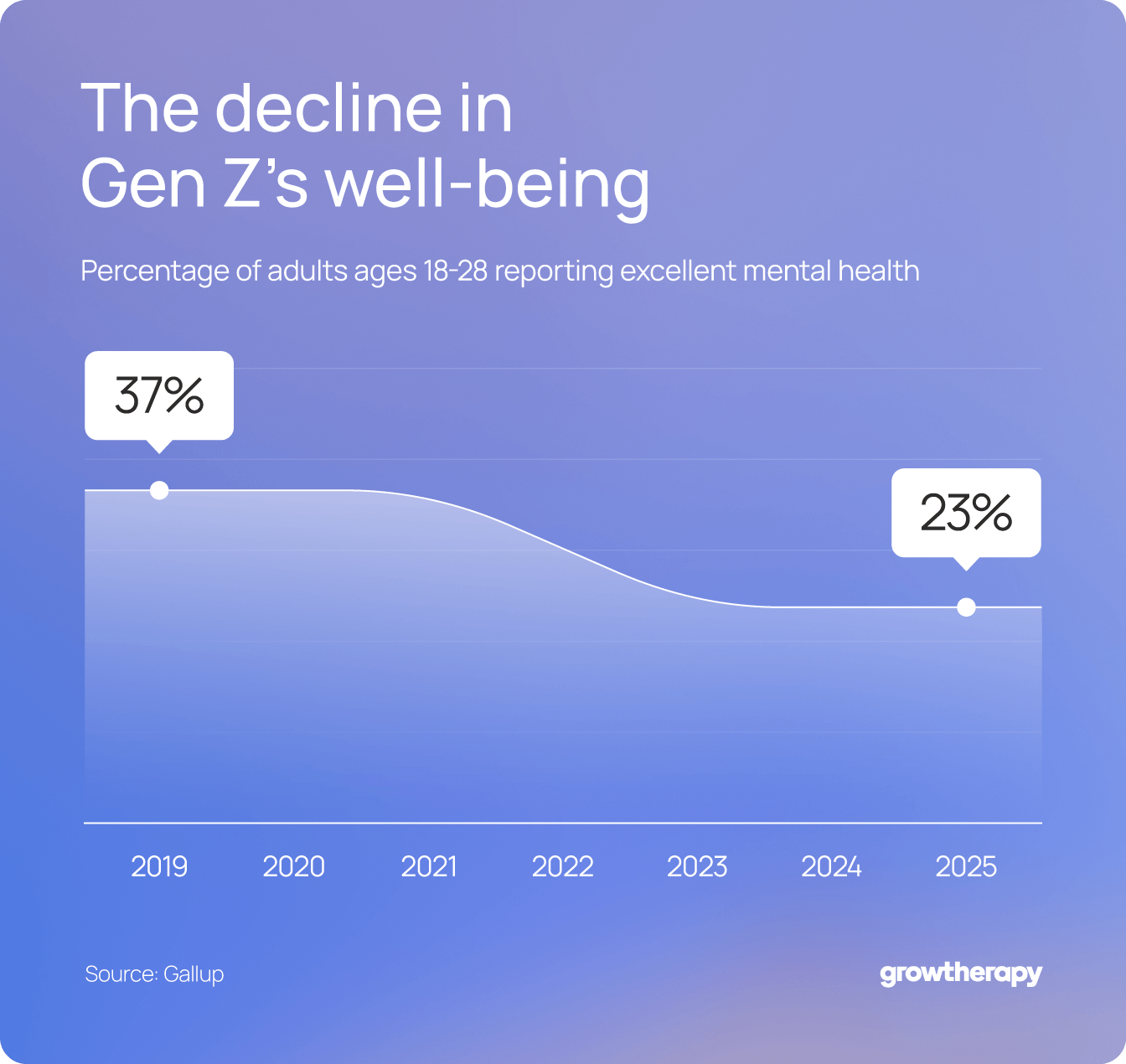
- The percentage of Gen Z adults reporting “excellent” mental health has declined by 14 points between 2019 and 2025. (Gallup, 2025)
- Well-being is a top priority for Gen Z and Millennials in 2026, as 58% of young adults set a formal mental health resolution at the start of the year. (American Psychiatric Association, 2026)
- About 60% of young adults of color say political media content has negatively affected their mental health in recent months. (The Aakoma Project, 2025)
- General life satisfaction is at a generational low, with only 45% of Gen Z reporting that they feel they are “thriving” in their lives. (Gallup, 2025)
- 55% of Gen Z from around the world feel they have the right coping skills to manage their mental health and wellness. (Unicef, 2025)
- Despite high stress, 63% of California’s Gen Z youth report feeling hopeful about their personal future. (Blue Shield of California, 2025)
Anxiety and depression trends among Gen Z
Many young adults today are navigating deep mental health challenges that can leave them feeling hopeless about the future. These struggles often affect different people in unique ways, and the weight of world events only adds to that pressure.
- 27% of adults under 30 report they have been diagnosed with depression at some point in their lives — a rate that has more than doubled since 2017. (Gallup, 2025)
- 3 out of 5 young adults of color say they’ve experienced moderate to severe anxiety (61%) or depression (60%). (The Aakoma Project, 2025)
- Daily distress remains common, as 40% of Gen Z workers report feeling anxious or depressed at least a few times every week. (The Hartford, 2025)
- Severe distress remains high for LGBTQ+ youth, as 39% seriously considered suicide in the past year, with that number rising to 46% for transgender and nonbinary young people. (The Trevor Project, 2024)
- Suicide is the second-leading cause of death for teens and young adults, ages 10-34 (CDC, 2024).
- Suicidal ideation among teen girls has decreased, with those seriously considering an attempt dropping from 30% to 27%. (CDC, 2024)
- Suicide attempts among Black students have decreased significantly, falling from 14% to 10% in recent years. (CDC, 2024)
Gen Z and social media
Digital spaces are a primary source of both connection and stress for young people today. While social media allows for community building, many Gen Zers recognize that their time online comes with a cost to their mental well-being.
- 60% of Gen Z adults spend at least four hours a day on social media, with 22% reporting seven or more hours of daily usage. (The Harris Poll, 2024)
- 27% of Gen Z social media users worldwide explicitly label these platforms as having a negative effect on their mental health, yet 32% report a positive impact. (McKinsey, 2023)
- Body image and self-confidence are significantly impacted by social media, with 32% of Gen Z women and 16% of men from around the world reporting a negative effect on their body image. (McKinsey, 2023)
- Confidence levels also vary by gender across the globe, as 24% of Gen Z women and 13% of men report that social platforms have a negative impact on their self-confidence. (McKinsey, 2023)
- 55% of Gen Z are trying out social media-driven habits like “bed rotting”—a practice reported by 24% of the generation as a way to cope with stress and burnout. (American Academy of Sleep Medicine, 2024)
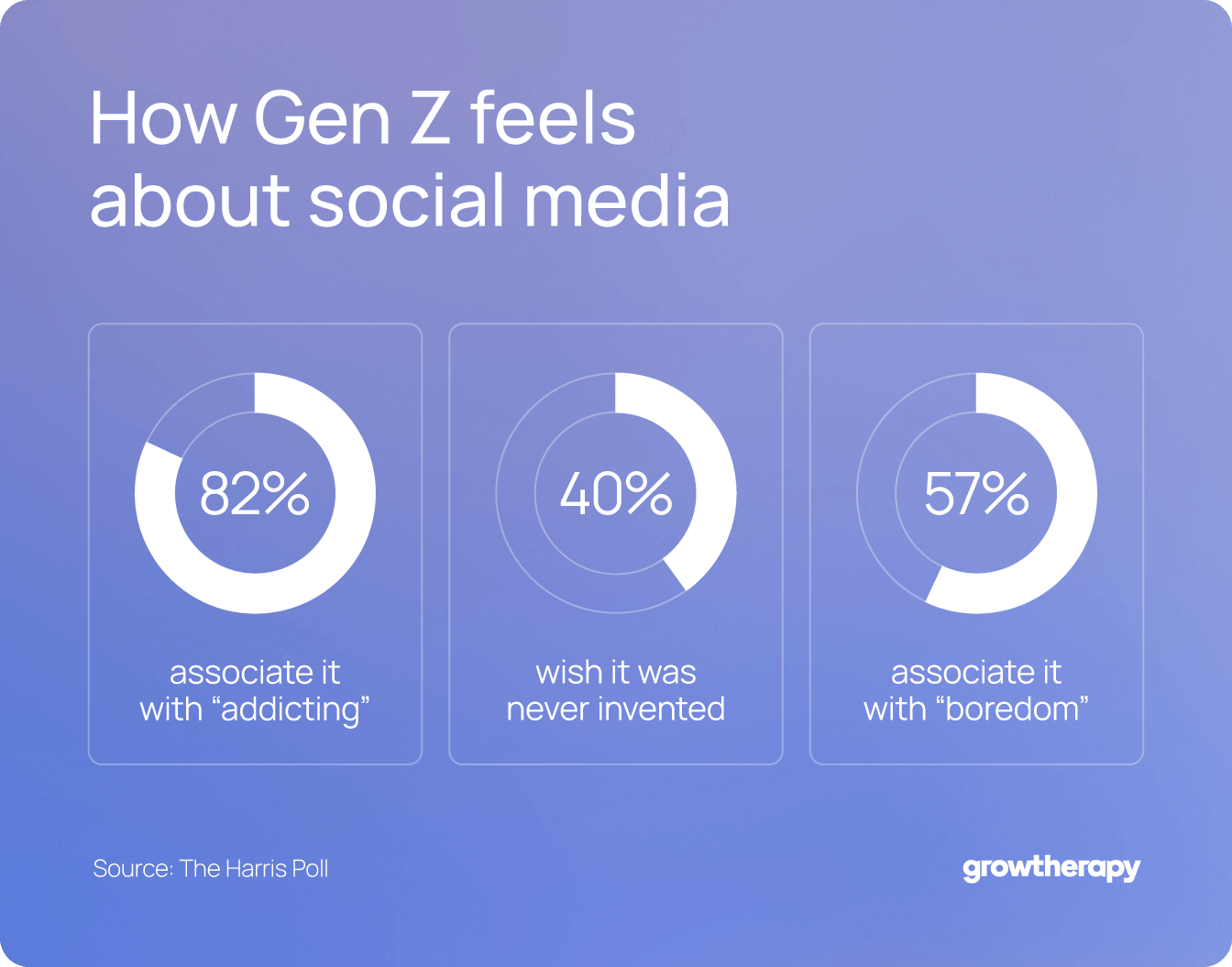
- Gen Z’s relationship with social media is often conflicting, as 82% of adults in this generation associate the word “addicting” with social media, while significant numbers also associate it with boredom (57%) and isolation (43%). (The Harris Poll, 2024)
- 47% of LGBTQ+ Gen Z individuals report that social media negatively affects their emotional health, compared to 35% of their non-LGBTQ+ peers. (The Harris Poll, 2024)
- Many Gen Z adults have mixed feelings about the digital age, as 40% report they wish social media had never been invented. (The Harris Poll, 2024)
- 34% of Gen Z teens at least sometimes use social media as a resource to find mental health information. (Pew Research Center, 2025)
- TikTok (43%), YouTube (39%), and Instagram (38%) are the primary platforms used by Gen Z youth seeking mental health support online. (JED Foundation, 2025)
Is social media use linked to depression and anxiety in teens?
Research suggests a relationship between heavy social media use and mental health challenges in young people, though the connection is complex. Studies indicate that passive scrolling and social comparison tend to have more negative effects than active, community-building use.
For Gen Z specifically, platforms like TikTok, Instagram, and YouTube are also among the most commonly used resources for finding mental health information — meaning social media can cut both ways. If social media use feels like it’s contributing to stress or low mood, speaking with a licensed therapist can help you develop healthier boundaries and coping strategies.
How Gen Z compares to other generations
While every generation faces mental health challenges, Gen Z reports the lowest rates of “thriving” compared to older age groups (Gallup/Walton Family Foundation, 2025). However, this generation is also more proactive about utilizing available resources. According to recent workplace mental health statistics, 26% of employees aged 18–29 have used their employer-provided mental health benefits within the last month, outpacing the general workforce average of 20%.
This higher rate of engagement suggests that while younger adults face significant pressures, they are also more likely to leverage professional benefits to manage their well-being.
- Gen Z represents the second-largest group in therapy, accounting for 32% of people seeking professional support, while Millennials make up 48% and Gen X accounts for 15%. (Grow Therapy, 2025)
- Gen Zers (57%) are more than twice as likely to deprioritize therapy during the end-of-year holiday season compared to Baby Boomers (28%). (Grow Therapy, 2025)
- Younger generations are leading the trend in seeking professional support for loss, with Gen Z (32%) significantly more likely to use grief therapy than Baby Boomers (23%). (Grow Therapy, 2026)
- Loneliness is nearly twice as common for Gen Z as it is for older generations. (GWI, 2024)
- Only 23% of Gen Z adults rate their mental health as “excellent,” while no less than 34% of Gen X and Baby Boomers report the same. (Gallup, 2025)
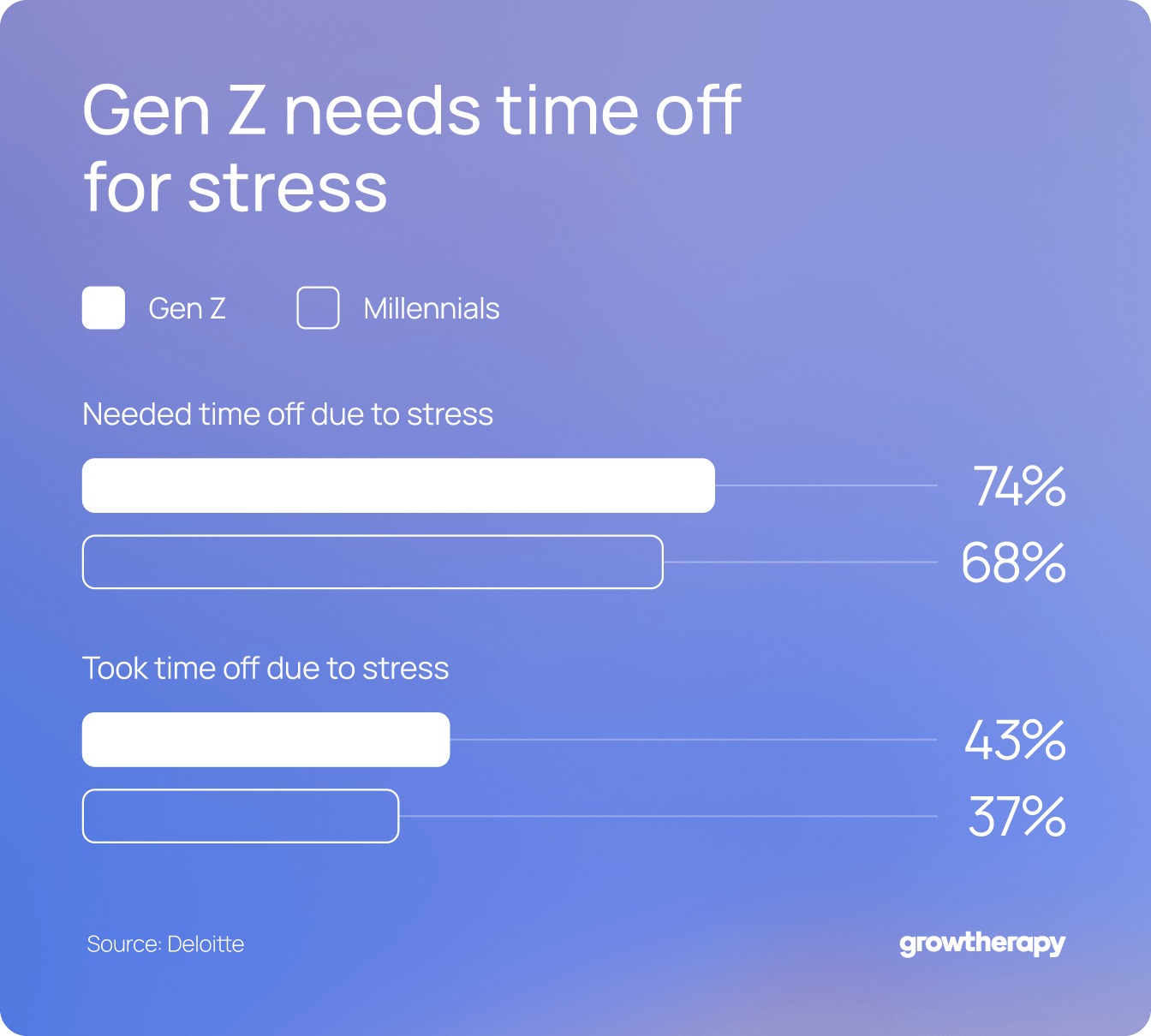
- While 74% of Gen Z workers report needing time off for stress, only 43% actually took those mental health breaks. (Deloitte, 2025)
- Digital mental health tools see the highest engagement from the global population of Gen Z, with 22% of this generation using these programs compared to 15% of Gen X and Baby Boomers. (McKinsey, 2023)
Therapy use and breaking the stigma
Asking for help has become a normalized part of life for many young people, yet barriers to care still exist. Many Gen Zers are comfortable recommending therapy to others, but a significant number still report they don’t know where to start to find the right therapist.
Addressing these hurdles is essential for ensuring that the generation’s openness leads to actual recovery and support.
- Stigma and cost remain the largest obstacles to professional care, with 35% of California youth who didn’t get help citing embarrassment as the main reason, followed by 23% who could not afford it and 21% who didn’t know where to find help. (Blue Shield of California, 2025)
- Access to support is a major hurdle, with 50% of LGBTQ+ young people who wanted mental health care in the past year reporting they couldn’t access care. (The Trevor Project, 2024)
- Peer support is a major trend for Gen Z, with 69% of young people reporting they have discussed their mental health with a friend. (Blue Shield of California, 2025)
- Stigma still blocks access to care, with 46% of Gen Z workers stating that shame and fear of judgment prevent them from seeking the help they need. (The Hartford, 2025)
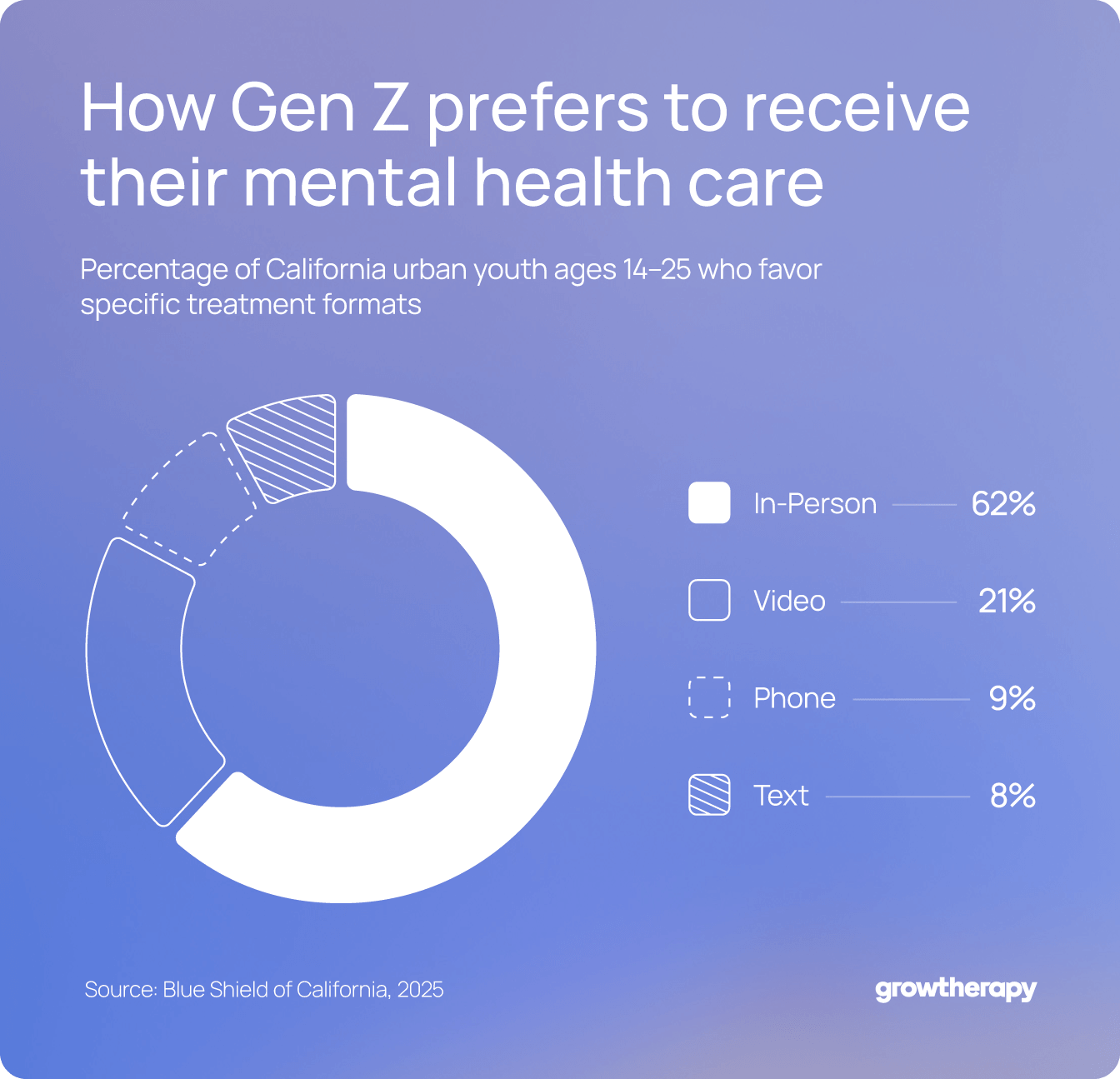
- Despite being a digital-first generation, Gen Z overwhelmingly prefers traditional therapy formats in California, with 62% of urban youth stating that in-person sessions are their most preferred way to receive professional care. (Blue Shield of California, 2025)
- The National Suicide Prevention Line (988) is the most recognized crisis resource, used by 36% of California youth who reached out for urgent support. (Blue Shield of California, 2025)
- Affirming environments act as a protective factor, as transgender and nonbinary youth in gender-affirming schools (54%) reported lower rates of attempting suicide. (The Trevor Project, 2024)
Gen Zers can find support with Grow Therapy
This collection of facts and figures makes one thing clear: Gen Z cares about wellness, but they are under a lot of pressure. Mental health trends aside, getting easy access to care is the best way to handle depression or other serious risks before they get worse.
Grow Therapy makes it simple for parents, teachers, and young adults to find the right support. Our platform connects you with providers who understand what this generation is going through. With flexible online therapy sessions, you can take care of your mind on your own schedule and in a place where you feel safe.
If you or a young person you know is ready for help, we are here for you. Look through our network today to find a therapist who fits your needs and start building a better future.