
When you’re considering therapy for the first time or comparing online therapy platforms testimonials only get you so far. At some point you want actual evidence.
A peer-reviewed study published in JMIR Formative Research examined deidentified data from more than 200,000 Grow Therapy clients who started care with symptoms of depression, anxiety, or both. The dataset includes patients who started treatment between 2022 and mid-2024, offering a large-scale look at how care actually unfolded on the platform during that period. While Grow has continued to expand its provider network and tools since then, the findings provide one of the clearest pictures available of what happens when people use an online therapy platform in real life — not a controlled research setting.
Key takeaways
- Nearly 70% of patients attended 3 or more sessions, the identified threshold for forming a therapeutic relationship
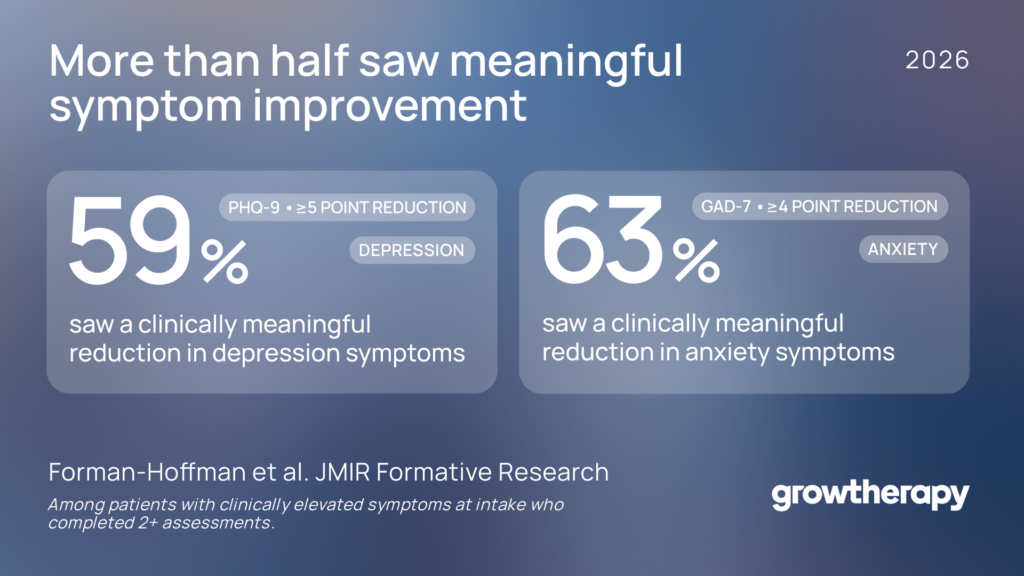
- Among patients who completed follow-up assessments, 63% with anxiety and 59% with depression showed a clinically meaningful reduction in symptoms.
- Patients who chose a therapist based on clinical specialty were more likely to see symptom improvement
- Patients who chose a therapist based on identity characteristics were 11-14% more likely to keep coming back
- These findings come from real-world care, not a controlled trial, but the scale and peer review lend them meaningful credibility
What makes Grow Therapy different from other platforms?
Grow Therapy is an online therapy platform that connects you with thousands of independently licensed therapists and psychiatric providers. With Grow, you have real input into who you work with before you ever book. You can choose between virtual or in-person sessions with telehealth options available in all 50 states — in-person care is offered in many major metro areas. Many providers also offer weekend and evening appointments, making it easier to fit therapy into your schedule.
When you search for a therapist on Grow, you can filter by clinical specialty (things like trauma, depression, anxiety, OCD, relationship issues, or grief) as well as by identity characteristics like race/ethnicity, religious affiliation, and sexual orientation. You can also filter by insurance, location, and availability before you ever book.
It turns out that having that kind of say in who you work with can shape what happens next. The data suggests that input into the matching process is associated with how care unfolds and, in some cases, better outcomes.
What does the research say about Grow Therapy’s effectiveness?
The study by Forman-Hoffman et al. (2026), published by JMIR Formative Research, analyzed deidentified electronic health data from adult Grow Therapy patients who started care between January 2022 and April 2024. It was published in a peer-reviewed journal, meaning the methods and findings were evaluated by independent researchers before publication. This allows the results to be interpreted within a scientific framework, using validated measures rather than anecdotal feedback alone.
There’s already a substantial body of research suggesting that online therapy can be effective. What makes this analysis notable is that it focuses specifically on Grow Therapy, examining outcomes from patients who used this platform in routine care. It’s also one of the largest analyses of a digital mental health platform published to date. When the same patterns show up across more than 200,000 people, it provides a different level of confidence than a small pilot study can.
Here’s what the study found:
Most patients kept coming back
Among patients with clinically elevated depression or anxiety symptoms at the start of care, nearly 70% attended 3 or more sessions.
Three sessions might not sound like a milestone, but research often uses this as a reasonable benchmark for establishing an initial therapeutic relationship between patient and provider. That bond is one of the more consistent predictors of whether therapy actually helps so getting there really matters.
More than half saw meaningful symptom improvement
Among patients who completed at least two symptom check-ins, the results were notable. About 59% of patients with elevated depression symptoms reached what researchers call a “minimal clinically important difference” — a reduction of at least 5 points on the PHQ-9, a widely used depression screening questionnaire. For anxiety, 63% reached the same benchmark on the GAD-7, a standard seven-question measure used to assess anxiety severity.
These were patients who started with clinically elevated symptoms, not everyday stress or mild worry. More than half moved to a meaningfully lower level of distress. This kind of shift tends to show up as better sleep, less persistent anxiety, fewer low-mood days, or simply feeling more like yourself again.
Does choosing your therapist on Grow make a difference?
One of the more interesting findings from the study had nothing to do with session counts or symptom severity. It focused on how patients selected their therapist before starting care and whether those early decisions were associated with differences in engagement and outcomes.
Choosing a therapist’s specialty was linked to better outcomes
About 35% of patients selected a clinical specialty when searching for a therapist. This means they filtered for providers who list specific areas of focus. Areas of focus may include trauma, depression, anxiety, grief, relationship issues, among others. Patients who made this choice in the depression cohort were about 8% more likely to reach meaningful symptom improvement. Those in the anxiety cohort were about 4% more likely.
If you have a sense of what you’re dealing with, even a general one, searching for a therapist who specializes in that area may give you a head start. For example, someone processing trauma may benefit from a therapist with trauma-informed training.
Plenty of people come to therapy without a clear sense of what they need, and that’s completely fine. You don’t need a diagnosis or a neat label to find a therapist who’s a good fit. Therapy can absolutely work even when you’re still figuring out what’s going on. These findings simply suggest that when you do have some clarity about what you’re looking for, acting on it tends to pay off.
Choosing based on identity was linked to staying in therapy longer
About 5% of patients filtered by a therapist’s identity characteristics — things like race/ethnicity, religious affiliation, or sexual orientation. Those patients were 11-14% more likely to attend 3 or more sessions than those who didn’t.
This data suggests that when patients feel genuinely understood by their therapist, not only clinically, but culturally, spiritually, or personally, they’re more likely to trust the process and keep showing up. For some people, shared identity or lived experience can make it easier to open up early in care.
On Grow, you can filter by both specialty and identity when searching for a provider making this kind of intentional matching part of the care experience rather than something left to chance. The study suggests that how those filters are used may be associated with engagement and outcomes over time.
How to get the most out of therapy on Grow
The study points to a few things worth keeping in mind as you think about starting care.
- Prioritize consistency early on: Showing up consistently, especially early on, makes a real difference. The data reinforces what therapists already know: the early sessions are where the foundation gets built. Getting to three or more appointments is where therapeutic relationships start to take hold. That trust can shape everything that follows.
- Be intentional about fit: Thinking about what you want in a therapist before you search is also worth the few extra minutes. Even a general sense of what you’re dealing with (anxiety, grief, relationship stress, trauma) can help you filter for a provider with relevant experience. The research suggests this kind of intentional matching is associated with better outcomes.
- Consider what helps you feel understood: Cultural, spiritual, or identity factors can affect how comfortable or understood you feel. Feeling at ease with your therapist isn’t a preference to push aside. It may play a role in whether you continue coming back.
Getting started with Grow Therapy
If you’ve been weighing whether therapy is worth it, this study offers meaningful reassurance. Many people who start care on Grow Therapy stay engaged, and many see measurable improvement over time.
You can explore therapists by specialty, identity, insurance, and availability and decide who feels like the right fit before you book.
If you’re ready, you can find a therapist on Grow or check whether your insurance is accepted.
Methodology
This analysis used a retrospective observational cohort design. Because it was not a randomized controlled trial, the findings reflect associations observed in routine care rather than causal effects. No control group was included for comparison, and the authors characterize the results as exploratory.
Clinical outcome analyses were conducted among patients who completed at least two symptom assessments, representing approximately 45% of the eligible study population. Patients with follow-up assessments differed slightly from those without, including being somewhat older and more likely to be female, which may limit generalizability.
Symptom improvement was defined using established minimal clinically important difference (MCID) thresholds for the PHQ-9 and GAD-7. These findings describe aggregate patterns across a large population and should not be interpreted as predictive of individual outcomes.