
We’re far past the point where employers can address workplace wellness with just a token gesture. Stress, burnout at work, and mental health challenges facing employees are intensifying, impacting everything from productivity to retention. Understanding these trends is the first step toward building a truly supportive and resilient organization.
To help, we’ve compiled the most authoritative workplace mental health statistics from businesses of all sizes and industries. Together, these stats project the critical issues employers need to address in 2026.
While every organization faces unique challenges, the overall picture reveals a profound need for accessible, high-quality mental health support among all employees.
Key statistics for 2026
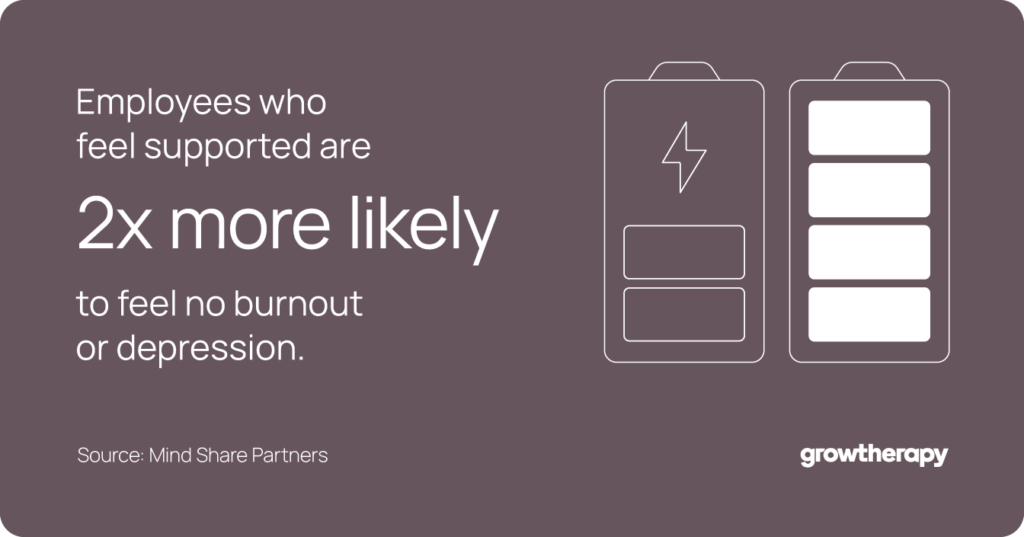
- Employer support makes a positive difference: Employees who feel like their mental health is supported are twice as likely to feel no burnout or depression. (Mind Share Partners, 2025)
- Burnout is persistent: Two-thirds (66%) of employees reported feeling burned out in some way during the past year. (Moodle, 2025)
- Stigma is still here, despite awareness: While 72% of workers report being comfortable supporting a coworker’s mental health, 42% still refrain from discussing their mental health concerns. (NAMI, 2025)
- The cost of reduced employee well-being is high: Diminished productivity drained $438 billion globally in 2024. (Gallup, 2025)
- Layoff anxiety is common: A majority of U.S. workers (54%) said that job insecurity significantly impacts their stress levels at work. (APA, 2025)
- Benefits go unused: Despite high demand, only 53% of employees know how to access mental health care through their employer. (NAMI, 2025
How common are mental health issues in the workplace?
Mental health challenges are prevalent across the U.S. workforce, especially in stressful work environments. For many, factors like poor management and intense workloads can compound their existing conditions.
In 2026, employers need to recognize that mental health is a foundational element of their entire workforce’s well-being.
- In 2024, more than 60 million people, or 23% of U.S. adults, experienced any mental illness (AMI). (Mental Health America, 2025)
- Among adults with AMI, 25% said they had an unmet need regarding treatment for their mental health in 2022 and 2023. (Mental Health America, 2025)
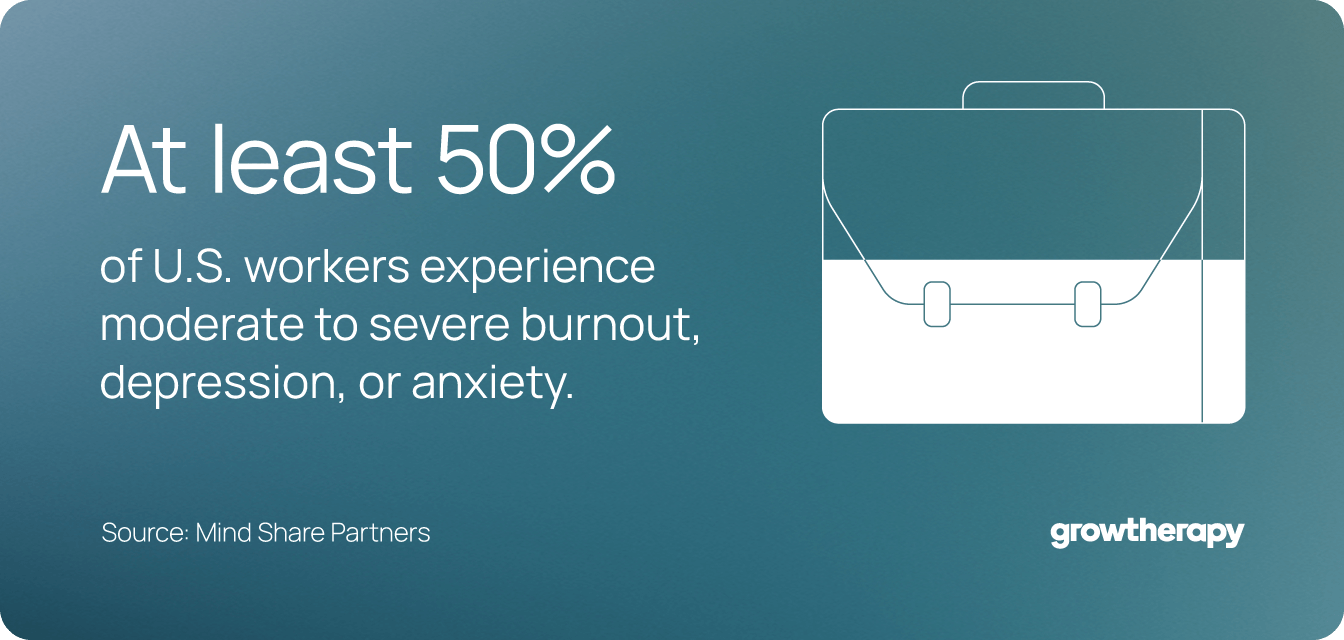
- Moderate to severe burnout, depression, or anxiety affects half of U.S. workers. (Mind Share Partners, 2025)
- More than three-quarters (76%) of U.S. workers reported experiencing some level of burnout, with 53% experiencing moderate to severe levels. (Mind Share Partners, 2025)
- Women in the workforce were 8 percentage points more likely than men to report feeling like they’re struggling or in crisis. (Lyra, 2025)
How does work affect mental health in the U.S.?
Work is one of the primary sources of stress and emotional strain for Americans. The blending of personal and professional lives, coupled with persistent economic uncertainty, means that work and mental health are directly linked. This compromise manifests as severe issues like burnout, anxiety, and sleep deprivation.
Addressing these negative outcomes requires employers to focus on structural factors, which are the systemic elements of the work environment. Key among these factors are managing unmanageable workloads, enhancing employee autonomy and control over their tasks, and ensuring fairness in reward and recognition systems.
- Work contributes a negative or very negative impact on mental health for 25% of employees. (Chartered Institute of Personnel and Development (CIPD), 2025)
- Nearly two-thirds (63%) of U.S. workers said that work has a positive impact on their mental health. (Mind Share Partners, 2025)
- The most-cited mental health stressors affecting U.S. workers are U.S. politics (43%), global events (42%), and personal finances (37%). (Mind Share Partners, 2025)
- Less than half (49%) of U.S. workers say they feel comfortable disconnecting after work or while on vacation. (Mind Share Partners, 2025)
Burnout and employee well-being statistics
The World Health Organization (WHO) defines burnout as an occupational phenomenon resulting from persistent stress in the workplace. It’s characterized by low energy, “checking out” or increased mental distance from a job, and reduced professional productivity.
In 2026, burnout continues to be one of the most significant threats to the workforce.
- 66% of U.S. employees today report feeling burnout in some form. (Moodle, 2025)
- 19% of employees are taking on too much work due to labor shortages in their industry. (Moodle, 2025)
- 13% of employees report that being worried about how AI will impact their role is driving their burnout. (Moodle, 2025)
- Employees who feel like their mental health is supported are twice as likely to feel no burnout or depression. (Mind Share Partners, 2025)
- 1 in 4 U.S. employees work outside of their scheduled hours “most of the time” or “every day,” while 63% work outside of those hours “sometimes.” (Mind Share Partners, 2025)
- 27% of workers whose company experienced drastic or significant impacts due to government policy changes reported emotional exhaustion. (American Psychological Association (APA), 2025)
How does mental health impact workplace productivity?
When employees are struggling mentally, it shows up in their work output and focus. The direct link between psychological well-being and performance underscores why mental health support is an important investment with a measurable return.
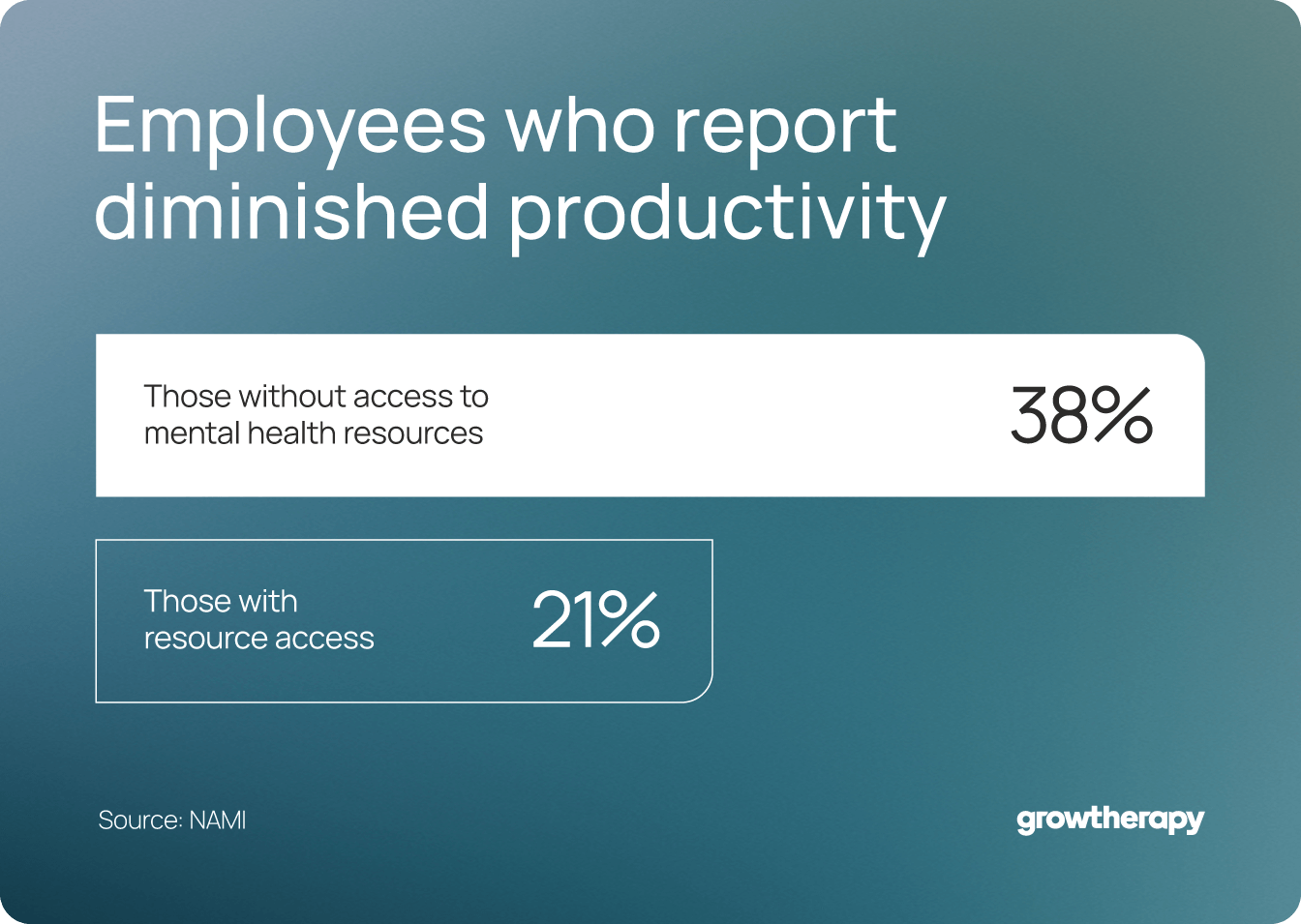
- In workplaces that offer mental health resources, employees are significantly less likely to report that their productivity has suffered (21% with access to resources vs. 38% without). (National Association on Mental Illness (NAMI), 2025)
- 34% of employees felt that their productivity suffered in 2024 because of their mental health. (NAMI, 2025)
- Globally, employee engagement dropped 2 percentage points to 21% in 2024, and the cost of lost employee productivity was $438 billion. (Gallup, 2025)
- 48% of U.S. employees have left a job for reasons tied to their mental health, and two-thirds of those departures were voluntary. (Mind Share Partners, 2025)
Workplace culture and support statistics
A psychologically safe culture is the foundation of any workplace’s mental health strategy. This means fostering environments where employees feel respected, included, and secure in setting boundaries.
When employees feel psychologically unsafe, it can lead to issues like error blindness and misguided decisions, as well as reduced productivity and innovation.
The data suggests that work-life balance, flexibility, and positive coworker relationships are often more impactful than complex, underutilized benefits packages.
- Workers said the most helpful factors to improve their mental well-being at work were work-life balance and flexibility (69%), safety and openness to talk about mental health (64%), mental health benefits (59%), and self-care resources (59%). (Mind Share Partners, 2025)
- Among factors that contribute to workplace mental health, 74% of workers rated their coworkers as a positive factor. (Mind Share Partners, 2025)
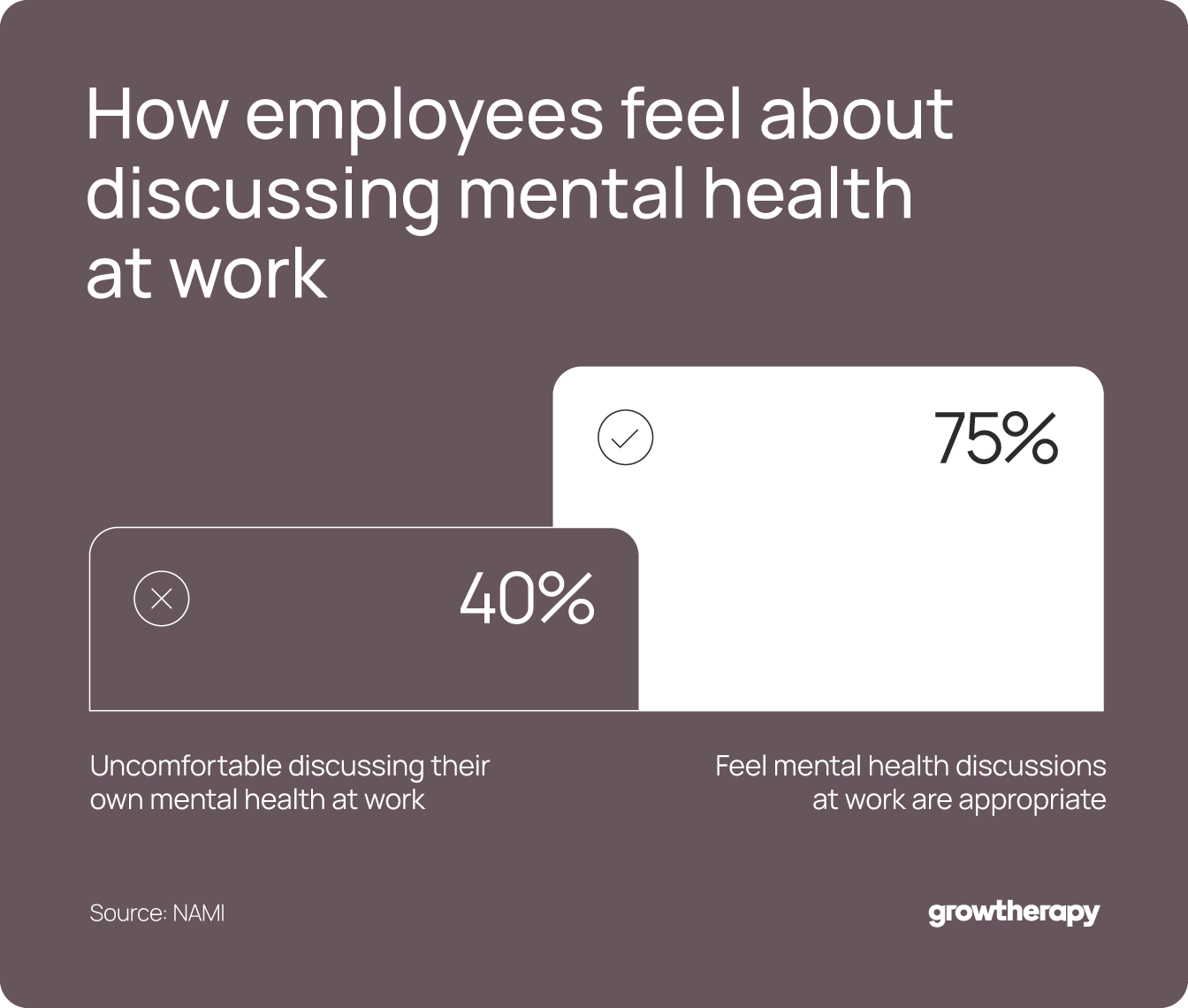
- 75% believe it’s appropriate to discuss mental health at work, but 40% are uncomfortable sharing about their own mental health. (NAMI, 2025)
- 72% of employees feel comfortable supporting a coworker who’s experiencing a mental health crisis. (NAMI, 2025)
The ripple effect: Mental health and layoffs
The 2025 wave of corporate layoffs has introduced a new layer of complexity to workplace mental health.
The psychological toll of layoffs can also impact the “survivors,” or those who remain employed but must contend with fear, insecurity, and increased workloads.
- A majority of U.S. workers (54%) said that their stress levels at work spike significantly due to job insecurity. (APA, 2025)
- Among workers concerned about losing their jobs in the next 12 months due to an economic slump, 42% said that work-related stress makes it difficult to sleep, and 36% have seen their personal relationships suffer. (APA, 2025)
- Middle managers (43%) and frontline workers (40%) were the most likely employees to fear that AI might cause some or all of their work duties to become obsolete. (APA, 2025)
- A majority of workers (64%) agreed that their employer is transparent about how technology will impact jobs in their organization. (APA, 2025)
- Among employees whose companies recently laid off coworkers, 65% worry about job insecurity, compared to just 24% of employees at companies without recent layoffs. (Nectar, 2025)
- 63% of workers at organizations with recent layoffs said they plan to look for a new job within three months, versus only 38% of employees at organizations where there were no recent layoffs. (Nectar, 2025)
- More than half (53%) of employees say they have no understanding of why layoffs happened at their organization. (Perceptyx, 2025)
- 49% of layoff survivors report a decline in morale and engagement at work after the disruption. (Kahoot!, 2025)
Employees need greater access to mental health resources
As a result of the upward trend in mental health awareness, employers are investing more in employee benefits. But the effectiveness of these investments often comes down to employee awareness, training, and accessibility.
Many organizations are realizing that simply having an EAP is not enough; the support needs to be known, trusted, and easy to access.
- A majority (65%) of HR professionals report feeling confident in supporting employee mental health, though fewer feel this way compared to 2024 (70%). (Society for Human Resource Management (SHRM), 2025)
- 25% of workplaces are more focused on prevention of mental health issues than reaction to existing issues; 38% focus more on reacting than preventing. (SHRM, 2025)
- 58% of U.S. employees report that their leadership advocates for mental health at work, while 57% note that their manager checks in regularly about their well-being. (Mind Share Partners, 2025)
- 64% of employees feel supported by their manager if they have a mental health-related challenge. (Mind Share Partners, 2025)
- Only 11% of workplaces require mental health training, though more than half say it increases their comfort in discussing mental health in the workplace. (NAMI, 2025)
Mental health benefits: Bridging the gap between offer and use
Employers are making mental health benefits a priority, but there’s a disconnect between the benefits offered and the services employees actually use. Barriers like low awareness stop employees from accessing the very care that’s available to them.
Cost confusion is also an issue for 32% of Americans, making it difficult to accurately predict the cost of therapy. This confusion might cause people to delay treatment. Luckily, Grow Therapy has a handy guide to paying for therapy that can help quiet that confusion.
- Employment-based insurance was the most common type of health insurance coverage in the U.S. in 2024, covering 54% of Americans. (United States Census Bureau, 2025)
- 29% of U.S. workers have high-deductible health plans (HDHPs) that can require hefty upfront payments for treatment and prevent policyholders from seeking help. (Grow Therapy, 2025)
- 97% of surveyed employee insurance plans offered some form of mental health services, but only 73% covered telehealth for services like online therapy, 62% covered counseling and therapy services, and 33% covered ongoing treatment for chronic conditions. (Employee Benefit Research Institute (EBRI), 2025)
- Only 22% of employers track employee utilization data for mental health benefits, meaning nearly 4 out of 5 may be missing key effectiveness data. (EBRI, 2025)
- In a survey, fewer than half of HR respondents reported that their organizations had mental health programs, such as training on mental health topics (37%) or policies that explicitly address mental health (26%). (Mind Share Partners, 2025)
- 20% of employees who have employer-sourced mental health care benefits have tried to use these benefits in the last month, with the rate higher among caregivers (28%), LGBTQ+ employees (27%), and employees aged 18-29 (26%). (NAMI, 2025)
- 77% of employees are satisfied with their overall health care insurance coverage, but only 68% are satisfied with their mental health care insurance coverage. (NAMI, 2025)
- Just 53% of employees know how to access mental health care through their employer. (NAMI, 2025)
- Around one-quarter of employees and 22% of managers don’t know if their workplace offers mental health benefits like employee assistance programs (EAPs) or days off for mental health. (NAMI, 2025)
- Organizations with comprehensive benefits are 8% more likely to see a positive return on investment (ROI) from those benefits and 13% more likely to see increased employee engagement. (Lyra, 2025)
Find the mental health support you need with Grow Therapy
These workplace mental health statistics clearly illustrate the ongoing crisis facing American workers. Whether you’re dealing with burnout, stress from management, or anxiety triggers related to job insecurity, accessing mental health care is important for your well-being and success.
Making sure you can find quality, affordable care that fits your schedule is the single most important step you can take for yourself this year. Grow Therapy makes it easy to connect with verified, licensed therapists who specialize in work-related stress, anxiety, and depression.
Don’t let the stressors of 2026 keep you from feeling your best. Take control of your mental health today and find a therapist who fits your unique needs.