
As the marketplace expands, having a standout profile is essential for growth. Your therapist bio is often a potential client’s first impression before they decide to reach out. Because clients are often in a vulnerable place when searching for care, a well-crafted bio can be the deciding factor in whether a prospective client connects with you or clicks away.
Key takeaways
- Your bio is a potential client’s first impression. Lead with empathy, not credentials.
- The more specifically you write for your ideal client, the more strongly they’ll feel the connection.
- Use plain language; avoid clinical jargon that may alienate prospective clients.
- Aim for 150 to 250 words, personal enough to resonate, short enough to actually be read.
- Review and update your bio frequently to keep it current and test what’s working.
Why your therapist bio matters
Most people searching for a therapist spend just a few minutes, sometimes seconds, scanning profiles before deciding. Think about what someone sees when they land on yours. A photo, a name, a list of specialties, and your bio. That bio is where you speak directly to them.
How clients use your bio to decide on care
Potential clients may read bios the way they might read a friend’s recommendation. They want to feel that you understand their situation, that your approach is compatible with theirs, and that you’re a real, approachable person. This is especially true on online directories and telehealth platforms where your bio may be the only communication they see before deciding whether to contact you.
For some people, their first therapy experience can shape how they feel about mental health care in general. If the first therapist doesn’t feel like the right fit, they may feel discouraged about trying therapy again. Being honest and clear about your style and approach can help clients decide if you fit their needs.
Also, remember that not every therapist will be the right fit for every person. A mismatch doesn’t mean anyone did anything wrong. It simply means the connection or approach may not have been the best match for that client.
Balancing professionalism, warmth, and safety
You want clients to feel confident in your qualifications while also feeling like they could actually talk to you. Avoid bios that read like a CV, but don’t go so casual that you undermine your credibility.
Most important things to include in your bio
At minimum, your bio should cover who you help, how you work, your credentials and licensure, and an invitation to connect. While these details provide necessary information, their primary function is to establish initial credibility.
How can I clarify my audience and niche?
A common mistake therapists make is writing a bio that tries to appeal to everyone. In those cases, it’s possible the result resonates with no one. Many struggle trying to be all things to all people. At the same time, identifying and focusing on a niche may be difficult for providers who haven’t decided on or clarified a specialty yet. The following tips can help you maximize the limited space and even more limited time you have to capture a potential client’s attention while they search for a match.
Identifying your ideal client
Start by picturing the person you most want to work with. What are they struggling with? What keeps them up at night? Use details that your ideal client finds relatable, avoid broad generalities, and focus on things that will spark recognition. Writing with that specific person in mind makes your bio feel targeted, not generic.
Naming populations you serve
Be clear about who you work with: adults, teens, couples, LGBTQ+ individuals, veterans, new parents, etc. These details help prospective clients quickly determine whether they’re in the right place, and they help platforms and directories match you to relevant searches.
Being inclusive without trying to serve everyone
There’s a difference between welcoming language and trying to fit everyone. Phrases like “I work with a wide variety of concerns” dilute your bio. Instead, name your primary focus areas and let your tone signal openness. Noting that you are LGBTQ+-affirming or culturally sensitive conveys inclusivity without implying you have no specialization. Grow Therapy offers a helpful resource on understanding provider qualifications that can help you frame your background with clarity.
How do I define my voice and tone?
Your voice is one of your most powerful differentiators. Two therapists with nearly identical training can write completely different bios, and one will resonate while the other falls flat, simply because of tone.
Choosing formal, conversational, or somewhere in between
Most effective therapist bios land somewhere in the middle — professional enough to convey competence, conversational enough to feel human. Read your draft aloud. Does it sound like something you’d actually say? If it sounds stiff or corporate, loosen it up. Technical jargon is a quick way to turn off prospective clients. More often than not, a client’s primary concern is whether you can help them feel better.
Using first person versus third person
First person (“I specialize in working with…”) reads as warmer and more direct. Third person (“Dr. Peters is a licensed therapist who…”) can feel formal and distant. This is fine for a CV, but less effective for connecting with a potential client.
Conveying warmth, boundaries, and cultural humility
Warmth comes through in small word choices: “I’d love to connect” rather than “contact me to schedule.” Cultural humility shows up when you acknowledge that a client’s identity, culture, and lived experience inform the work. Stating that you approach sessions without judgment goes a long way.
Looking to what other therapist bios are doing well
Another way to help develop your voice is to check out the bios of other therapists. As you take stock of what other bios do well, this can help get your creative juices flowing. A reminder: The goal here is not to copy or steal from another therapist — it’s to see what piques your interest, to see what works in a successful bio, and to identify why it works.
Structuring your therapist bio
A well-structured bio helps a reader feel understood and feel confident in your qualifications. The following format gives you a repeatable framework that works across directories and personal websites alike.
Recommended length and format
Most online directories work best with a bio of 150 to 250 words. If a bio is too long, potential clients may skip over it entirely. To keep readers engaged, use short paragraphs with a clear focus and ensure every sentence earns its place.
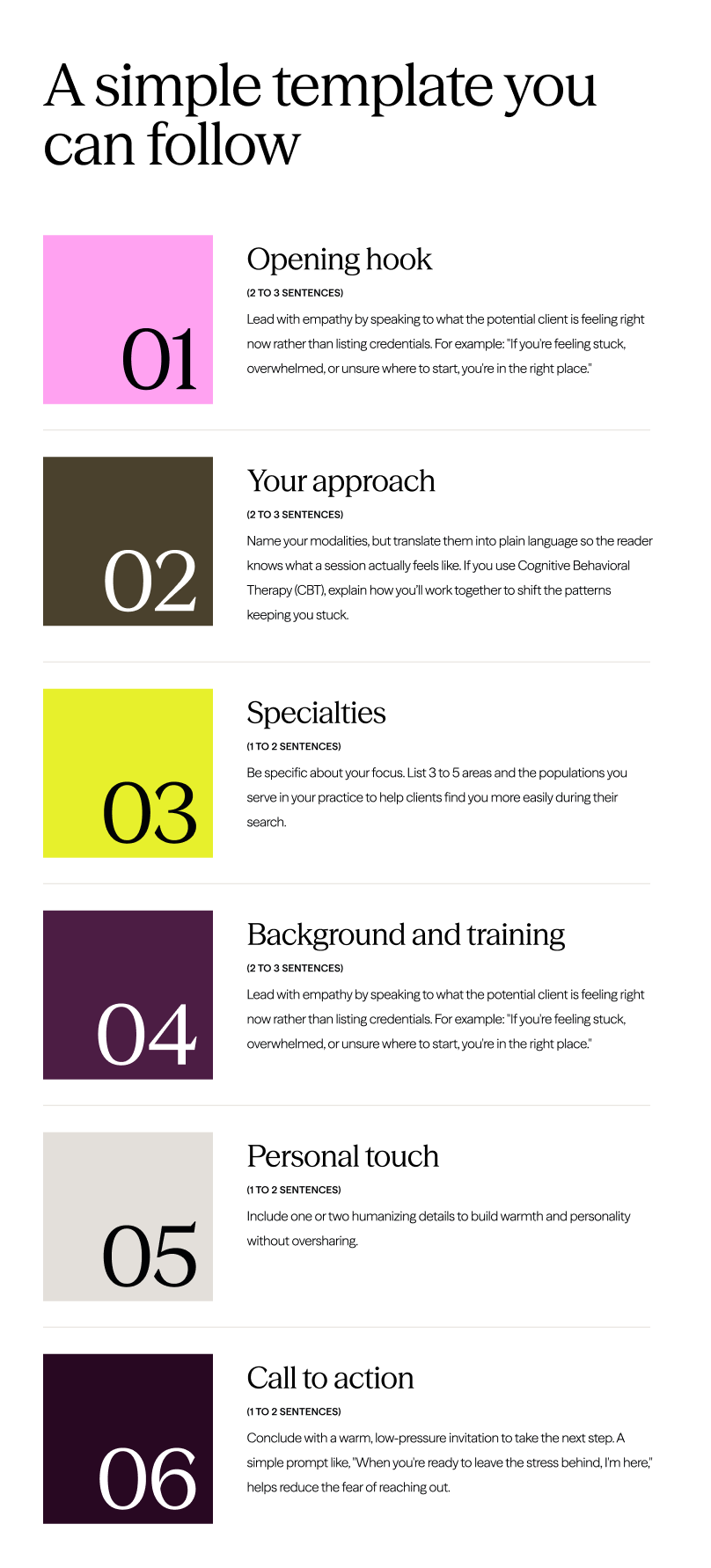
Online directory versus private practice website bios
The format and length of your bio should match where it lives. Online directories tend to have character limits and are often browsed on mobile. Keep directory bios tight, with your most important information showing first.
On your own website, you have more room. But even there, lead with the client’s needs rather than your background.
Grow Therapy’s Guide to Private Practice is a useful resource for building your broader professional presence.
How should I start my therapist or provider bio?
The first few sentences are the most important. This is where potential clients decide whether to keep reading. Lead with empathy, not credentials.
Starting with the client’s concerns, not your credentials
Instead of opening with “I am a Licensed Clinical Social Worker with 12 years of experience,” try: “If you’ve been feeling overwhelmed, stuck, or like you’ve been carrying too much for too long, you don’t have to keep doing it alone.” This puts the prospective client’s experience front and center from the first word.
Using plain language instead of clinical jargon
Most potential clients don’t know what psychodynamic therapy means, and some may feel intimidated by acronyms. When you mention modalities, briefly explain what they look like in practice. Expand acronyms to their full length and provide background on the certification or qualification value when in doubt.
Should I include my therapy rates or insurance in my bio?
Including rates or insurance information in your bio is generally optional, but it can reduce friction for prospective clients who are evaluating cost as part of their decision. If your rates are competitive or you accept a broad range of insurance plans, mentioning this upfront can increase the likelihood that a good-fit client reaches out rather than clicking away.
On platforms like Grow Therapy, insurance and pricing information is displayed separately from your bio — so you can keep your bio focused on connection and let the platform handle the logistics. If you do include rates on a personal website, keep the language straightforward and avoid making it the centerpiece of your introduction.
What Grow’s clinical outcome study found about provider bios
According to Grow Therapy’s clinical outcomes report, providers who invest in clear, compelling profiles tend to see better client engagement. And Grow Therapy’s effectiveness research highlights that the therapeutic relationship is one of the strongest predictors of positive outcomes, and the bio is often where that relationship first begins to form.
What should my therapist/provider bio cover?
Once you’ve hooked a reader with your opening, the body of your bio does the work of building trust and helping clients picture themselves in your care. Here’s what to cover and how to frame it.
Explaining how you work in the therapy room
People want to know what working with you will actually feel like. Will sessions be structured or exploratory? Do you assign homework? This kind of practical description helps potential clients picture themselves in your care. Set expectations for the first session, since communicating what clients can expect helps reduce friction and build early engagement.
Highlighting your training, credentials, and experience
Include your degree, license type, state, years in practice, and any specialized training directly relevant to the clients you serve. Keep the list focused. Frame these details in a way that feels accessible rather than intimidating.
Sharing personal details appropriately
A few well-chosen personal details can make your therapist bio feel warm and memorable. Whether you mention a favorite hobby or a value that guides your life, this helps prospective clients feel a sense of connection before their first session.
Writing for inclusivity and accessibility
Use language that is welcoming to people of all backgrounds, identities, and experiences. If you’re specifically trained to work with particular communities, say so.
Language is also a key component of accessibility. If you are a bilingual or multilingual therapist, consider providing your therapist bio in the languages that you specialize in.
Editing, refining, and getting feedback
A strong first draft is just the starting point. Editing with fresh eyes — and a few practical checks — is what separates a good bio from a great one.
Common mistakes therapists make in bios
The most common pitfalls: leading with credentials instead of client concerns, using too much jargon, being vague about who you help, and forgetting a call to action. Another frequent issue is writing a bio once and never revisiting it.
Checking for clarity, warmth, and accuracy
Read your bio from the perspective of someone who has never met you and knows nothing about therapy. Does it make you want to reach out? Does it sound like a real person wrote it? Consider finding a trusted peer editor to proofread your profile; a fresh set of eyes catches typos and grammatical errors that can undermine an otherwise strong bio.
Ethical and legal review for regulated professions
Your bio must adhere to your licensing board’s advertising guidelines, being accurate about credentials, avoiding implied outcome guarantees, and not using client testimonials without explicit consent. When in doubt, check with your state licensing board or professional association.
Asking colleagues or trusted clients for feedback
Peer review from a colleague or supervisor ensures your bio accurately reflects your professional style. For deeper insight, ask long-term clients what drew them to your profile. Their first-hand feedback can offer practical guidance on what resonates with potential clients.
Maintaining and updating your bio over time
Your bio isn’t a set-it-and-forget-it document. As your practice evolves, your bio should too. Here’s how to keep it current and working for you.
When to revise your bio
Review your profile often to ensure accuracy and test what attracts potential clients. If making updates, change only a few elements at a time to track what drives results. Always update your therapist bio when you earn a new certification, change specialties, or adjust practice settings.
Tracking what resonates with clients
Monitor your inquiry patterns to see if the prospective clients reaching out align with your ideal niche. If you are attracting clients who aren’t a strong fit, it is a signal to refine your practice description.
Aligning your bio with your evolving practice
Your bio should reflect your current therapeutic identity, not who you were years ago. To grow further, maintain a professional profile photo, which can lead to a higher booking rate. Consider resources like the Personal Marketing Checklist to strengthen your presence in private practice.