
Fathers pass down so much more than just genes or last names. How a man’s father handled stress and vulnerability often became the default behavior his children absorbed. For a lot of men, that meant learning to keep their feelings to themselves.
Men have historically been less likely than women to seek mental health support. Grow Therapy’s Caregivers Report confirms that women caregivers are consistently more likely than men to seek out mental health support.
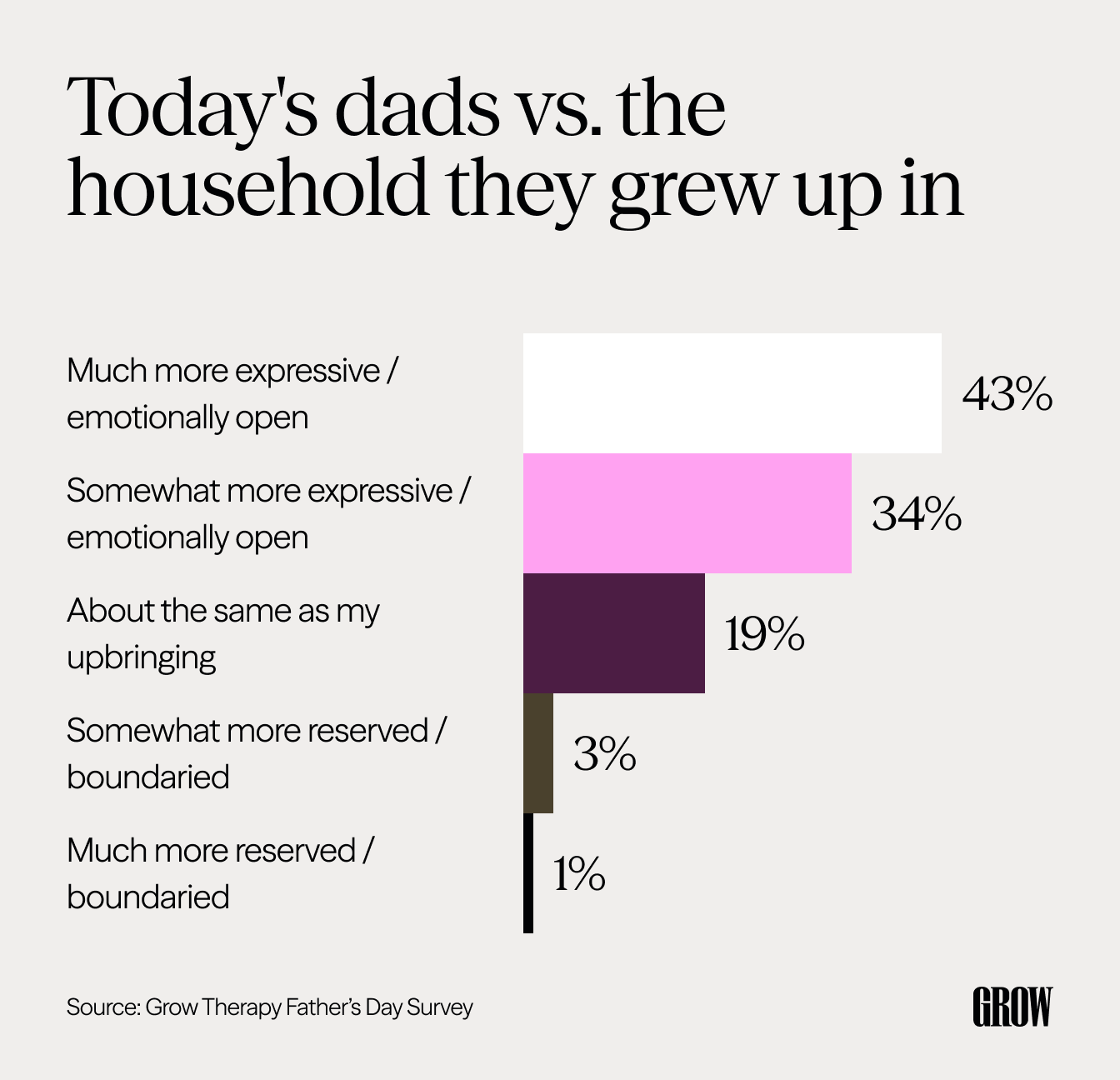
Grow Therapy surveyed over 1,500 fathers of children under 18 to understand how today’s dads are approaching emotional openness and mental health at home. 78% say they approach those conversations more openly than the household they grew up in.
A separate Grow Therapy survey focused on parents’ understanding of their children’s mental health also found that fathers were nearly identical to mothers in their confidence in recognizing signs of mental health struggles in their children. 41% of fathers said they feel very prepared and know what signs to look for, compared to 40% of mothers. What our new survey of fathers shows is that wanting to parent differently and knowing how to do it in the moment aren’t always the same thing, and there are specific places where old habits still hold.
Key takeaways
- 78% of fathers say they approach emotional and mental health conversations with their children more openly than in the household they grew up in.
- 70% actively encourage their children to come to them with emotional or mental health problems, but only 52% say they proactively start those conversations and feel prepared to lead them.
- Only 35% of fathers selected “express vulnerability openly” as an approach they use or plan to use in parenting, suggesting that many fathers may still be navigating what emotional openness looks like in practice.
- Only 20% would tell their children if they’ve attended therapy, even though 38% said professional support for their child would be most helpful, and 35% said the same for themselves.
Today’s fathers are having the mental health conversations their own dads largely didn’t
Nearly 4 in 5 fathers describe their approach to emotional and mental health conversations with their children as more expressive than what they experienced growing up. That comparison is often shaped by early models of masculinity, caregiving, and emotional expression: 82% said a father or stepfather was their primary male adult figure in childhood. For many fathers, the goal is not abstract. It is connected to what they saw, what they needed, and what they want to do differently.
Most fathers in this survey weren’t raised in emotionally closed homes. Three-quarters of those who had a primary male adult in childhood felt at least somewhat comfortable bringing emotional or mental health problems to that person.
For many of the fathers in this survey, there was already a decent foundation to build on from the male figures in their lives. And 70% of all fathers actively encourage their own children to come to them with those same conversations, suggesting most are determined to at least match what they experienced.
The 23% who felt uncomfortable opening up to their own father figure are showing up differently for their households. Of those who felt uncomfortable, 51% said their approach is much more expressive and emotionally open than the way they grew up. Fathers who felt less comfortable opening up to their own male figures and fathers who felt comfortable are both choosing to go further, just from different starting points. The data doesn’t rank those motivations, but both count.
Did you know?
Among fathers who felt very uncomfortable opening up to their own primary male adult figure growing up, 88% now describe themselves as more emotionally expressive with their own children, compared to 77% of fathers who had a very comfortable relationship with their own dad.
Whatever the starting point, 70% of fathers in this survey actively encourage their children to come to them with emotional or mental health problems. Avoiding these conversations is now a fringe position (fewer than 2%).
Most dads are starting the conversation, but modeling is the harder step
Starting a conversation about emotions and actually showing emotional vulnerability aren’t the same skill. Vulnerability is a skill because it requires recognizing what you feel, tolerating the discomfort of exposure, and trusting that the other person can hold it. Showing vulnerability takes practice most adults never got. Few of us grew up with adults around us who modeled it. Data suggests fathers are further along on one than the other.
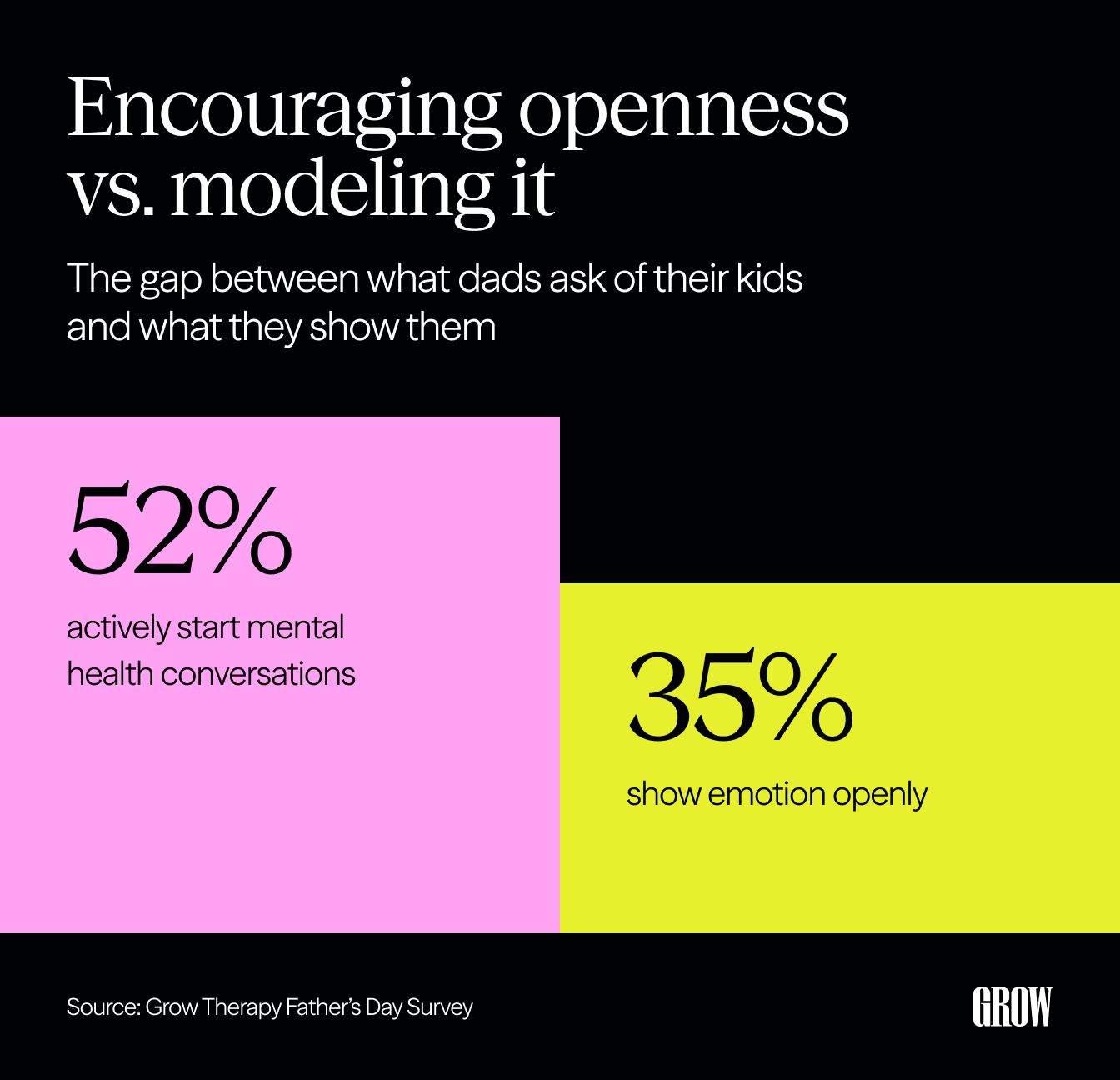
More than half (52%) of fathers say they actively start mental health and emotional conversations with their children and feel prepared to lead them. Many others are engaged but still building confidence: 26% say they try to start these conversations but sometimes feel like they are winging it or unsure of the right words, while 15% say they do not proactively start conversations but make themselves available to listen when their child comes to them.
Making space to listen is already an important form of care. Being available and receptive can create an important foundation of safety. The next step for many fathers may be moving from openness when a child
Only 35% of fathers selected “express vulnerability openly” as an approach they use or plan to use in parenting, such as acknowledging stress, showing emotion, or letting their children see them work through something hard. That suggests many fathers may still be navigating what healthy emotional modeling looks like in practice.
It’s worth mentioning that showing vulnerability with children can feel like walking a tightrope as a parent. If you show too little, your child may not see emotional openness modeled and end up feeling like they need to bottle their feelings. If you show too much vulnerability, your child may take on your stress and anxiety as their own and feel responsible for helping you feel better.
Other parenting approaches from the survey add useful texture:
- 53% encourage their children to talk about emotions
- 47% teach that mental health is as important as physical health
- 42% create routines that support emotional well-being
- 42% model staying calm and composed in stressful situations
- 35% emphasize resilience and not letting emotions overwhelm day-to-day functioning
- 31% actively avoid phrases like “tough it out” or “suck it up”
These are constructive approaches. Staying calm can be a real parenting strength, especially when children need steadiness and reassurance.
But when fewer than 4 in 10 fathers select “express vulnerability openly” as an approach they use or plan to use in parenting, it raises a more nuanced question: how do parents balance emotional steadiness with emotional visibility? Calm can be grounding, but it also risks looking like emotional withholding and start to resemble the quieter stoicism many fathers are trying not to pass down.
Still, it’s worth acknowledging what the data can’t fully capture: Knowing you want to parent differently and actually doing it in the moment are two separate challenges. Telling your child it’s okay to cry is often easier than letting them see you cry. Fathers in this survey are clearly trying. And for children, a parent who is genuinely working to show up differently is already doing something meaningful. The practice of emotional openness doesn’t arrive fully formed. It builds.
Dads are warming up to therapy —talking about it at home is the next frontier
Most fathers have made real progress with emotional openness. But therapy is the part of that conversation that still feels personal in a different way.
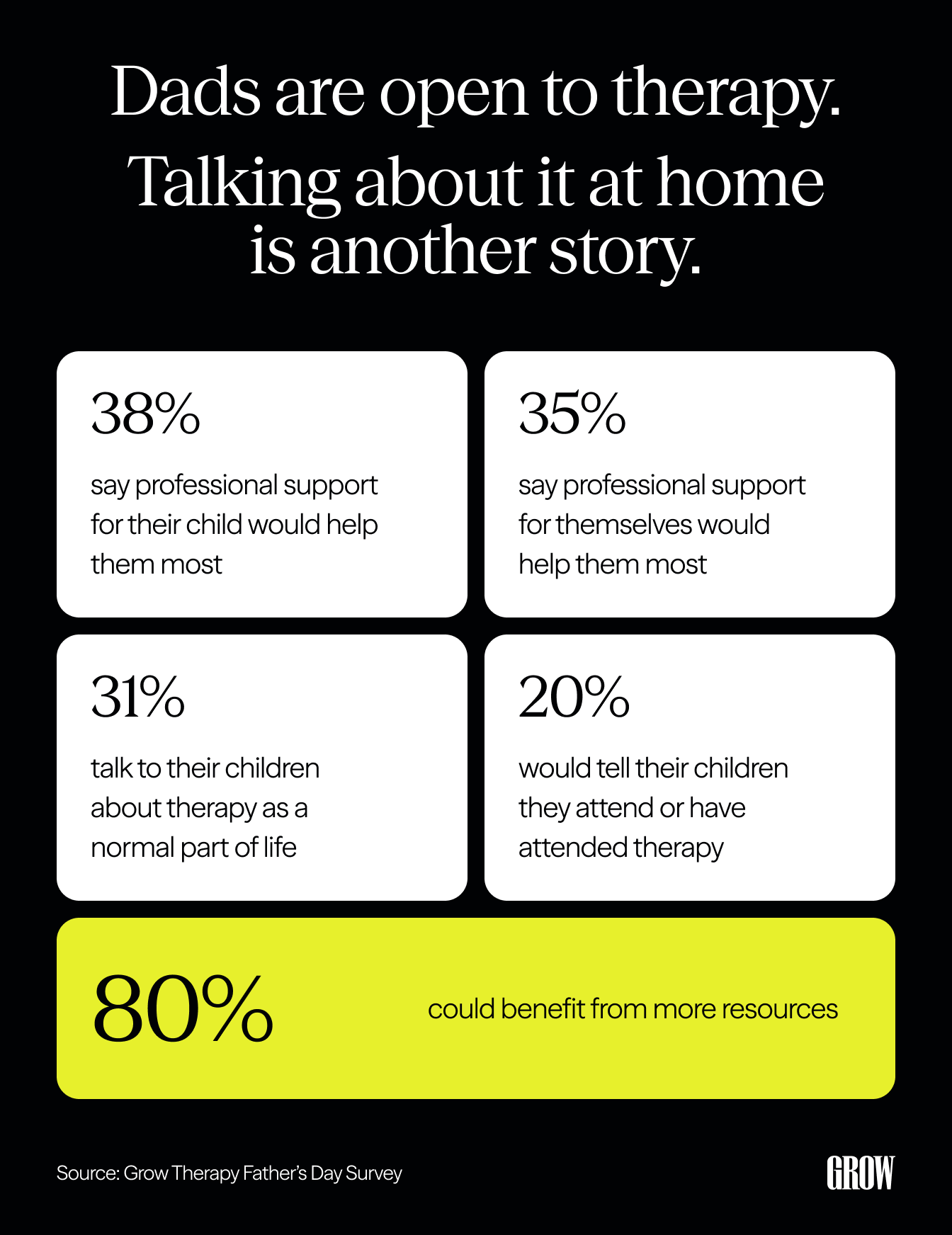
Only 31% of fathers talk to their children about therapy as a normal part of life. Only 20% say they would tell their children if they’ve attended therapy. Those numbers are low, but they’re not surprising. Therapy is still a relatively recent addition to how many families talk about mental health. For fathers who didn’t grow up seeing it modeled, knowing how to introduce it naturally at home is its own learning curve.
But that doesn’t reflect a lack of interest. 38% said professional support for their child would be most helpful to them right now, and 35% said the same for themselves. Fathers in this survey tend to accept the value of therapy well before they discuss it openly at home. The willingness to seek help and talk about it is just arriving on different timelines.
Fathers also have a desire for more support. 37% said books, podcasts, or content made specifically for fathers would be helpful. 31% said a community of other fathers navigating similar situations would help. 28% wanted specific language or scripts for starting conversations.
Only 20% feel adequately equipped already, meaning 4 in 5 fathers see room for more support. For fathers who want to find mental health coverage options that work for their family, understanding what’s available makes that easier.
The therapy stigma that has historically kept men from seeking care hasn’t disappeared. Based on the data in this survey, many fathers seem to have accepted the idea of therapy, but talking about it openly at home can be more complicated. There’s a difference between modeling openness and asking children to hold adult emotional weight. For some fathers, telling a child they see a therapist may raise questions about how to frame it in a way that feels honest, reassuring, and age-appropriate.
Some fathers may worry that talking about their own therapy will shift the family dynamic or cause their children to see them differently. And that concern is not necessarily avoidance; it may reflect an understandable desire to protect their children from worry. At the same time, when therapy is framed as a healthy form of support adults use to care for themselves, it can help children understand mental health care as ordinary rather than alarming. The data suggests many fathers are still navigating that balance.
Find a therapist who fits your life
What this means for the next generation
The data shows today’s dads understand what’s at stake. Most are actively trying to do something about it.
Most fathers in this survey aren’t resistant to change. They’re still working out the practice of it, and that’s not easy. The desire is clearly there. Fathers want resources, and many are already open to professional support for themselves and their children.
For fathers looking for professional support for their child, Grow Therapy’s guide to thesigns your child may benefit from therapy is a practical place to start. Many child therapists also work with parents directly, whether that’s building new parenting strategies or finding ways to parent differently than you were raised.
For fathers ready to commit to their own personal growth with a licensed therapist,Grow Therapy accepts 125+ insurance plans, including Medicaid in select states. Most clients pay around $21 per session, with no subscription required. Clients choose their own therapist using filters that let them find someone who actually fits.
Methodology
The survey was conducted by Centiment for Grow Therapy. The survey was fielded from May 11–15, 2026. The results are based on 1,534 completed surveys. In order to qualify, respondents were screened to be residents of the United States, over 18 years of age, and a father of at least one child aged 18 or younger. Data is unweighted, and the margin of error is approximately +/-3 % for the overall sample with a 95% confidence level.