
Parenting is difficult, and discovering that your child is struggling, and figuring out where to turn for help, can feel exceptionally overwhelming. Beyond other challenges, such as cost and insurance limitations, 19% of parents say that not knowing where to start is the biggest obstacle to seeking care for their kids.
Online therapy platforms have made support more accessible to families, especially with evening and weekend appointment options and providers who specialize in kids. However, choosing the right fit can still feel heavy, especially when you’re acting as their advocate.
To make it simpler, we vetted the platforms below to find the best online therapy for kids based on cost, ages served, parent involvement, and how care works. Here is a look at the platforms, plus guidance for choosing the option that fits your family.
Key takeaways:
- The best online therapy for kids depends on age, insurance coverage, and the concerns you want to address.
- Insurance-based platforms, like Grow Therapy, tend to offer the lowest out-of-pocket costs.
- Age ranges vary widely, with some platforms providing care for infants, young children, teens, or all ages.
- Parent involvement often differs by platform and your child’s age.
- With Grow Therapy, families can browse and choose providers who see children and teens and accept their insurance.
Best online child therapy platforms at a glance
| Platform | Age | Choosing a provider | Accepts Medicaid? | Medication management for minors? |
|---|---|---|---|---|
| Grow Therapy | 6+ | Browse and choose | ✓ | ✓ |
| Thriveworks | 0-17 | Provider browsing and matching | ✓ | ✓ |
| Brightline | Up to 18 | Provider matching | ✗ | ✓ |
| Little Otter | 0–18 | Provider matching | ✗ | ✓ |
| Emora Health | 0-25 | Provider matching | ✓ | ✓ |
| LifeStance Health | 2+ | Provider matching | ✓ | ✓ |
| Rula | 5+ | Provider matching | ✓ | ✓ |
| Amwell | 10+ | Browse and choose | ✗ | ✗ |
| Talkspace | 13–17 | Provider matching | ✗ | ✗ |
| Teen Counseling | 13–19 | Provider matching | ✗ | ✗ |
1. Grow Therapy

Grow Therapy is an online therapy platform that accepts insurance and connects families with licensed therapists and prescribers for virtual or in-person care. Rather than assigning a provider to your child, you can choose a therapist who gets them, filtering by identity, specialty, background, language, and treatment method. If your first choice isn’t a good fit, you can switch providers at no additional cost.
For parents comparing online counseling for children, Grow Therapy’s appeal lies in its combination of insurance coverage and choice. Therapy and medication management also live in one place, and appointments are often available outside of school and working hours. Plus, providers and parents can message directly through the patient portal.
Cost and insurance
- Insurance acceptance and costs are dependent on an individual’s plan and provider coverage. Costs should be checked directly with the insurance provider for accurate pricing.
- With insurance: Most pay an average of ~$21 per session with insurance, and some pay as little as $0 (varies by plan)
- Without insurance: $75-$250+ per session (depending on provider’s credentials and location)
Ages served and care type
Grow Therapy’s network includes providers who see children, teens, and adults. Care includes talk therapy, such as cognitive behavioral therapy (CBT), and medication management, with providers experienced in various conditions, like trauma and grief.
Parent involvement
Caregiver involvement varies by provider, and you can choose someone who describes how they work with families and involve caregivers. Some therapists also offer family-centered care and evidence-based approaches, such as parent-child interaction therapy (PCIT) and child-parent psychotherapy (CPP).
Who it’s a good fit for
Grow Therapy is a strong fit for families who want to use insurance and choose a child’s therapist themselves rather than be assigned one.
| Pros | Cons |
|---|---|
| Works with 125+ insurance plans, including Medicaid | Cash pay rates vary by provider |
| In-person and online options | Location determines in-person availability |
| Cost estimates provided before booking | |
| Filtering tools provide search options for specific specialties |
2. Thriveworks
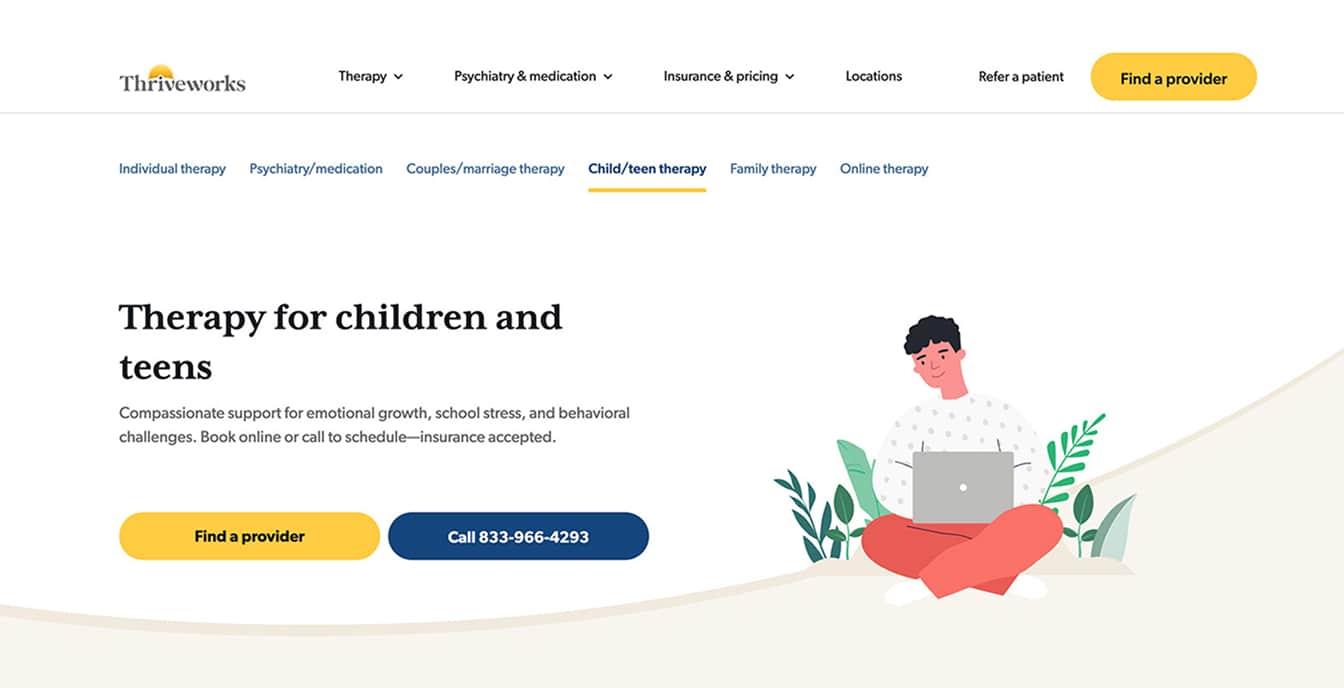
Thriveworks offers psychiatry services and therapy in 49 states (excluding Vermont) and Washington, D.C., with in-person offices available for families who prefer to meet locally. It provides dedicated child and teen therapy for emotional growth, school stress, and behavioral challenges, with virtual medication management in select states.
With Thriveworks:
- Clinicians use evidence-based approaches for age-specific needs
- TherapyLand centers offer kids under 12 support through play therapy
- Providers support children with neurodiversity, language development needs, trauma, grief, and other conditions
Cost and insurance
- With insurance: Many clients pay copays of $0 to $55/session
- Without insurance: Initial therapy sessions from $200-$240, therapy follow-ups from $160 to $195, psychiatry services from $300-$375, and psychiatry follow-ups from $210-$300
Ages served and care type
Thriveworks welcomes children of all ages (from 0 to 17) for child therapy, using techniques matched to each child’s age. Care can be delivered online, in person, or through play-based therapy centers.
Parent involvement
For child and teen therapy, caregivers are kept informed of their child’s progress through occasional parent sessions.
Who it’s a good fit for
Thriveworks is a good fit for families who want the option of a nearby in-person office plus online flexibility.
| Pros | Cons |
|---|---|
| 340+ in-person office locations | Not available in Vermont, and child psychiatry availability varies |
| Child therapy for all ages, with play-based and evidence-based approaches | TherapyLand centers are only available in 14 states |
| Accepts most major insurance plans, including Medicare |
3. Brightline
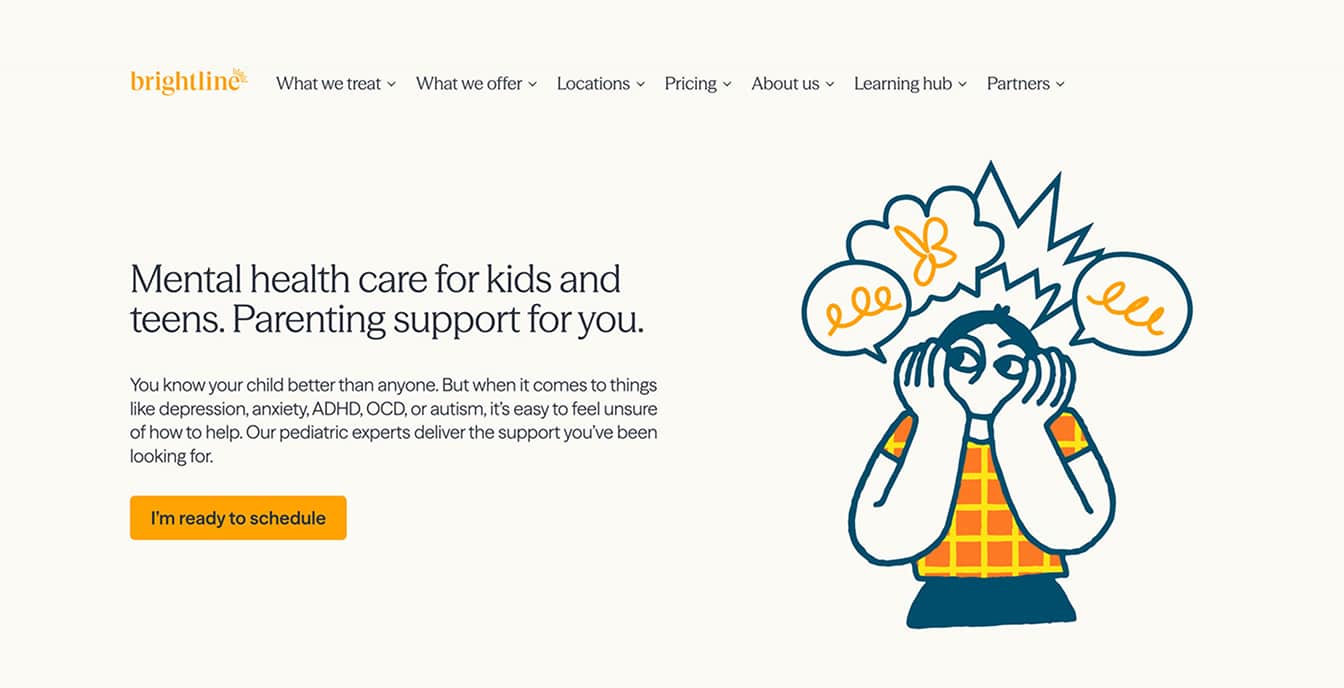
Brightline is a pediatric behavioral health practice that offers therapy, psychiatry, psychological testing, and coaching. For parents doing careful online child consulting and comparison, Brightline:
- Provides care for ADHD, anxiety, OCD, and disruptive behaviors
- Focuses on family-based behaviors and changes
- Offers free coaching in California through BrightLife Kids
- Extends behavioral coaching and parent support in eligible states
Cost and insurance
- With insurance: $33/therapy session, $38/psychiatry session, and $42/testing session
- Without insurance: Therapy ranges from $200-$350, psychiatry ranges from $225-$350, and psychological testing begins at $2,000
Ages served and care type
Brightline uses evidence-based approaches to treat kids and teens up to age 18. In California, families with children 12 and under can also access free coaching.
Parent involvement
Brightline’s model is family-centered, with parent coaching and progress tracking built into care so caregivers stay closely involved. Caregiver involvement is based on the child’s age, needs, and developmental abilities, and may shift over time.
Who it’s a good fit for
Brightline fits families in the select states where it’s available, along with California families who want free early coaching for kids 12 and under.
| Pros | Cons |
|---|---|
| Pediatric-specialized care for ages 0 to 18 | Full clinical therapy and psychiatry services are limited to five states (CT, NY, NJ, MA, and WA) |
| Therapy, psychiatry, testing, and coaching in one practice | Focuses only on a defined set of concerns, including ADHD, anxiety, OCD, and disruptive behaviors |
| Family-centered with parent coaching and progress tracking |
4. Little Otter
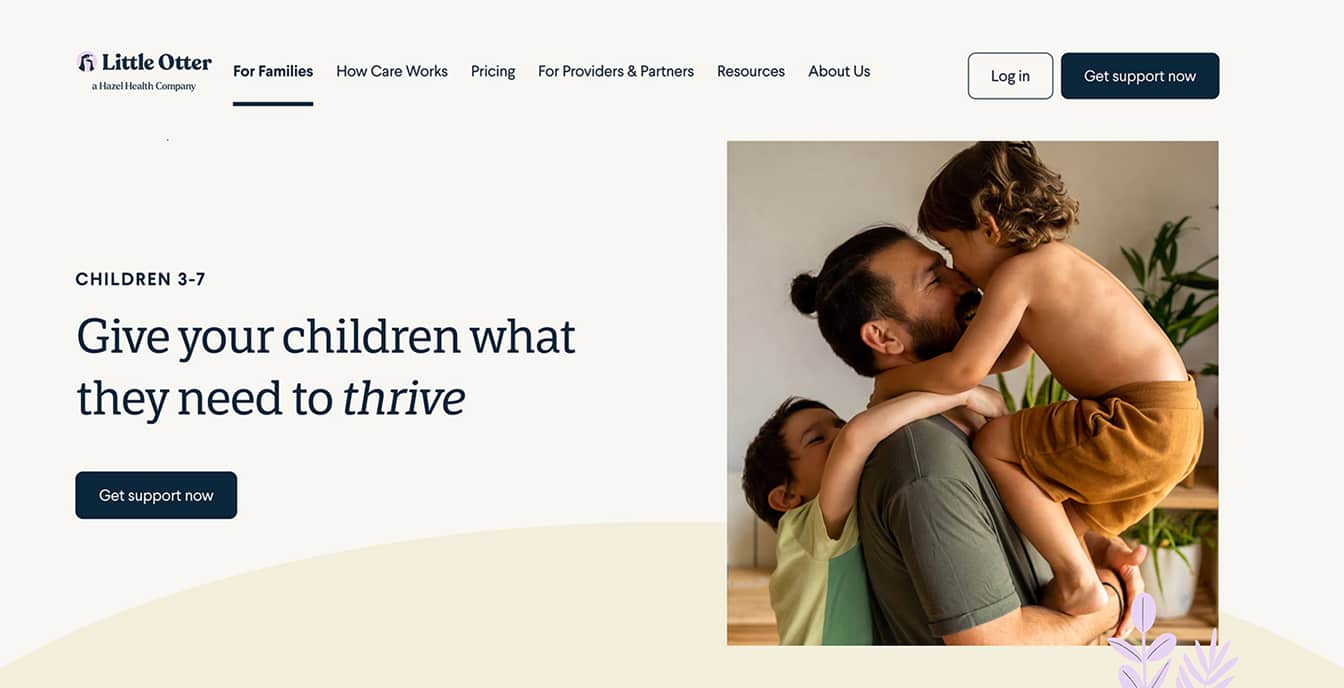
Little Otter is a whole-family, pediatric-focused platform that supports children and their caregivers together. Its online child counseling approach uses a model that treats the family as part of the child’s care rather than focusing on the child alone.
Little Otter provides:
- Individual, couples, and family therapy, alongside parent coaching
- An app to track care plans and progress
- Access to tailored treatment plans, assessment results, progress reports, and clinician notes
Cost and insurance
- With insurance: Co-pays and deductibles vary by individual coverage
- Without insurance: Assessments between $200 and $500, $200/therapy and parent coaching session, and $250/psychiatry session
Ages served and care type
Little Otter offers virtual therapy and psychiatry for children 0 to 18 and their adult caregivers, including individual and family therapy, parent coaching, and medication management.
Parent involvement
Parent involvement is central to Little Otter’s model, with a whole-family approach, parent coaching, and an app that keeps caregivers connected to their child’s plan and progress.
Who it’s a good fit for
Little Otter suits families in its service states who can use out-of-network benefits or pay out of pocket.
| Pros | Cons |
|---|---|
| Pediatric-focused model | Available in select states only |
| App-connected individual or family therapy and psychiatry | Largely out-of-network |
| Caregiver involvement and progress tracking | No sliding scale for payments |
5. Emora Health
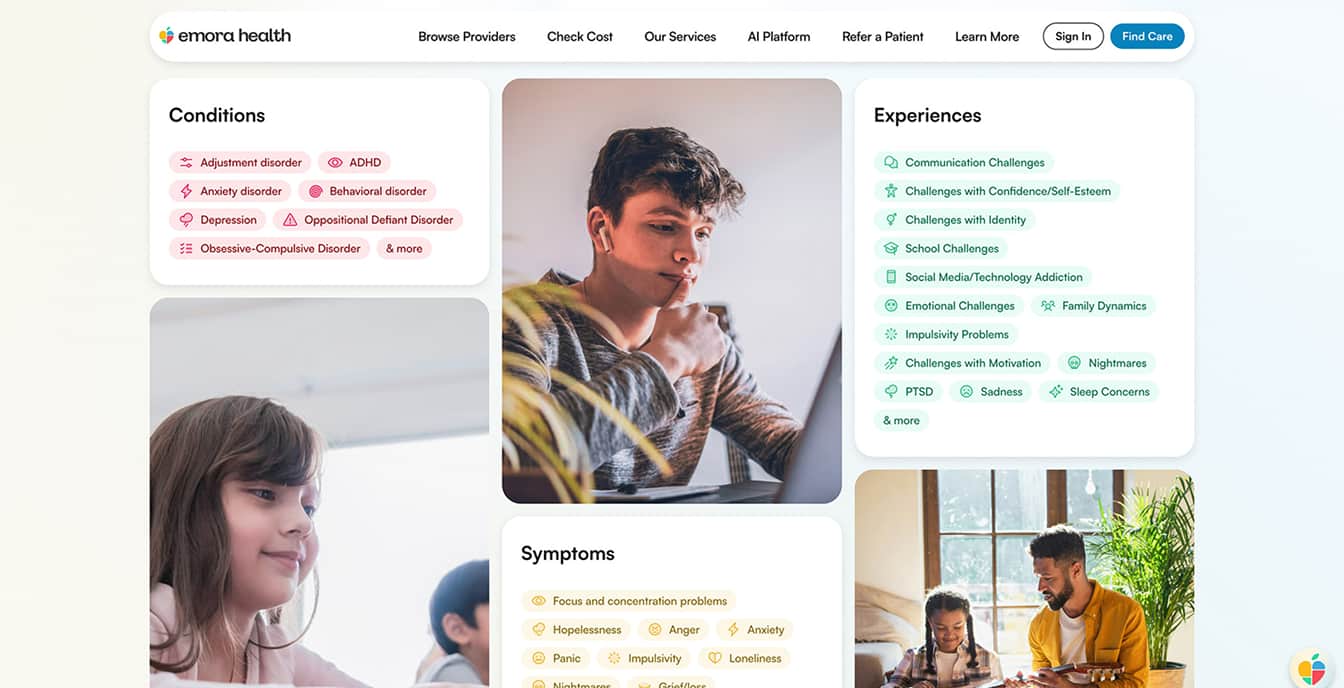
While Emora Health offers care for all ages, it’s primarily a youth-focused platform built specifically for children, teens, and young adults. Clinicians are matched to each client’s developmental stage and must demonstrate direct experience treating kids and adolescents.
Care offered through Emora Health:
- Is age-specialized for kids, tweens, teens, and emerging adults
- Offers medication management with licensed psychiatric clinicians
- Includes psychologist-led evaluations, including ADHD and autism assessments
Cost and insurance
- With insurance: Average copay is ~$0-$30
- Without insurance: From $150-$300 for an initial evaluation or assessment, $85-$125/therapy session, $150 for medication management follow-up, $2,300 for ADHD testing, and $2,550 for autism testing
Ages served and care type
Emora treats children, teens, and young adults, roughly ages 0 through 25. Its evidence-based treatment methods include talk therapy, medication management, and clinical evaluations.
Parent involvement
Emora Health takes a holistic approach to treatment that involves the family, adapts to feedback from both the parent and child, and includes parent therapy options as part of care.
Who it’s a good fit for
Emora suits families who want age-specialized care for a child, teen, or young adult and who have one of the commercial plans Emora accepts.
| Pros | Cons |
|---|---|
| Parent-based therapy | Focused on commercial insurance rather than Medicaid |
| First sessions are often available within a couple of days | Availability depends on where clinicians are licensed |
| Specializes in many conditions, including academic stress and bullying |
6. LifeStance Health
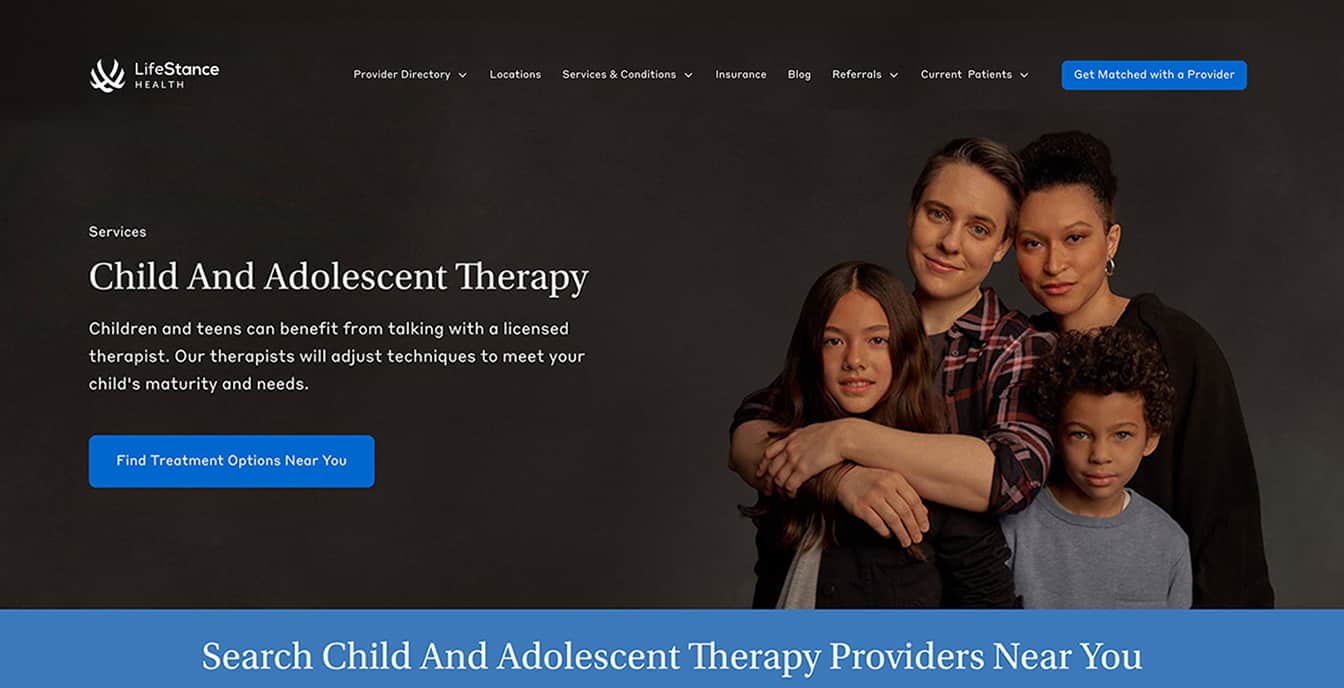
LifeStance Health is a large practice offering both in-person and telehealth care across 33 states. This platform offers online child therapy for young children and teens, including options for different types of therapy, such as family and group therapy.
With LifeStance Health, families may:
- Receive child-specific care like play, art, and music therapy
- Opt for PCIT or CBT treatment
- Transition from online to in-person care
Cost and insurance
- Coverage varies by state and provider, including Medicare and Medicaid
- With insurance: Most copays land between $22-$36
- Without insurance: Based on location, therapy ranges from $118-$589, and psychiatry ranges from $124-$567
Ages served and care type
LifeStance Health serves children, teens, and adults, though not all clinics provide services for all ages. Its child and teen services include therapy, testing, and psychiatry, with in-person options like play, art, and music therapy for younger children.
Parent involvement
Parents often play an active role in child therapy sessions, and school-based services typically involve collaboration with parents and educators. However, some therapists work one-on-one with the child and keep parents informed.
Who it’s a good fit for
LifeStance Health fits families who want a choice between in-person and online care, plus access to testing and psychiatry.
| Pros | Cons |
|---|---|
| In-person and telehealth options | Availability varies by location |
| Accepts most commercial insurance plans, plus some Medicaid or Medicare by state | Experience and specialties vary by office |
| Offers testing, psychiatry, and child-specific therapies |
7. Rula
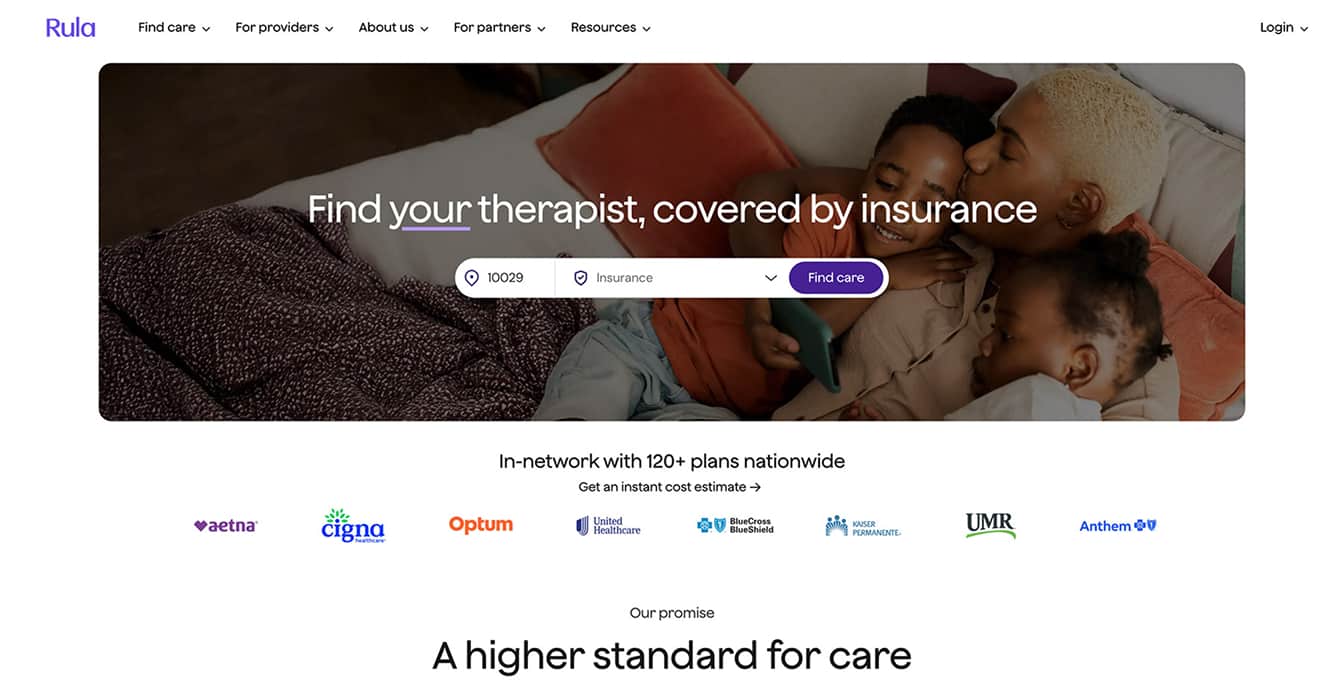
Rula is a platform that provides virtual therapy for kids and connects families with licensed therapists nationwide while working with most major insurance plans. Parents choose a provider from a curated list in their state, which makes it a flexible option for insurance-covered care.
Through Rula, families receive:
- Individual, family, and child therapy
- Teen therapy and psychiatry for older kids
- Live video sessions, with limited in-person options
Cost and insurance
- With insurance: $15/copay on average
- Without insurance: $150/session for individuals or $165/session for families or couples
Ages served and care type
Rula’s network can treat children ages 5 and up, with psychiatry and medication management available for ages 13 and up, in all 50 states. Providers often offer child-centered play therapy, CBT, and family therapy.
Parent involvement
Parents are required to attend the first session with a child under age 13. While not expected for those between 13 and 17, it’s recommended. Additionally, caregivers should act as collaborative partners in all aspects of their child’s behavioral health care.
Who it’s a good fit for
Rula fits families who want insurance-covered therapy for children aged five or older.
| Pros | Cons |
|---|---|
| No subscription fees | Limited in-person options |
| Available in all 50 states | Psychiatry is not available for children under 13 |
| Ability for users to choose their provider | Not structured as a whole-family program |
8. Amwell
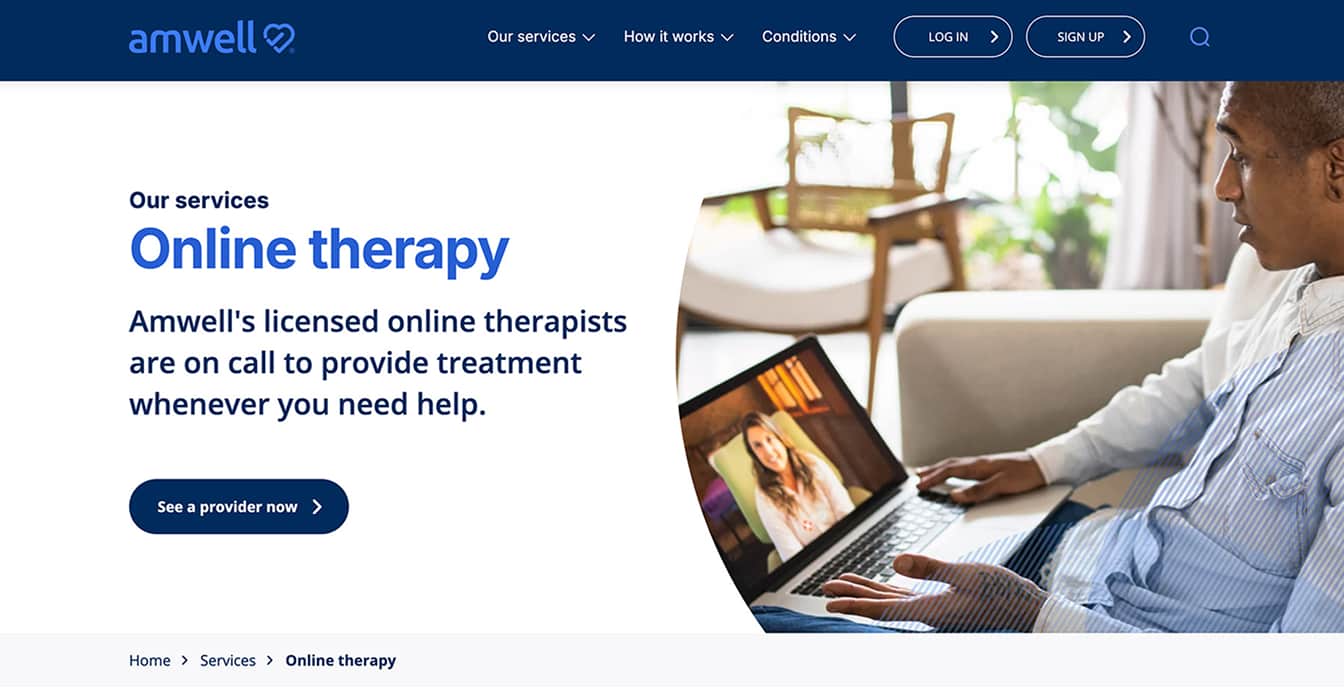
Amwell is a national telehealth platform where families can meet with a licensed therapist via live video. Provider availability often includes next-day and evening or weekend appointments, making this platform a convenient option for older kids and teens who need talk therapy.
Amwell’s platform offers:
- Therapy for children ages 10 to 17
- Ongoing conversations and tailored treatment plans
- Therapist availability while traveling or after relocating
Cost and insurance
- Pay-per-visit fees vary by service, copay, and coinsurance
Ages served and care type
Amwell offers therapy for children ages 10 to 17 with parental or guardian consent. Providers offer talk therapy for these ages. However, psychiatry and medication management are only available to patients 18 and older.
Parent involvement
A parent creates the account, adds the child, and helps them sign in, and then the level of parent involvement in sessions is up to the therapist.
Who it’s a good fit for
Amwell fits families who want fast, convenient video therapy without medication management for a child aged 10 to 17.
| Pros | Cons |
|---|---|
| Nationwide network of providers | Lacks therapy options for kids under 10 |
| Pay per visit, with no subscription | No psychiatry or medication management for kids under 18 |
| Accepts many major commercial insurance plans | Requires parent account setup and consent |
9. Talkspace

Talkspace offers a dedicated teen therapy program that combines messaging with live sessions. The platform’s treatment options are covered by many insurance plans, and providers offer teens private, flexible support.
With Talkspace, users get:
- Live video, audio, or chat sessions, in addition to messaging
- Support for relationships, family, body image, and other situations
- Culturally sensitive guidance
Cost and insurance
- With insurance: Varies by plan and provider
- Without insurance: Therapy sessions from $69-$109/week and psychiatry from $175 to $299/session
Ages served and care type
Talkspace teen therapy serves teens ages 13 to 17, offering talk therapy options through unlimited messaging and live sessions.
Parent involvement
Parental consent is required in most states, completed through the app. Teen sessions are confidential and protected under HIPAA, so parents do not see the messages unless the teen agrees, though therapists may share safety concerns when needed.
Who it’s a good fit for
Talkspace is for teens ages 13 to 17 who value privacy and flexible messaging.
| Pros | Cons |
|---|---|
| Covered by many plans, and free through some employer and city programs | Not available for children under 13 |
| Unlimited messaging plus live sessions for flexibility | Subscription-based instead of pay-per-session |
| Strong privacy protections for teens | Confidential model may mean limited parent visibility into sessions |
10. Teen Counseling
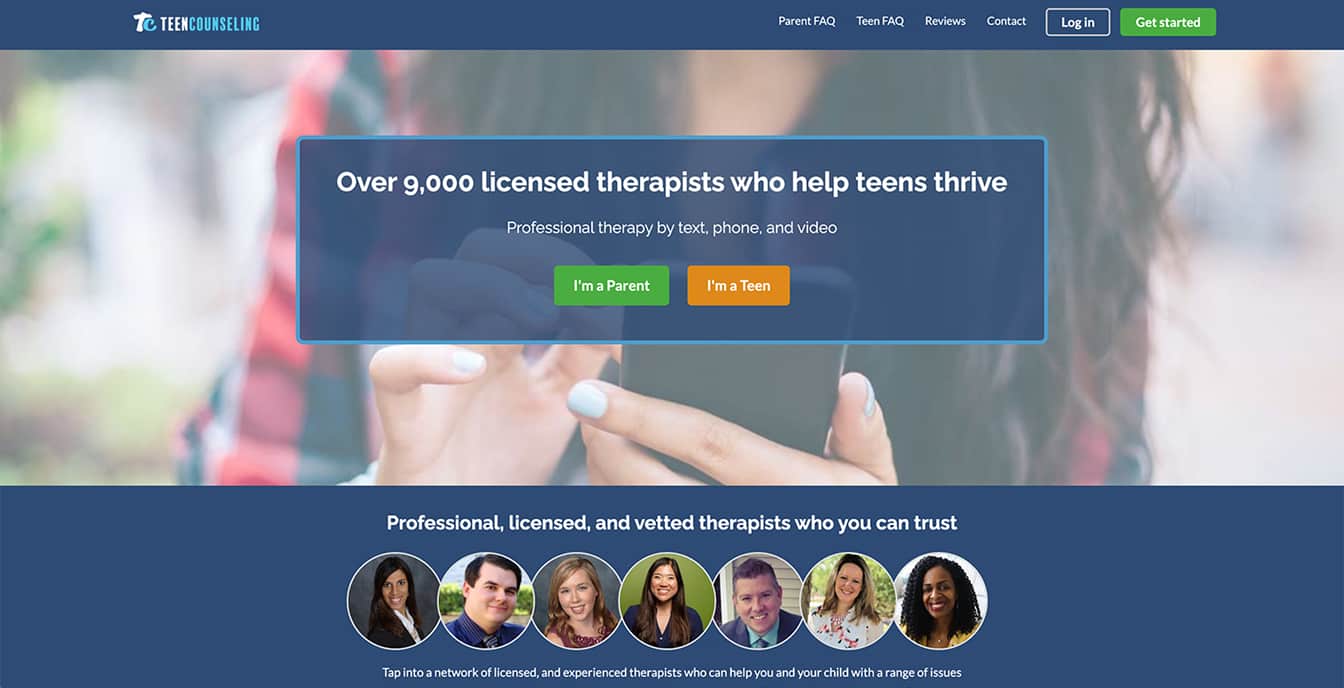
Teen Counseling, an online therapy platform and sister site to BetterHelp, offers teens weekly live sessions plus unlimited messaging in a private online space. This platform offers support for concerns like anxiety and depression.
Through Teen Counseling’s services, families:
- Receive access to unlimited messaging with a licensed therapist
- Are matched with a licensed and vetted counselor
- Gain access to a dedicated support team
Cost and insurance
- Subscription prices vary by location, source, preferences, and therapist availability.
- Without insurance: From $70 to $100/week
Ages served and care type
Teen Counseling serves teens ages 13 to 19 nationwide. It provides talk therapy only, with no medication management, and is intended for mild to moderate concerns rather than crises.
Parent involvement
A parent signs up, pays, and has an initial conversation with the therapist, and the teen’s sessions remain confidential aside from required safety disclosures. Parents may choose to meet with a child’s therapist separately.
Who it’s a good fit for
Teen Counseling fits families of teens 13 to 19 who do not need insurance coverage for convenient, private support.
| Pros | Cons |
|---|---|
| Weekly live sessions plus unlimited messaging | Does not accept insurance |
| Nationwide availability | No medication management, diagnosis, or superbills |
| Separate, private spaces for teen and caregivers | Therapists are assigned rather than chosen |
What to look for in an online therapy provider for kids
Every child and family is different, and the right provider will treat your family with care and offer you a place to grow.
“Therapy is a safe space to talk through emotions, versus holding them in or expressing them in unhealthy ways. Therapy can help children learn coping strategies that not only minimize symptoms but also manage them,” says Monica Randle, LPCC, a Grow Therapy provider.
Keep these factors in mind while looking for care for younger kids or finding the best counselor for your teen:
- Do they accept your insurance?: Choosing an in-network platform can lower what you pay, allowing you to invest in your child’s care for longer.
- Do they treat your child’s age group?: Children and teens have developmental needs that differ from adults, so choose a professional trained to work with kids.
- Do they treat co-occurring conditions?: Kids may experience overlapping concerns like anxiety and ADHD, so a multi-faceted approach and platform may be better suited to your child’s needs.
- How do they approach caregiver involvement?: For some types of care and younger age groups, parent or guardian involvement shows the strongest results, so know how much a platform includes caregivers.
- Can you choose the provider yourself?: Fit matters, and the ability to review a provider’s background and switch if needed helps your child feel comfortable.
- Do they offer flexible appointment availability?: Care that fits around school and work, including evening or weekend options, makes it far easier to stay consistent.
Get your child the support they need with Grow Therapy
Choosing the best online therapy for kids is a personal journey that requires you to consider their needs and your budget. If you’ve spotted the signs that your child may benefit from therapy, Grow Therapy offers insurance-covered care and flexible appointment options while allowing you to choose their provider.
When you’re ready, browse providers who work with children and teens, and filter by their specialty and availability. If medication may be part of the picture, you can also explore online psychiatry options. But no matter what your child is facing, exploring Grow Therapy is a positive step forward.