
When parents say “it takes a village,” they usually mean the people who show up when they need it: A grandparent handling pickup, a neighbor who watches their kid for an hour when they’re stuck at work.
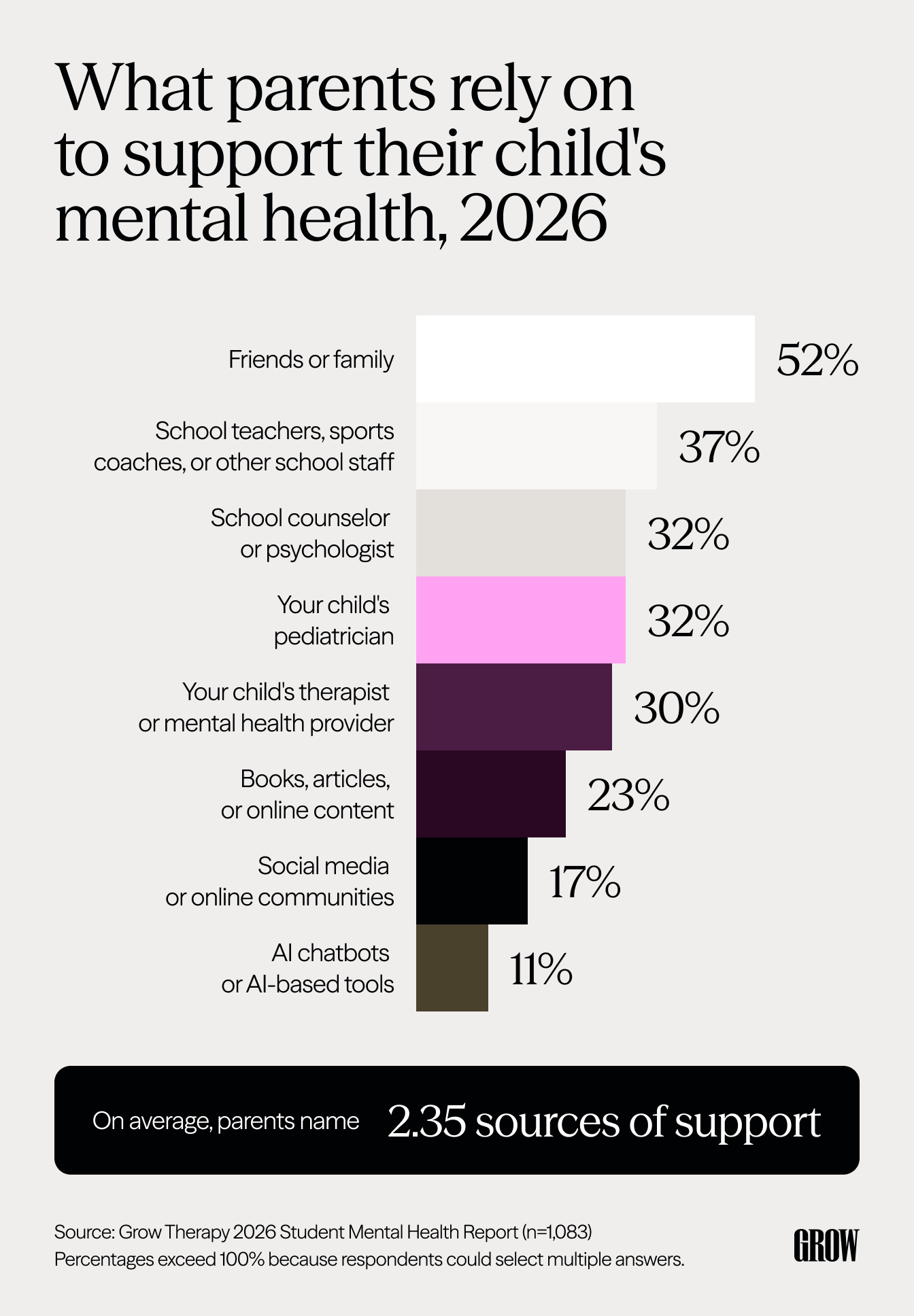
As students head back into a new school year, that village is doing more work than the phrase implies. Parents of school-age children now name an average of 2.35 different sources of support for their child’s mental health, which is a sign of how much support students are drawing on as the pressures of school ramp back up.
One source of support has grown considerably since last year. More than 4 in 5 parents report that they have now sought professional mental health support for their child, up from about 3 in 5 in our 2025 Student Mental Health Report.
But parents reaching out can lead to friction. The barriers that grew fastest this year were human rather than logistical. A child’s own resistance to help more than doubled. So did the share of parents who say they’ve personally felt judged for seeking help. Both outpaced cost or waitlist barriers by roughly two to one.
That friction hasn’t stopped parents, though. They’re still reaching further and pulling in more kinds of support, which is what this year’s survey set out to measure. This is Grow Therapy’s second annual survey of U.S. parents, tracking how families are navigating student mental health together.
Key takeaways
- The village raising today’s kids has quietly grown past family and friends. School staff (37%), counselors (32%), pediatricians (32%), and therapists (30%) are now a substantial part of the support network parents lean on, even though friends and family still lead at 52%.
- The share of parents who’ve sought mental health support for their child climbed from 62% to nearly 82%, a roughly 20-point jump in a single year.
- Younger parents are making the village even wider: 19% of parents ages 18–29 use AI chatbots to support their child’s mental health, versus just 6% of parents 46 and older.
- A child’s own resistance to help rose from 11% to 28%.
- More parents say they’ve personally felt judged when seeking mental health support for their child, up from 8% to 20%.
What’s actually in the village raising America’s kids
Family and friends remain the most common way parents describe their support system, at 52% among parents with a child currently in school. That part tracks with the old picture, but it’s no longer the whole story.
School teachers, coaches, or other staff show up in 37% of these networks. A school counselor or psychologist appears in 32%, a pediatrician in another 32%, and a child’s therapist or mental health provider in 30%, meaning the adults a parent can now regularly lean on include other adults who are invested in their child’s day-to-day life and positioned to notice what a parent might miss.
With an average of 2.35 sources per parent, reaching beyond the immediate family has become closer to the norm for many households. Only 10%* of parents rely on friends and family alone. Another 43%* pair friends and family with other resources, and 48%* don’t rely on friends and family at all, having built their child’s support network entirely from other sources.
Professional support is already part of that village for most families. 63% of parents include at least one clinical or professional source — a school counselor, therapist, or pediatrician — in their child’s support network.
And parents are seeking more support faster than before. The share of parents who’ve sought professional mental health support for their child climbed from 62% last year to nearly 82% this past year.
The village is also extending into digital spaces that didn’t exist a generation ago, though unevenly across generations. 19% of parents ages 18 to 29 use AI chatbots to support their child’s mental health, compared to only 6% of parents 46 and older. The same pattern holds for social media and online communities: 25% of parents ages 18 to 29 rely on them, compared with 10% of parents 46 and older.
Did you know?
The U.S. Surgeon General’s 2024 advisory on Parental Mental Health & Wellbeing reports that 41% of parents say they’re so stressed on most days that they can’t function, which is one reason the advisory calls for treating a child’s upbringing as a shared responsibility rather than something parents carry alone.
Why parents keep widening the circle
More kids are visibly struggling than a year ago. 47% of parents say their child has struggled with noticeable stress, anxiety, or sadness during the school year, up from 41%.
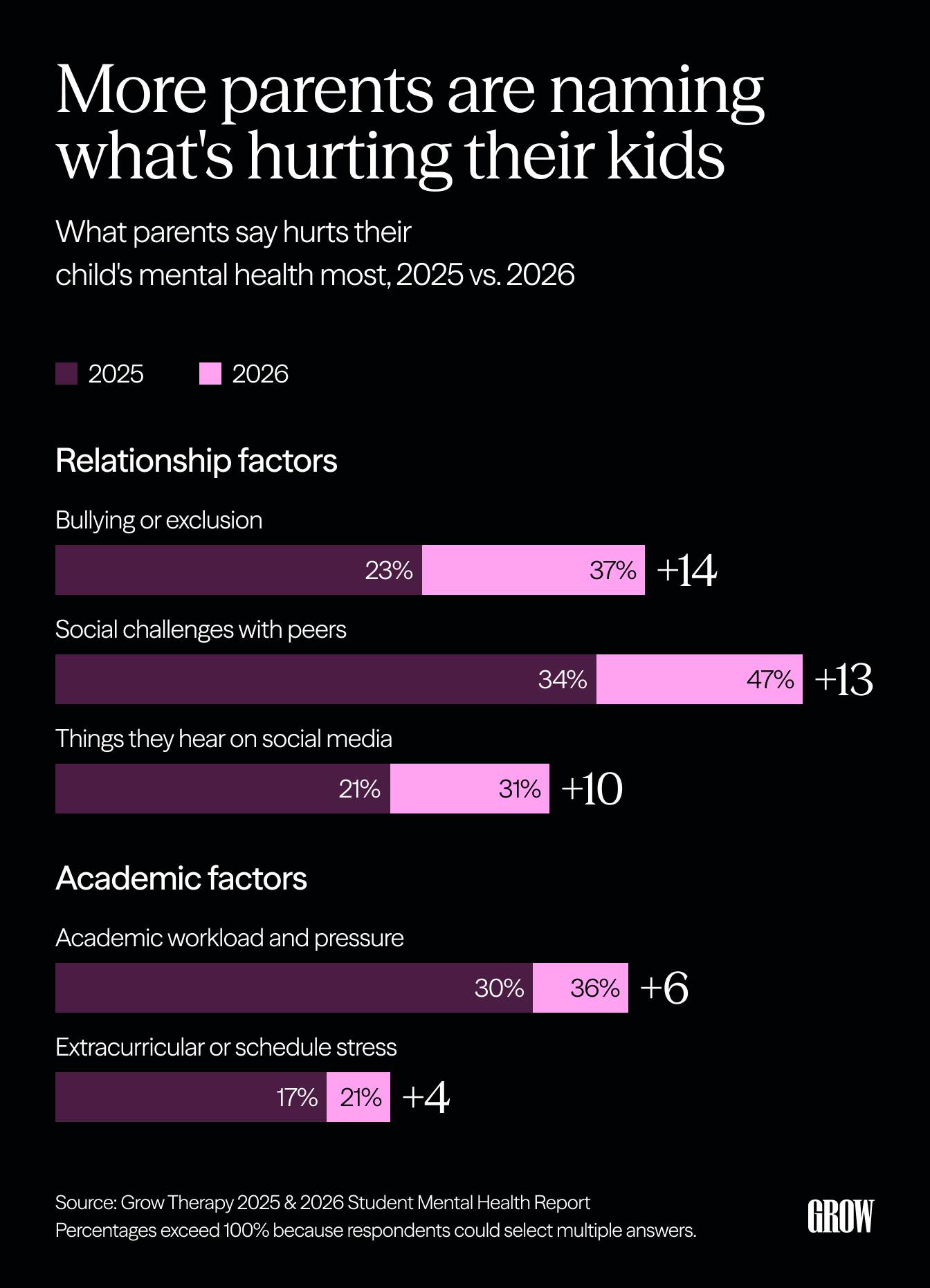
What’s driving that has more to do with relationships than grades. Social challenges with peers and friends remain the most-cited factor parents say negatively affects their child’s mental health (47%, up from 34%). Bullying or exclusion follows (37%, up from 23%). Academic workload and pressure rose to 36% (up from 30%).
Kids themselves are drawing similar conclusions about the social side of their lives. As our roundup of mental health statistics notes, 48% of U.S. teenagers now say social media has a mostly harmful effect on people their age, up from 32% in 2022, according to Pew Research Center.
Part of the change is that more parents are actually naming a stressor at all. 80% of parents now point to at least one stressor affecting their child, up from 64% last year. But not all parents see their child as struggling. One in five say their child’s mental health hasn’t been negatively impacted at all.
Preparedness also increased, just not as quickly as some of the barriers families are running into. The share of parents who feel very prepared or have a general idea of how to recognize signs of mental health struggles in their children rose five points this year, from 76% to 81%. But a child’s own resistance to getting help rose more than three times as fast over the same year, climbing from 11% to 28%.
Parents and their kids don’t always identify the same risks, which is part of why other adults matter. A 2025 Child Mind Institute study of 1,000 parent-child pairs, spanning parents and youth ages 11 to 22 (an older youth range than this report’s under-18 audience), suggests parents are far more likely to name substance use as a top concern for youth mental health (74%, versus 42% of kids), while kids are more likely to flag AI and social media (60%, versus 47% of parents).
A teacher or coach watching from another angle may be catching signs a parent simply isn’t positioned to see. That vantage point is what makes the wider village useful, though not a substitute for a parent’s read on their own kid.
What are the signs that a child needs therapy?
Common signs include a noticeable shift in mood or energy, pulling away from friends or activities they used to enjoy, changes in sleep or appetite, declining grades, or new physical complaints like stomachaches or headaches with no clear cause. In tweens and teens, distress can also show up as acting out: new or escalating risk-taking, like skipping school, sneaking out, or breaking rules they used to follow. A single bad week isn’t necessarily a red flag; consistency and a change from your child’s usual baseline matter more than any one sign alone. One exception to the wait-and-watch approach: if your child talks about hopelessness, hurting themselves, or not wanting to be here, take it seriously and reach out to a professional right away. In the U.S., you can call or text 988 for free, 24/7 support
The barriers that grew fastest aren’t about money or waitlists
The nearly 20-point jump in the number of parents seeking support didn’t happen without friction. Every barrier we tracked in both years grew, but not evenly.
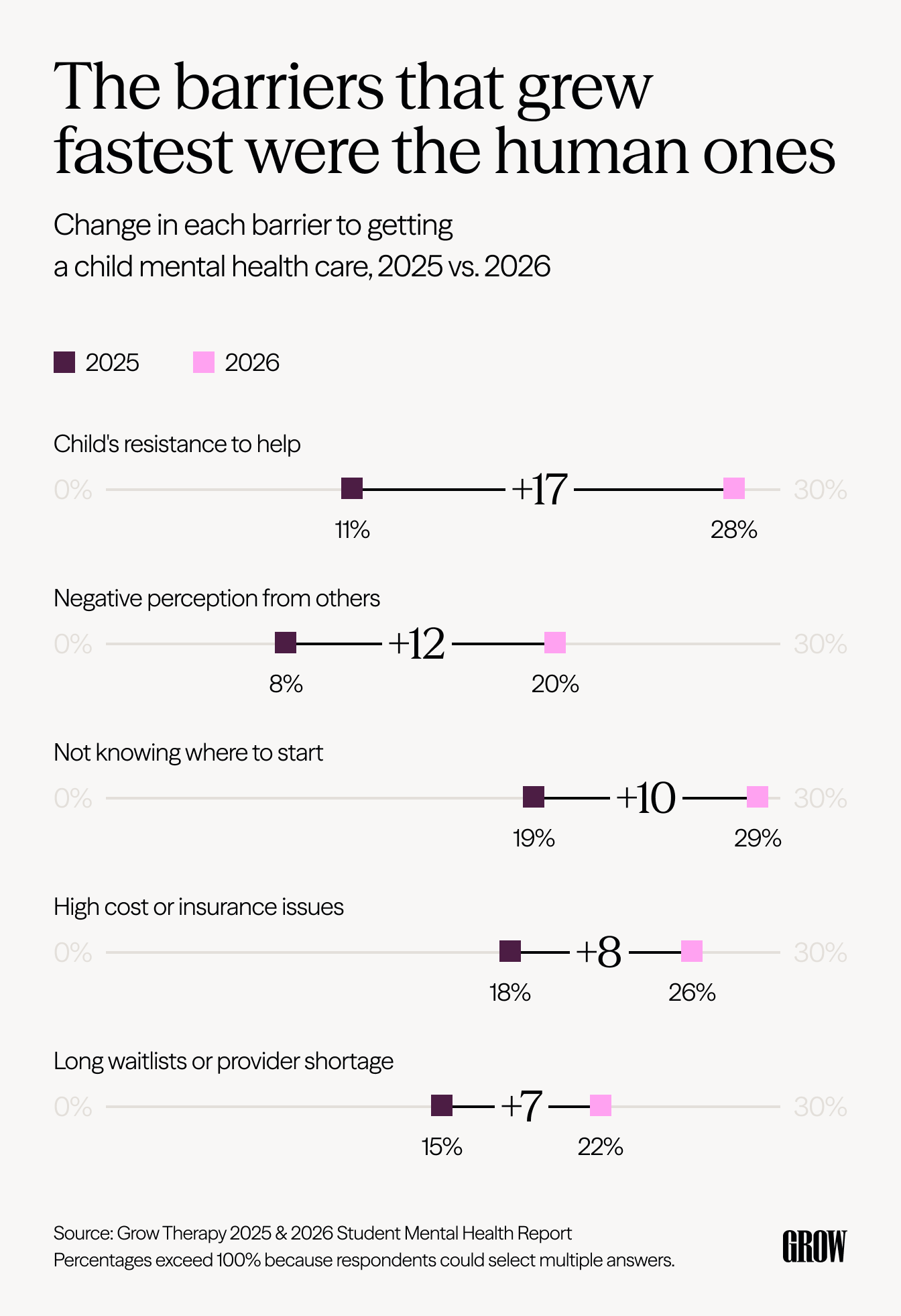
A child’s resistance to help rose the most, from 11% to 28%. The share of parents who say they’ve felt judged by others rose from 8% to 20%. Both are barriers a parent can’t fix with money or a phone call, which means that getting a student help isn’t just about clearing a logistical hurdle. Anyone building programs to help more students has to plan for those obstacles, too.
Not every barrier on the list is abstract like those, though. Not knowing where to start climbed from 19% to 29%, and unlike the other two, this hurdle can be addressed more concretely. Starting with a broad search of every therapist in your area is genuinely overwhelming. But certain providers, including Grow Therapy, let you filter by insurance, specialty, and availability, so that list gets short enough to act on.
Paying for therapy remains a real obstacle as well, with cost or insurance issues rising from 18% to 26% and long waitlists from 15% to 22%. But the two relationship barriers grew roughly twice as fast, on average, as those logistical issues did.
Bringing more people into a child’s care means bringing in more opinions, and most of that input is welcome, since it’s the reason the wider circle helps at all. Some of it isn’t, though, which is what the rise in parents feeling judged points to.
Schools are one of the resources parents are turning to, and right now, most don’t think schools are pulling their weight. Among parents with a child currently in school, 45% say their school does some, but not enough, to support students’ mental health, and 13% say their school does not support student mental health at all. Together, that’s a majority who see room to improve. Only 28% say their school is already doing enough.
Parents also know what they want more of. Their top requests are more mental health education or awareness programs (44%), better communication between school and parents about their child’s wellbeing (41%), anti-bullying programs or enforcement (37%), and access to a school counselor or psychologist (36%). The anti-bullying request lines up with the rise in bullying as a stressor.
When we asked specifically about schools, most said they want that piece of the village to do more. But when school support falls short, knowing how to find a teen counselor gives parents someone else to turn to.
What actually helps, according to parents
Among parents with a child currently in school, 63% say their child faces more pressure to succeed than they did at the same age, with 31% saying much more pressure. Only 22% say it’s about the same.
That pressure shapes what parents worry about. Asked what concerns them most about their child’s future, 59% name their overall happiness and mental wellbeing. That outranks finding a stable, well-paying career (47%), affording a home or starting a family (39%), and getting into college (39%).
Given all that, what parents credit as actually helping isn’t complicated. Time with friends leads at 52%, with time outdoors or in nature close behind at 50%. Both land ahead of team sports (39%), visual arts or creative hobbies (34%), and music or performing arts (34%). What’s doing the most good, in parents’ eyes, doesn’t require a fee or a structure.
What this means for parents this school year
Most parents are already expanding their support systems beyond what the phrase “it takes a village” once implied. The next step is putting your village to use.
Keep the other adults in your child’s life in the loop. A teacher or coach sees your kid in settings you don’t, so what they notice can fill in what you can’t see on your own. Those conversations are often the most useful starting point when you’re deciding what to do about your child’s mental health.
Parents in this survey were specific and reasonable about what they want from those supporting their children, schools included. Their answers make for a straightforward conversation with your child’s school: ask what mental health education students actually get, and how the school reaches out when a student is struggling.
Reaching out for professional support is common now, and Grow Therapy makes it easier to do. Parents who don’t know where to start can browse licensed child and adolescent therapists by insurance, specialty, and availability, and see coverage before booking.
Find a therapist for your child,
Methodology
The survey was conducted by Centiment for Grow Therapy. The survey was fielded between July 17, 2026, and July 21, 2026. The results are based on 1,386 completed surveys. Respondents were screened to be U.S. residents, 18 years of age or older, and a parent or legal guardian of at least one child under 18. The full sample answered questions on emotional wellbeing, stressors, preparedness, and barriers to care, with the exception of the question on whether a child hides negative emotions, which was shown only to the 652 respondents whose child had struggled with stress, anxiety, or sadness. Of the full sample, the 1,083 whose child currently attends school also answered questions on school support, future worries, support resources, pressure to succeed, and activities. Data is unweighted, and the margin of error is approximately +/-3% for the overall sample at a 95% confidence level.
Year-over-year comparisons reference Grow Therapy’s 2025 Student Mental Health Report, conducted online by YouGov among 752 U.S. parents of children under 18 between September 29 and October 3, 2025, with results weighted to reflect the demographic profile of U.S. adults who are parents of children under 18. Five questions were repeated with minor wording changes to support direct comparison. The factors question also added a new answer option in 2026 (“Shifting job markets and new technology”) that did not exist in 2025. Because the two surveys used different vendors, panels, weighting approaches, and field dates, year-over-year comparisons should be read as directional.