
Online therapy for obsessive-compulsive disorder (OCD) has done something remarkable for care by untethering specialized treatment from your zip code. Exposure and response prevention (ERP) is the first-line psychological treatment for OCD, but this form of therapy requires specialty training, and there’s no guarantee you’ll find a trained provider locally.
With an online therapy platform, you can access a wider range of potential providers, including those who specifically list ERP training. Plus, you may be able to access more transparent pricing and scheduling options than you’d typically find where you live.
Choose a provider with confidence and use this guide to compare the best online OCD therapy platforms, with verified pricing and insurance details.
Key takeaways
- ERP is the standard for OCD care, and it has been found to be as effective virtually as it is in person.
- Insurance-based and pay-per-session platforms like Grow Therapy can reduce one-time and recurring OCD treatment costs.
- Not every platform offers ERP-trained providers, so users will need to research their options before committing.
- Platforms may offer both talk therapy and psychiatry, simplifying how users receive treatment for complex presentations.
- Higher levels of care, like a virtual intensive outpatient program, may be best for those with severe or treatment-resistant symptoms.
Best online OCD therapy platforms at a glance
| Platform | Takes insurance | Payment model | Medication management |
|---|---|---|---|
| Grow Therapy | ✓ (Accepts 135+ plans) | Pay-per-session | ✓ |
| NOCD | ✓ | Pay-per-session | ✗ |
| Talkspace | ✓ | Pay-per-session and subscription (varies by insurance coverage) | ✓ |
| Talkiatry | ✓ | Pay-per-session | ✓ |
| Brightside Health | ✓ | Pay-per-session and subscription (varies by insurance coverage) | ✓ |
| BetterHelp | ◑ (Limited by state) | Subscription | ✓ (Via UpLift, a separate platform) |
| Charlie Health | ✓ | Program-based | ◑ (Varies by state) |
| Calmerry | ✗ | Subscription | ✗ |
1. Grow Therapy
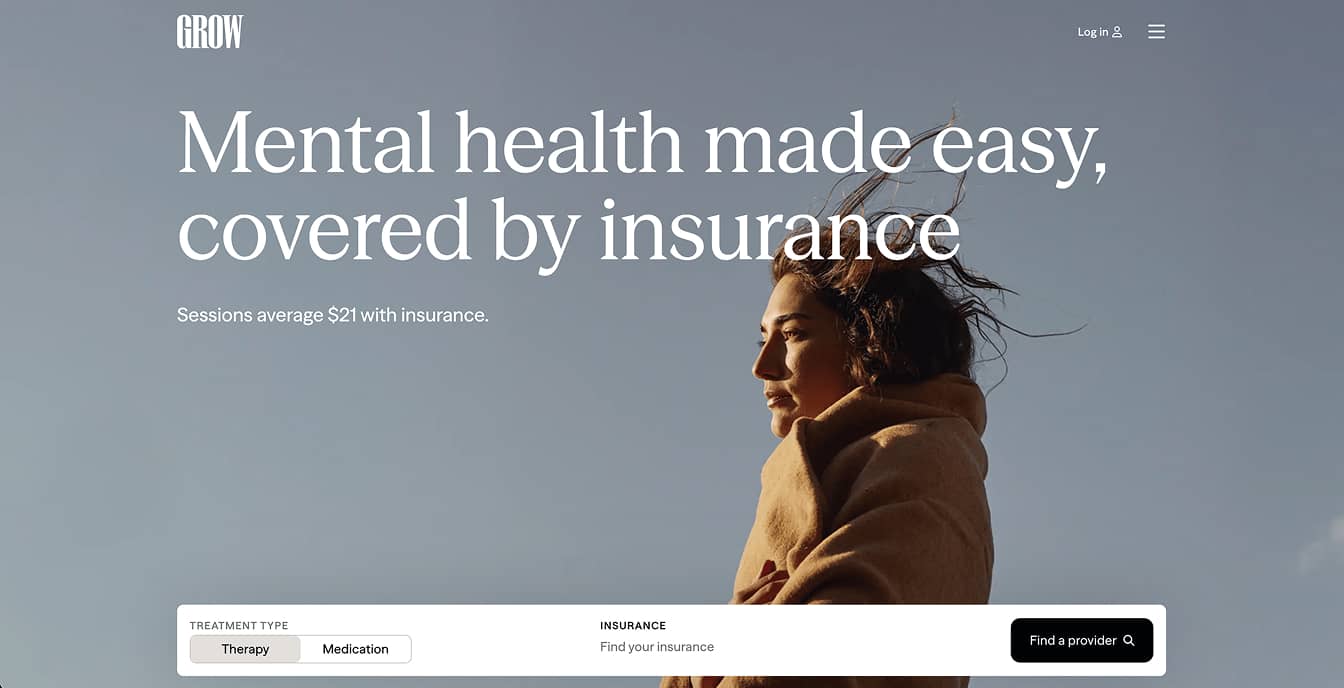
Grow Therapy is an insurance-accepting therapy platform with providers that specialize in online treatment for OCD, including ERP. You can browse the nationwide network of more than 25,000 therapists and prescribers and filter by identity, insurance, language, availability, and specialty, such as exposure therapy.
Depending on the provider you choose, sessions are available virtually or in person, and you can schedule, reschedule, cancel, or switch therapists. Because Grow Therapy works with a wide range of plans, including Medicare and Medicaid in some states, many clients pay a standard copay rather than a monthly subscription fee.
The platform also offers medication management alongside talk therapy, which is useful for OCD specifically. SSRIs are commonly used alongside ERP, and keeping both parts of treatment in one place means less coordination work for you.
Cost and insurance
- Accepts 135+ insurance plans, including Medicaid and Medicare (availability varies by state)
- With insurance: Most clients pay an average of $21 per session, while some pay as little as $0 (depending on their plan)
- Without insurance: $75-$250 per session (pay-per-session, no subscription fees)
Who it’s a good fit for
Grow Therapy fits people who want to choose their own OCD provider, use insurance, pay session by session, or coordinate therapy and medication management in one place.
| Pros | Cons |
|---|---|
| Online and in-person therapy options | In-person options vary by location |
| In-network cost estimates before booking | Out-of-pocket pricing varies by provider |
| Transparent per-session pricing | |
| Search and filtering tools to find the right provider for OCD and ERP |
2. NOCD
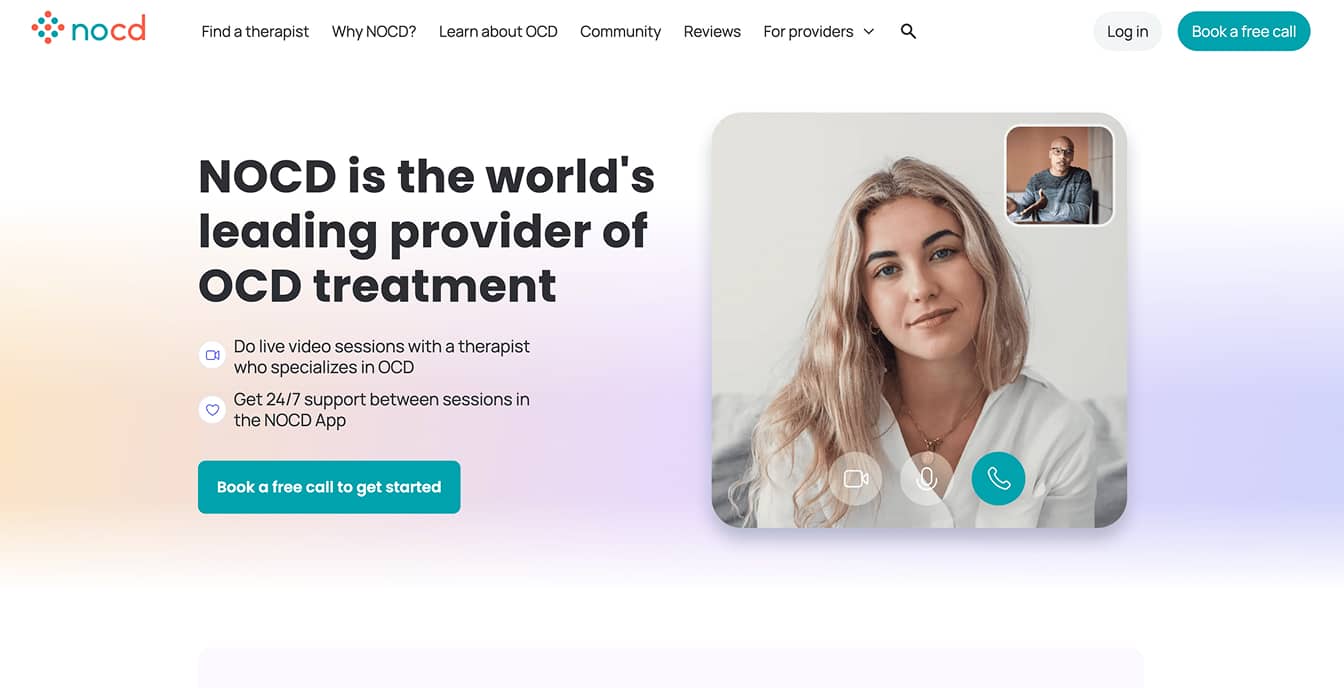
NOCD is built exclusively around online OCD therapy and treatment options. The platform’s providers are all trained in ERP, and treatment pairs live video sessions with education between appointments.
What’s included:
- Options for individuals aged five years or older
- Care for all OCD subtypes
- Family involvement for younger clients
- A peer support community
- Exposure-tracking tools
Cost and insurance
- With insurance: $0 to $50, depending on your plan
- Without insurance: An interest-free payment plan of $95/week, or 30-minute sessions at $120, 45-minute sessions at $180, and 60-minute sessions at $240
Who it’s a good fit for
NOCD is a strong fit for those who want certainty that their therapist is ERP-trained and like the idea of structured support between sessions.
| Pros | Cons |
|---|---|
| All therapists are specialty-trained for OCD treatment | Does not support medication management |
| Messaging and structured tools | No care for conditions outside the OCD spectrum |
| Available in all 50 states |
3. Talkspace
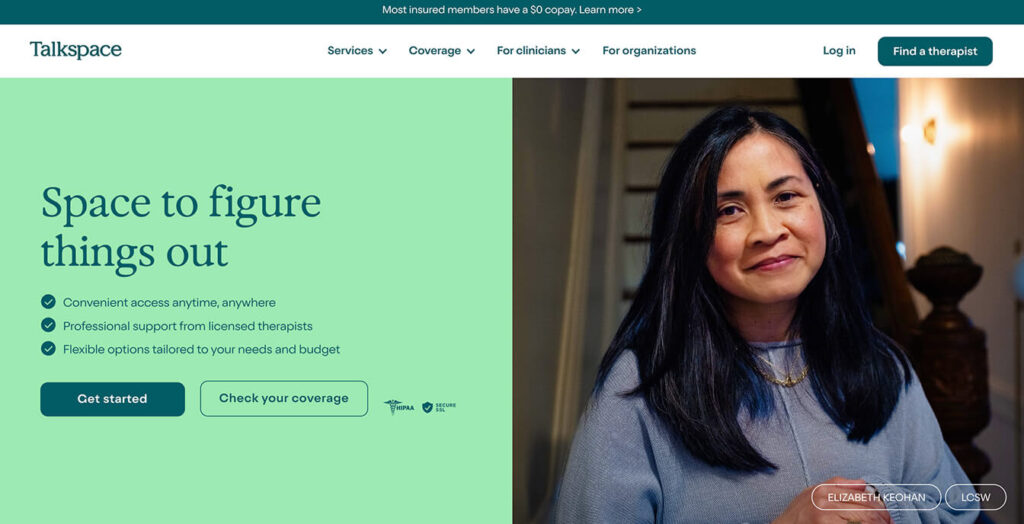
Talkspace pairs messaging-based support with live video sessions, and it’s in-network with many major plans. It is a general-purpose platform, so OCD treatment experience varies by provider.
The platform covers:
- Access to licensed therapists in two days
- Talkcast personalized podcasts
- Options to switch providers at no cost
Cost and insurance
- With insurance: Average copays between $0 and $25/session
- Without insurance: Typically $69 to $109/week with additional sessions available for $69/meeting
Who it’s a good fit for
Talkspace works well for those whose plan is in-network and who value messaging outside of sessions.
| Pros | Cons |
|---|---|
| Video, phone, and text-based therapy | Messaging-first format doesn’t suit everyone |
| Flexible scheduling with evening and weekend availability | Doesn’t accept Medicaid |
| Psychiatric support |
4. Talkiatry

Talkiatry connects users to board-certified psychiatrists, and therapy is available alongside that care rather than on its own. It’s a psychiatry-first platform that serves clients from childhood through adulthood.
Users of Talkiatry gain:
- Psychiatric evaluations and ongoing medication management
- Only in-network providers
- A partnership with NOCD for ERP referrals
- Care access in 45 states
Cost and insurance
- Self-pay is not accepted
- With insurance: $30 or less for most patients (varies by plan)
Who it’s a good fit for
Talkiatry may be a good fit if medication is a central part of your OCD treatment and you have in-network coverage.
| Pros | Cons |
|---|---|
| Board-certified psychiatrists | No self-pay option |
| Thorough mental health evaluations | Not available in all states |
| Options for kids, teens, and adults | Medication-focused rather than ERP-focused |
| Individuals needing ERP-focused care may be referred away from the platform |
5. Brightside Health
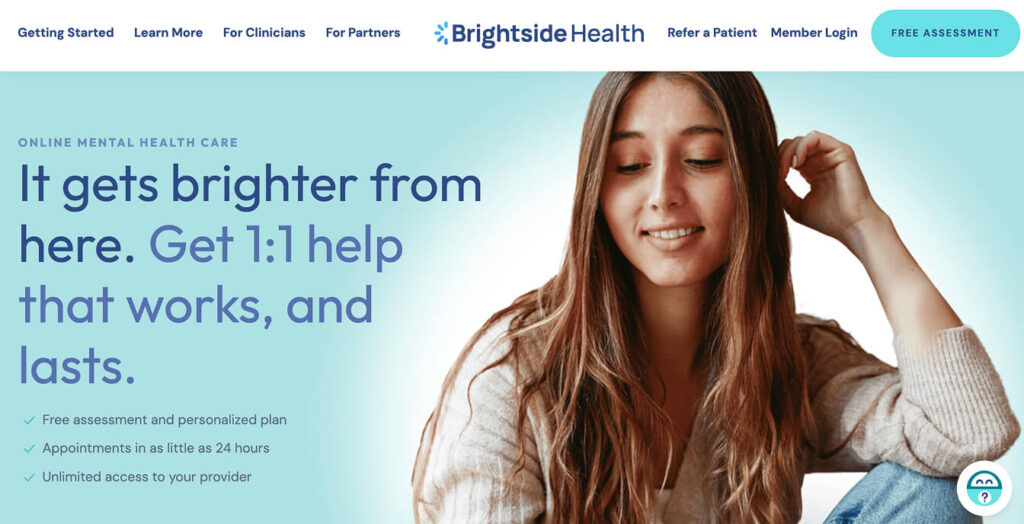
Brightside Health is built around structured, measurement-informed care and lists OCD among the conditions it treats. Care comes in monthly plans that bundle a set number of video sessions with unlimited messaging, and psychiatry can be added separately.
The platform offers:
- Crisis care for adults
- Therapy, psychiatry, or both in one plan
- A free assessment and personalized plan
- Options for appointments in as little as two days
- Virtual intensive outpatient program in select states
Cost and insurance
- With insurance: Varies by plan
- Without insurance: Starting at $95/month for psychiatry-only, $299/month for therapy, and $349/month for combined plans
Who it’s a good fit for
Brightside Health suits those who want therapy and medication coordinated under a single plan and may be a good fit for those seeking higher levels of care.
| Pros | Cons |
|---|---|
| Self-guided therapy content | No in-person treatment options |
| Coordinated therapy and medication management | Session count is capped by plan |
| Free assessment and personalized treatment plan | Payment for subscriptions occurs even when treatment isn’t used |
6. BetterHelp
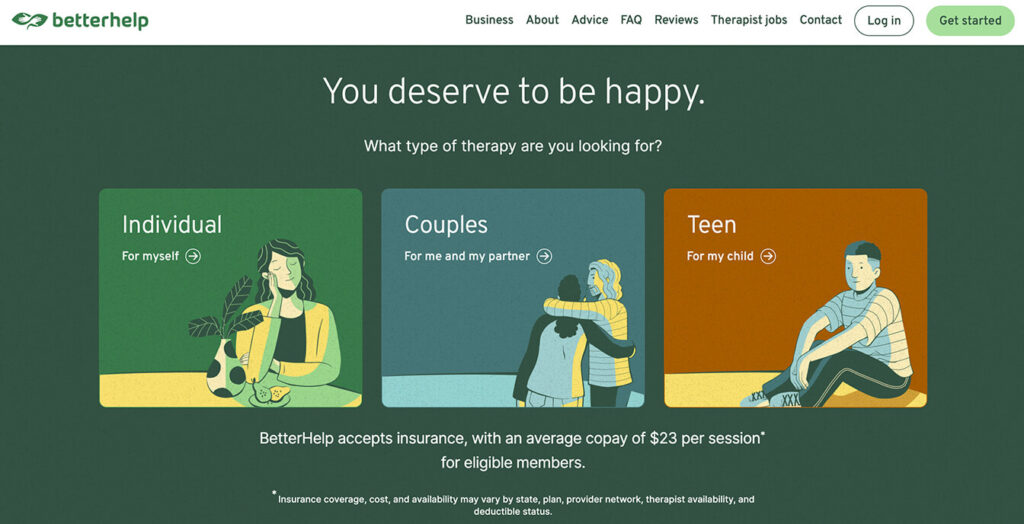
BetterHelp is a therapy platform that offers OCD support. Users complete an intake questionnaire, connect with a therapist, and communicate by video, phone, live chat, or messaging.
For BetterHelp, it’s worth knowing that:
- Weekly group webinars are available
- You gain unlimited messaging with your therapist
- Therapists are recommended based on needs and conditions
Cost and insurance
- With insurance: Eligible members’ copays average $23/session
- Without insurance: Subscriptions typically cost $70 to $100/week
Who it’s a good fit for
BetterHelp serves insured and uninsured individuals who value multiple communication formats.
| Pros | Cons |
|---|---|
| Live chat, phone, and video sessions | Insurance acceptance is limited |
| Regular appointments for a consistent cost | Psychiatry is offered through a secondary platform |
| Access to group webinars and digital tools | Users pay a subscription fee rather than a session fee |
7. Charlie Health
Charlie Health delivers a virtual intensive outpatient program (IOP) for individuals aged eight to 64. Its OCD program runs six to 12 weeks and combines individual therapy with peer group and family sessions.
IOP patients with Charlie Health receive:
- Three group sessions and one individual therapy session per week
- Treatment for co-occurring conditions like depression and anxiety
- Psychiatry as part of the program
- Family-inclusive care
Cost and insurance
- Program costs vary by patient
- With insurance: Charlie Health’s IOPs are billed as a whole program rather than per session
- Without insurance: Self-pay is available in select states, with payment plans.
Who it’s a good fit for
Charlie Health fits those whose OCD symptoms are significantly disrupting daily life, or who have recently experienced a symptom-related crisis or hospitalization.
| Pros | Cons |
|---|---|
| A higher level of care than weekly therapy | Significant weekly time commitment |
| Expert-led peer groups | More intensive than some people need |
| HIPAA-compliant, private, and secure care | Pricing isn’t published upfront |
| Flexible scheduling |
8. Calmerry
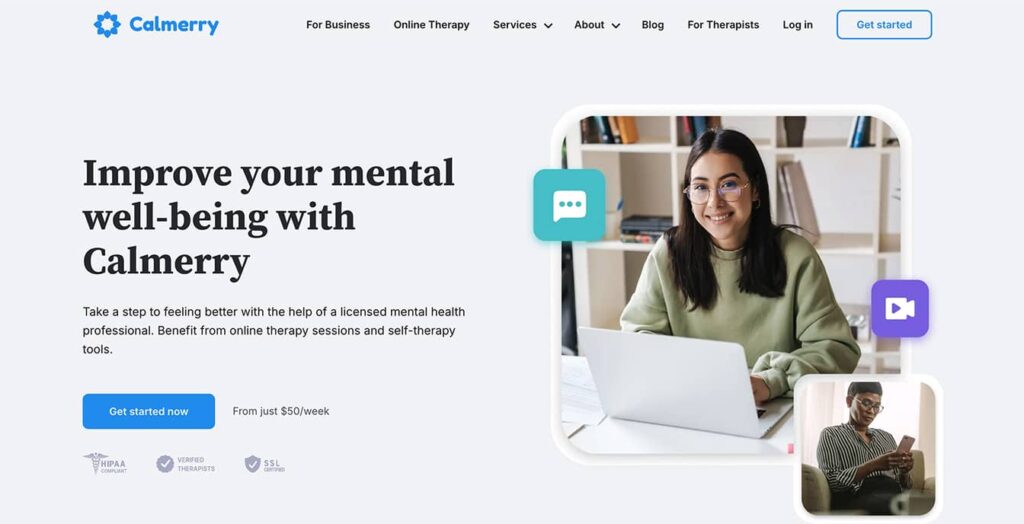
Calmerry is a subscription-based platform that offers unlimited messaging and optional 30-minute live video sessions, depending on your plan. Its cash-pay-only plans are available for adults aged 18 or older.
What’s included with Calmerry:
- 24/7 access to journaling and tracking tools
- Evening and weekend scheduling
- Client-counselor matching
- Evidence-based models, such as cognitive behavioral therapy (CBT)
Cost and insurance
- Receipts for reimbursements are available
- Without insurance (billed monthly)
- Messaging: First month is $49.50/week, then $57/week on renewal
- Four live videos: First month is $54.50/week, then $62.50/week on renewal
- Two live videos + messaging: First month is $66/week, then $77.50/week on renewal
- Four live videos + messaging: First month is $73.75/week, then $90/week on renewal
Who it’s a good fit for
Calmerry is a reasonable option for those who are uninsured and appreciate between-session features, such as unlimited messaging and journaling.
| Pros | Cons |
|---|---|
| Unlimited messaging included | Does not accept insurance |
| Multiple messaging and video tiers | Medication management is not offered |
| Can cancel at any time | Live sessions capped by plan |
Did you know?
A study on the effectiveness of telehealth in treating OCD found that remote ERP can effectively improve both OCD and co-occurring conditions. This format helps overcome some traditional barriers to treatment, including accessibility to trained providers.
What to look for in an online OCD therapy provider
When you’re caught between intrusive thoughts and the compulsions that ease them, the therapy that helps most is the kind built for that specific OCD loop. To find a provider equipped to support your needs, use these questions as a screen before you book:
- Do they accept your insurance? Coverage often varies by state and product, so inquire about your specific plan (not just the carrier).
- Are they trained in ERP? ERP is a structured, protocol-driven treatment, and listing OCD as a specialty isn’t the same as being trained to treat it. Ask how the clinician was trained, and how much of their current caseload involves OCD or anxiety disorders.
- Do they treat your specific OCD subtype or co-occurring conditions? OCD shows up in many forms, from contamination fears to intrusive harm thoughts. Co-occurring conditions like anxiety or depression may also surface, so ask whether the provider has experience with your particular presentation.
- Do they offer psychiatry or medication management? Some people benefit from medication alongside ERP. If you believe this may become part of your plan, consider looking for a provider or platform that offers both to simplify your treatment coordination.
- Can you browse and select a provider yourself? Reading profiles and credentials to choose your own clinician makes it easier to verify ERP training and switch providers if necessary.
- Do they offer flexible appointment availability? ERP requires real work between sessions, so consistency matters. Evening and weekend availability may make it easier to show up regularly.
- Do they support more treatment-resistant symptoms? If symptoms are taking over your day or you’ve tried treatment without progress, ask whether the platform offers a higher level of care, such as an intensive outpatient program, or can refer you to one.
Find the right OCD therapist through Grow Therapy
ERP challenges you to sit with the discomfort that an obsession creates, and skip the rituals that could bring temporary relief. This isn’t a small ask, which is why the best online OCD therapy involves an ERP-trained provider you trust enough to follow into an exposure you’d rather avoid.
Grow Therapy lets you screen each provider and find a therapist who specializes in OCD before committing. If the provider isn’t the right fit, you can switch at no additional cost. And if they align with what you need, you can book based on their availability and only pay for the care you receive.