
Attention-deficit/hyperactivity disorder (ADHD) in relationships often feels different from how it looks. One partner with ADHD may have difficulty managing time, while the other may find themselves hovering over their significant other’s schedule, growing frustrated over what they perceive as a lack of attention. In many cases, both people can feel misunderstood or alone in the same relationship.
This guide walks through the most common friction points, why they develop, and what actually helps, including when to consider professional support.
Key takeaways
- ADHD affects both partners in a relationship — the partner with ADHD may struggle with attention, follow-through, and emotional regulation, while the non-ADHD partner may feel unheard, overburdened, or emotionally distant.
- Undiagnosed ADHD often intensifies relationship friction over time, because neither partner has a shared framework for understanding the patterns they’re experiencing.
- Common ADHD relationship dynamics — like the parent-child dynamic, the criticism-defense cycle, and unequal household labor — are predictable and, with the right strategies, workable.
- Practical tools like shared systems, ADHD-friendly communication, and strength-based task division address the neurological roots of relationship strain rather than assigning blame.
- Professional support, including couples therapy and individual ADHD treatment, can meaningfully reduce the symptoms and patterns that most strain ADHD relationships.
How does ADHD affect relationships?
ADHD is a neurodevelopmental condition characterized by patterns of inattention, hyperactivity, and impulsivity that interfere with daily life. While it’s most commonly associated with childhood, the condition frequently persists into adulthood.
Because ADHD and ADD symptoms exist on a spectrum and vary significantly from person to person, no two ADHD relationships look the same. However, there can be a felt distance, even without any actual emotional withdrawal.
According to Joseph Melendez, a licensed clinical social worker, a non-ADHD partner may feel this distance more. “The non-ADHD partner often describes it as looking inside a house from the outside. No matter how hard [they try] to see in the house, [they’re] always looking from the outside.” This feeling of distance and disconnection, however, can be felt by any partner.
Here’s what that distance often looks like from both sides of the relationship:
| Category | ADHD partner experiences | Non-ADHD partner experiences |
|---|---|---|
| Attention | Genuinely forgetting conversations, plans, commitments, or important dates, and becoming frustrated with themselves | Feeling unheard or like they have to repeat themselves constantly |
| Communication | Being interrupted mid-thought, losing the thread of long conversations, or struggling to track multi-part requests | Feeling like they’re not getting through, or that conversations don’t lead anywhere |
| Emotional dynamics | Intense reactions that may feel disproportionate to situations, but also feeling unable to control or regulate them | Worried for their partner’s well-being while feeling unprepared for potential escalations |
| Intimacy | Early hyperfocus on a partner that naturally shifts over time, and difficulty being present during low-stimulation moments | Feeling intensely connected during the early stages of the relationship, followed by a shift that can feel like withdrawal |
| Household responsibilities | Genuinely intending to complete tasks but struggling with initiation, follow-through, or knowing where to start | Carrying more responsibility for chores and tasks, often without either partner fully realizing it |
The effect of undiagnosed ADHD
When ADHD goes undiagnosed, neither partner has a framework for understanding their relationship dynamics. This condition also often goes undiagnosed in women and girls, which can increase friction between partners caused by a lack of information or knowledge of how their (or their partner’s) brain works.
Unaddressed patterns tend to intensify over time, particularly as the executive functioning demands of everyday life grow. The multiplication of shared responsibilities, such as finances, parenting, and household management, can also increase tension. This is especially true if one partner is suffering from ADHD symptoms like time blindness and a lack of organization, which can affect memory and follow-through.
Many individuals with ADHD genuinely want to show up for their partners, though their undiagnosed symptoms may make it overwhelming or feel impossible. Testing for ADHD and receiving a diagnosis, even in adulthood, can be genuinely reorienting, giving partners a shared framework and a different starting point for unresolved conversations.
Common symptoms in ADHD relationships
The symptoms of adult ADHD don’t disappear when someone enters a relationship. Instead, they tend to become more visible because relationships require consistent attention, communication, and follow-through.
The table below covers several common symptoms that may impact how a person shows up in their relationship, along with what those symptoms may look like.
| Symptom | Definition | What it looks like |
|---|---|---|
| Inattention | Difficulty sustaining focus, following conversations, or completing tasks without drifting | • Forgetting important dates • Zoning out mid-conversationMissing details of discussed plans |
| Emotional dysregulation | Difficulty keeping emotional responses proportionate to a situation | • Escalating quickly during disagreements • Expressing frustration in ways that feel outsized to the trigger • Cycling through highs and lows in a single day |
| Rejection sensitive dysphoria (RSD)* | An intense emotional response to real or perceived rejection or criticism | • Interpreting feedback as an attack • Shutting down or responding with anger when a concern is raised • Seeking frequent reassurance |
| Hyperfocus | The ability to concentrate intensely on something stimulating or novel | • Focusing intensely on a partner, then appearing to withdraw • Putting intense energy into a hobby while neglecting shared responsibilities |
| Poor organization | Executive function difficulties with planning, sequencing, and task initiation | • Failing to follow through on household tasksLosing track of shared responsibilities • Struggling to plan ahead for important events |
| Impulsivity | Acting on urges without pausing to consider consequences | • Interrupting conversations • Making financial decisions without a partner • Reacting strongly during conflict |
| Time blindness | A neurological difficulty in perceiving how much time is passing | • Chronic lateness to shared plans • Consistently underestimating how long tasks take |
| Avoidance | A motivation-driven pattern where the brain resists tasks that don’t provide immediate engagement or stimulation | • Delayed completion of important but unstimulating responsibilities • Avoiding asking for help • Steering clear of phone calls |
The strengths ADHD brings to relationships
While there are some downsides, many partners with ADHD bring distinct strengths, like:
- A heightened capacity for creativity and spontaneity
- An ability to hyperfocus on a partner or problem with intensity
- A deep well of empathy shaped by years of navigating a world not built for their brain
- A genuine enthusiasm for ideas and experiences that can make a relationship feel alive
When both partners understand the full picture of challenges and strengths together, it becomes possible to build a relationship around the people, not the symptoms.
The most common ADHD relationship patterns
Many adult ADHD relationships experience similar dynamics because ADHD creates predictable conditions. Recognizing these patterns is the first step toward stepping outside them.
The parent-child dynamic
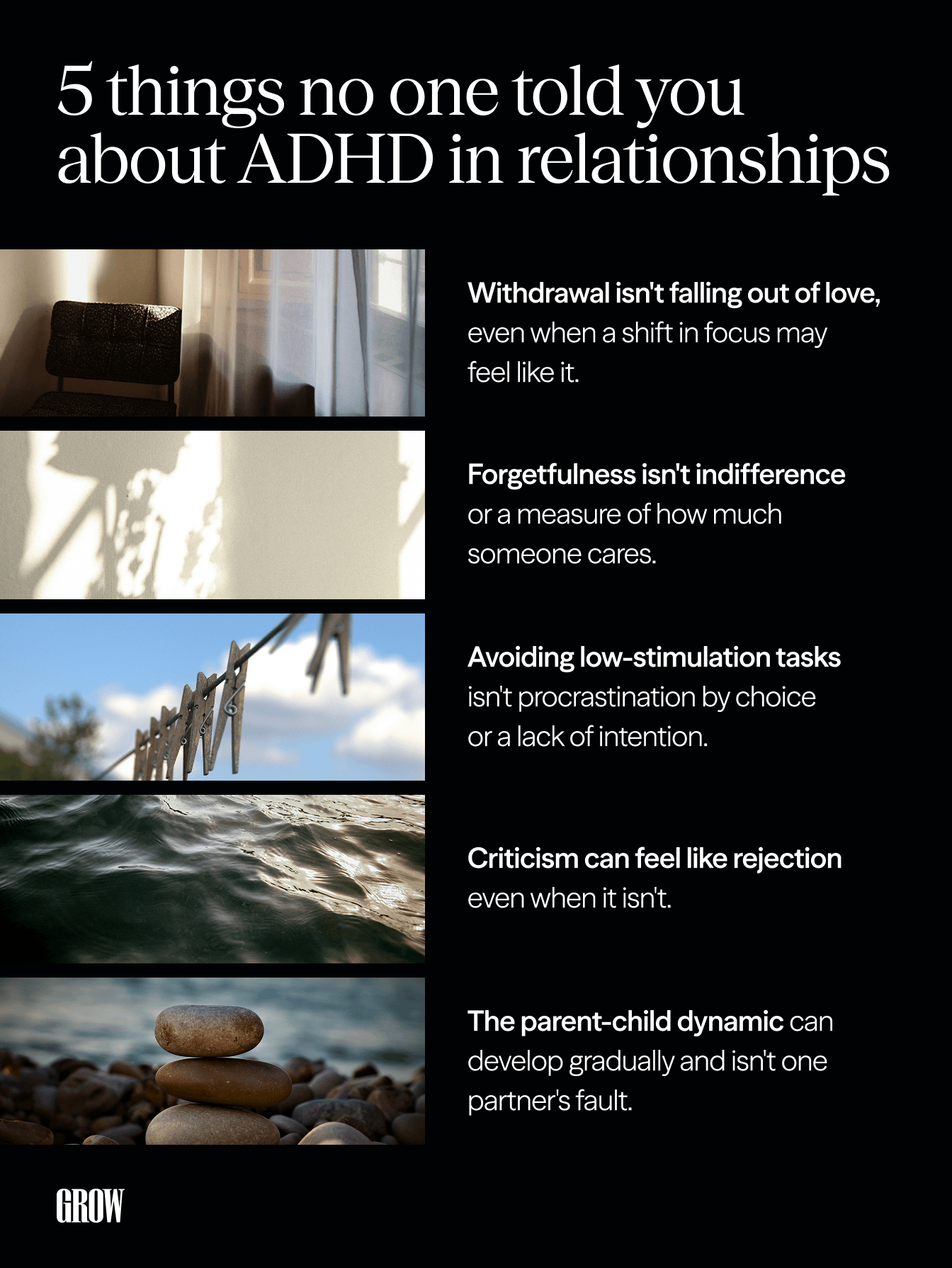
The parent-child dynamic is one of the most common (and damaging) dynamics caused by ADHD in relationships. It often develops gradually, where a non-ADHD partner fills in gaps while an ADHD-affected partner starts feeling managed and dependent — and sometimes resentful of it.
The result is a relationship that no longer feels like a partnership. In many cases, the non-ADHD partner feels like a caretaker, and the ADHD partner feels infantilized or incapable. While neither partner chooses this dynamic, it can be difficult to break.
The criticism-defense cycle
The criticism-defense cycle can be damaging, especially when the intent behind confrontation is forgotten. In this cycle, when a partner raises a concern, an ADHD partner may experience it as criticism before they hear it as a request. This perceived rejection often leads to an immediate defensive or shut-down response.
The concern typically goes unresolved in this cycle. When a partner raises the concern again, it’s often louder and more urgent, causing the ADHD partner to withdraw further. Over time, this cycle trains both partners to avoid real conversations and creates more distance than the original issue would have.
Unequal distribution of household labor
Research consistently shows that unequal division of household labor is one of the top predictors of relationship dissatisfaction. When ADHD is part of the picture, the imbalance often becomes more pronounced because executive function challenges make initiating and completing tasks harder.
ADHD in relationships may cause a non-ADHD partner to handle more busywork over time, which may lead to a feeling of unfairness that compounds into resentment. Understanding the neurological basis of this imbalance doesn’t erase it, but it moves the conversation away from blame to partnered support.
Strategies that actually help ADHD couples
Whether you’re pursuing ADHD treatment options or want at-home strategies for your relationship, these options address dynamics by embracing how the ADHD brain actually works.
Build relational structure
External structure reduces the cognitive load on both partners. When systems exist, neither person has to rely on memory or goodwill alone.
For example, many couples find that these systems work well:
- Shared calendars with appointments, events, and recurring tasks.
- Regular relationship check-ins at the same time and place to surface concerns before they become arguments.
- A household task board with assigned responsibilities.
- Designated spots for frequently misplaced items like keys, wallets, and chargers.
These types of structures aren’t a sign of distrust. For those with ADHD, these are genuine accommodations that help partners work together instead of against each other.
Separate the behavior from the person
One of the most important reframes for any ADHD couple is learning to distinguish between symptoms and character. For example:
- Forgetting isn’t laziness.
- Impulsivity isn’t selfishness.
- Emotional flooding isn’t manipulation.
Instead of labeling a partner for their unintentional actions, recognizing things like forgetfulness and difficulty following through as symptoms of ADHD changes the kind of conversation that is possible.
Note
Consider reading psychoeducation resources like CHADD or Grow Therapy’s Dating Someone With ADHD resource to learn more about ADHD in relationships.
Communicate in ADHD-friendly ways
Working memory limitations mean that a multi-part conversation can quickly become overwhelming, making single-topic conversations easier for those with ADHD to track and respond to.
Some specific ADHD-friendly communication adjustments include:
- Leading with a specific request rather than a complaint
- Use written follow-ups for important topics.
- Choose face-to-face conversations over phone communication as it’s harder to misread tone and easier to stay present.
- Ask clarifying questions, and don’t hesitate to ask your partner to repeat themselves.
| Non-ADHD-friendly example | ADHD-friendly example |
|---|---|
| “You never tell me where you are.” | “Can you text me when you’re leaving?” |
| “I can’t believe you forgot.” | “I felt disappointed when [situation].” |
| “We’re going to be late again.” | “Just a heads up, we leave in an hour.” |
| “You always start dinner too late.” | “Can you set a timer when you start cooking so we eat before 8?” |
Address RSD directly in conflict
RSD can cause ADHD partners to become defensive or shut down, which isn’t effective for resolving conflict or promoting intimacy. When a conversation triggers an RSD response:
- The non-ADHD partner: Can lead with curiosity rather than frustration by using “I” statements that keep the conversation focused on experience rather than accusation.
- The ADHD partner: Can learn to recognize the physical and emotional signals that RSD is activating and create space to pause before responding.
Physical signals between partners (like a raised hand or a safe word) can become a shared cue that a pause is needed before continuing.
Divide responsibilities based on strengths, not fairness
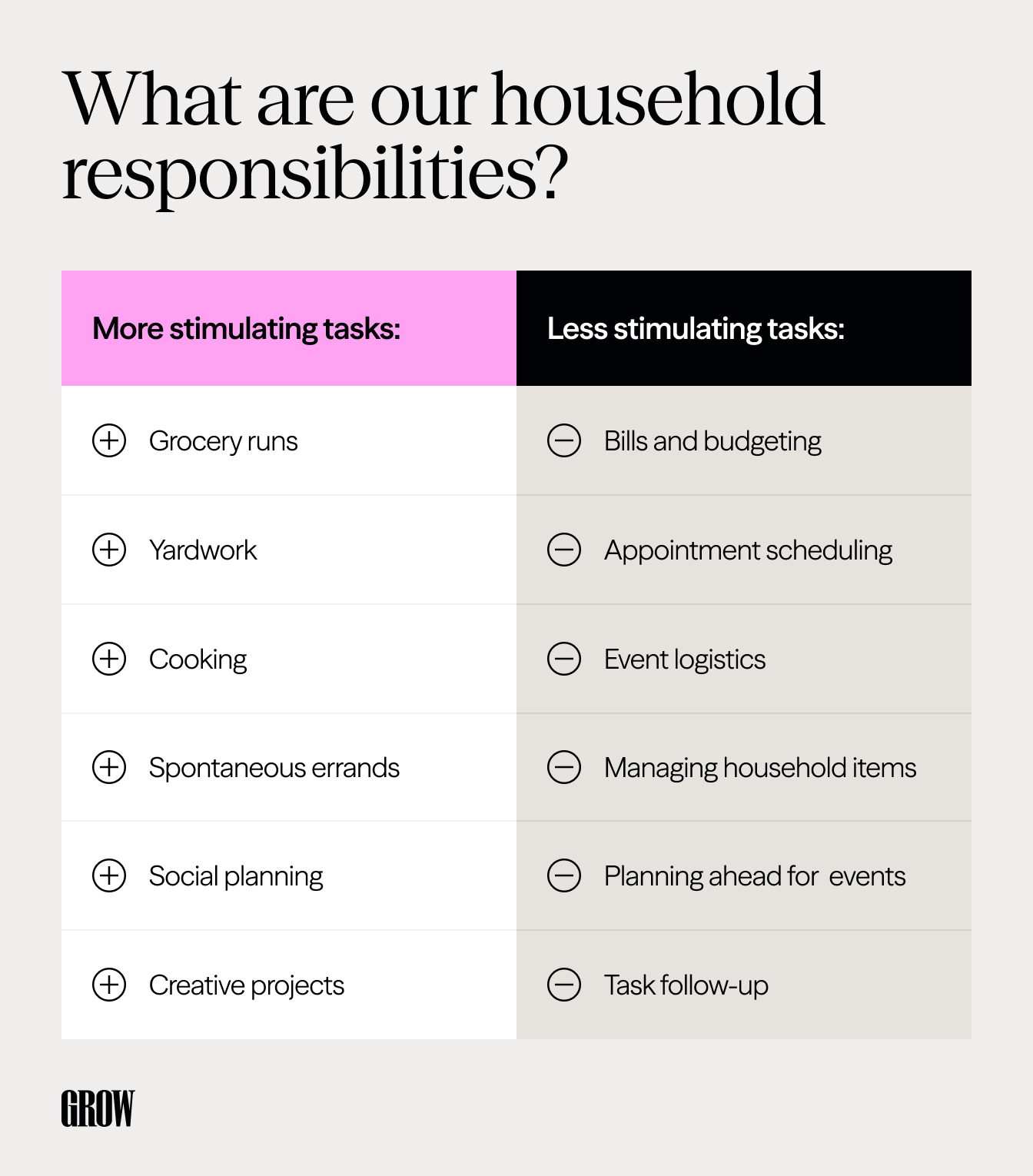
A strict 50/50 split of household responsibilities often backfires because it ignores the reality of how individuals work. Often, a more effective approach is to assign tasks based on each partner’s actual capacity and strengths.
In practice, this might look like:
- An ADHD partner is more likely to take on (and enjoy) physically engaging or stimulating tasks.
- A non-ADHD partner may handle other tasks with intense organization more often.
The goal isn’t to make the split perfectly equal, but instead to make it functional and sustainable for both people.
How to support a partner with ADHD
If you’re the non-ADHD partner, supporting your partner with ADHD doesn’t mean suppressing your own needs or devaluing your experiences. Instead, it means finding ways to show up for both of you, like:
- Learning about ADHD: The more you understand ADHD as a neurological condition rather than a personality flaw, the easier it is to respond to its symptoms without taking them personally.
- Acknowledging your impact: Your frustration, even when understandable, can come across as criticism to an ADHD partner. Don’t manage your feelings away, but find ways to express them through connection.
- Focusing on intention, not action: The disconnect between intention and follow-through is painful and misunderstood, and distinguishing between them can foster connection.
- Protecting your well-being: Individual therapy can be a space to process your experiences without adding relational strain.
How to support your own ADHD relationship
If you’re the partner with ADHD, you may be carrying shame and guilt. You’re not failing as a partner because of your ADHD, but you’re navigating a condition in a context that often wasn’t built to accommodate it.
To support yourself and your partner:
- Work on self-awareness: Understanding your own patterns gives you concrete things to communicate to your partner.
- Collaborate with your partner: The systems that work best in ADHD relationships are built together, so come together to design structures that work for you both.
- Explore treatment options: Therapy for ADHD, like cognitive behavioral therapy (CBT), can meaningfully reduce the symptoms that most strain relationships.
- Consider medication: A therapist or ADHD psychiatrist can help you identify what combination (if any) makes the most sense for your specific situation.
Find professional support for ADHD in relationships with Grow Therapy
ADHD in relationships is one of the most treatable sources of relationship strain, especially when both partners understand its effects.
Whether you’re dating someone with ADHD, managing symptoms yourself, or trying to make sense of a pattern you’ve both been stuck in for years, professional support can offer a clearer path forward. Grow Therapy connects you with licensed therapists and couples counselors who specialize in ADHD and relationships.
Filter providers by specialty, availability, and more to find a provider who feels like the right fit for where you are right now.