
Summer is supposed to be the season that recharges everyone. Workers often count down to their summer PTO for months, then somehow end up just as tired when they get back as they were before they left. Work stress doesn’t take a break just because a person does.
New data shows that stress shows up before the vacation even begins. For some workers, pre-vacation anxiety is part of something bigger. Those who felt significantly more stressed than usual before their last vacation are also more likely to say summer overall is one of their most stressful times of year — 39% versus just 9% of workers who felt calmer than usual beforehand.
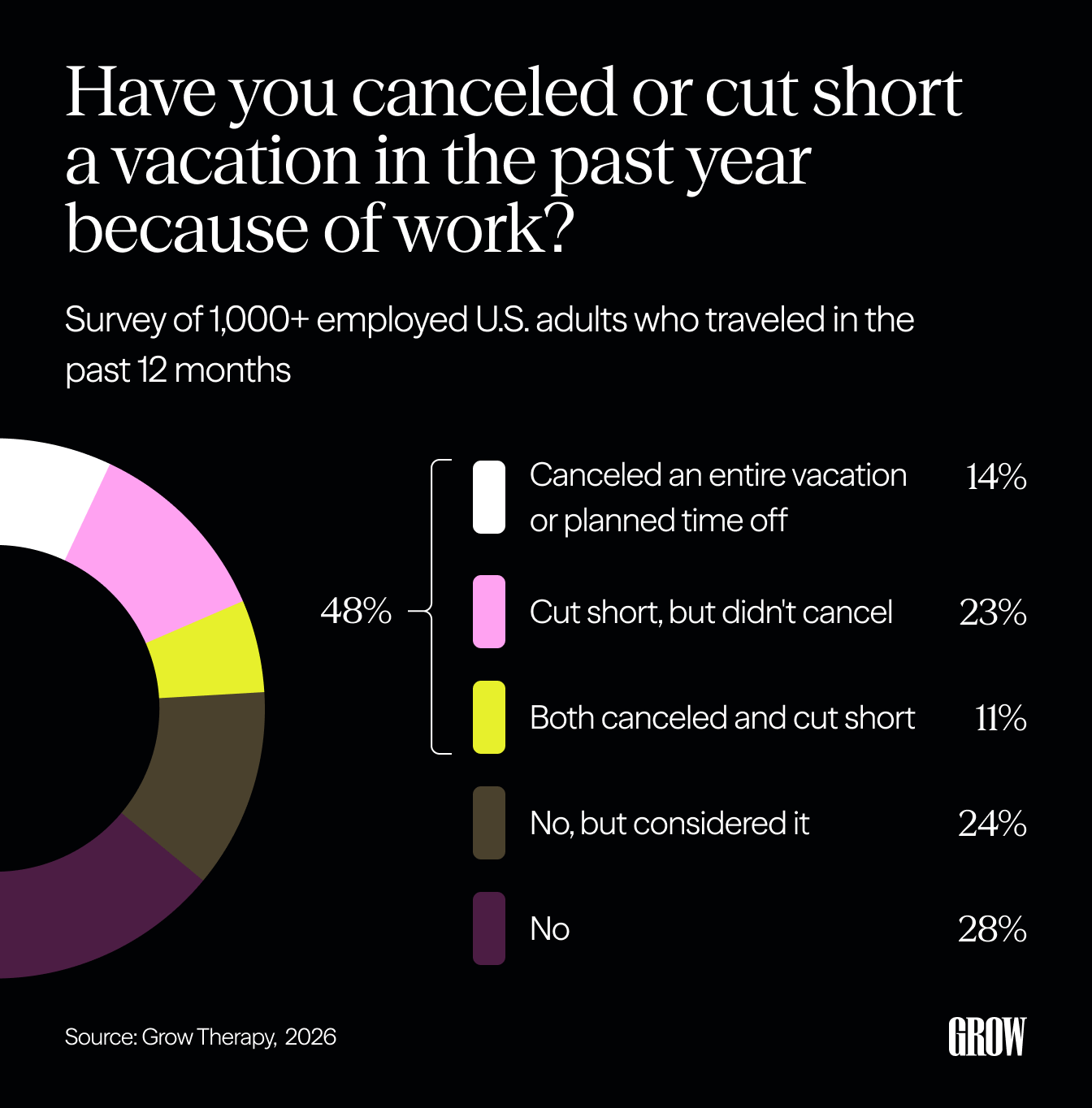
This comes from a national survey of more than 1,000 U.S.-based employed workers about how people’s stress levels change before, during, and after time off. Nearly half (48%) of workers say they’ve canceled a vacation or cut one short in the past year because work got in the way.
Taken together, these numbers tell a pattern: Workers who feel anxious before a break are also more likely to have canceled or cut one short at some point in the past year. Rest is meant to be one of the main results of taking time off. For many workers, it never actually arrives.
“I think so many people feel anxious when taking time off, even if they know they’ve earned it, for the same reason people feel anxious sitting still or sitting in silence. As a society, we’ve gotten so used to scrolling, swiping, managing multiple screens, and functioning at such a fast pace that the stillness and the downtime can confuse our nervous system.”
Heather Rafanello, LCSW
Key takeaways
- Nearly half of respondents say they’ve canceled an entire vacation, cut one short or done both in the past year due to work demands.
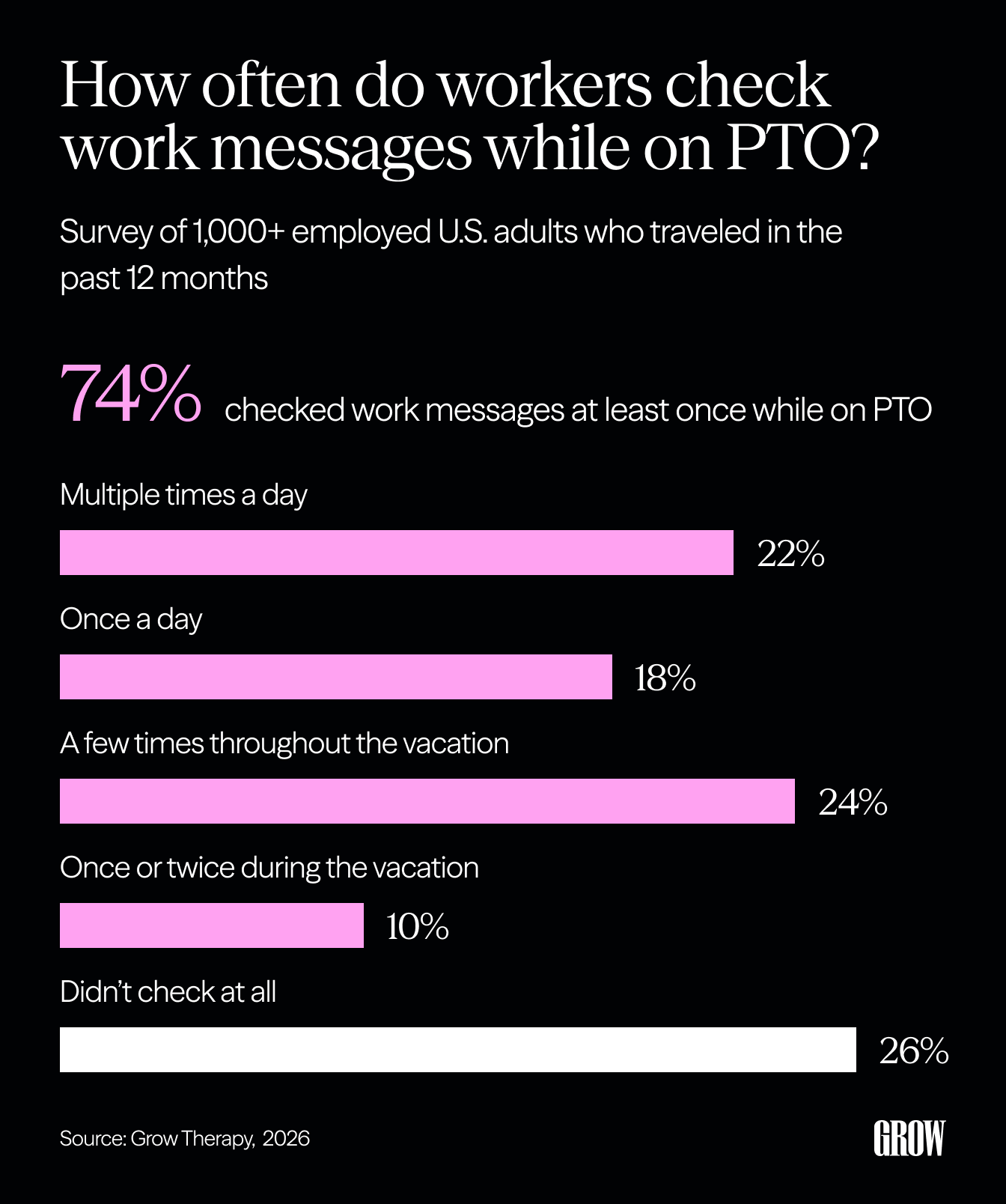
- 74% of employees check work messages while on vacation, with 40% of them checking at least once a day.
- 42% of workers feel more stressed in the week or two leading up to a vacation than during a typical workweek, and 47% returned from vacation feeling the same stress, or even worse.
- 68% would consider therapy to help them manage workplace stress.
Anxious workers skip vacation nearly twice as often as everyone else
Vacation is supposed to be the one appointment nobody cancels. Research from Texas A&M University suggests you shouldn’t cancel that vacation, since travel is linked to better heart health, lower stress, and higher productivity.
But for a lot of people, work manages to get in the way. Nearly half (48%) of the people we surveyed say they’ve canceled an entire vacation, cut one short, or done both in the past year because of work demands.
But work is not the only factor. Money worries and family duties add their own layer of pressure. Financial stress tied to the cost of the trip affects 69% of workers, and family or personal obligations at home affect another 68%, leaving little room to actually unwind once the vacation finally starts.
That pressure may start building well before the suitcases come out, which could help explain why so many workers end up canceling their time off or cutting it short.
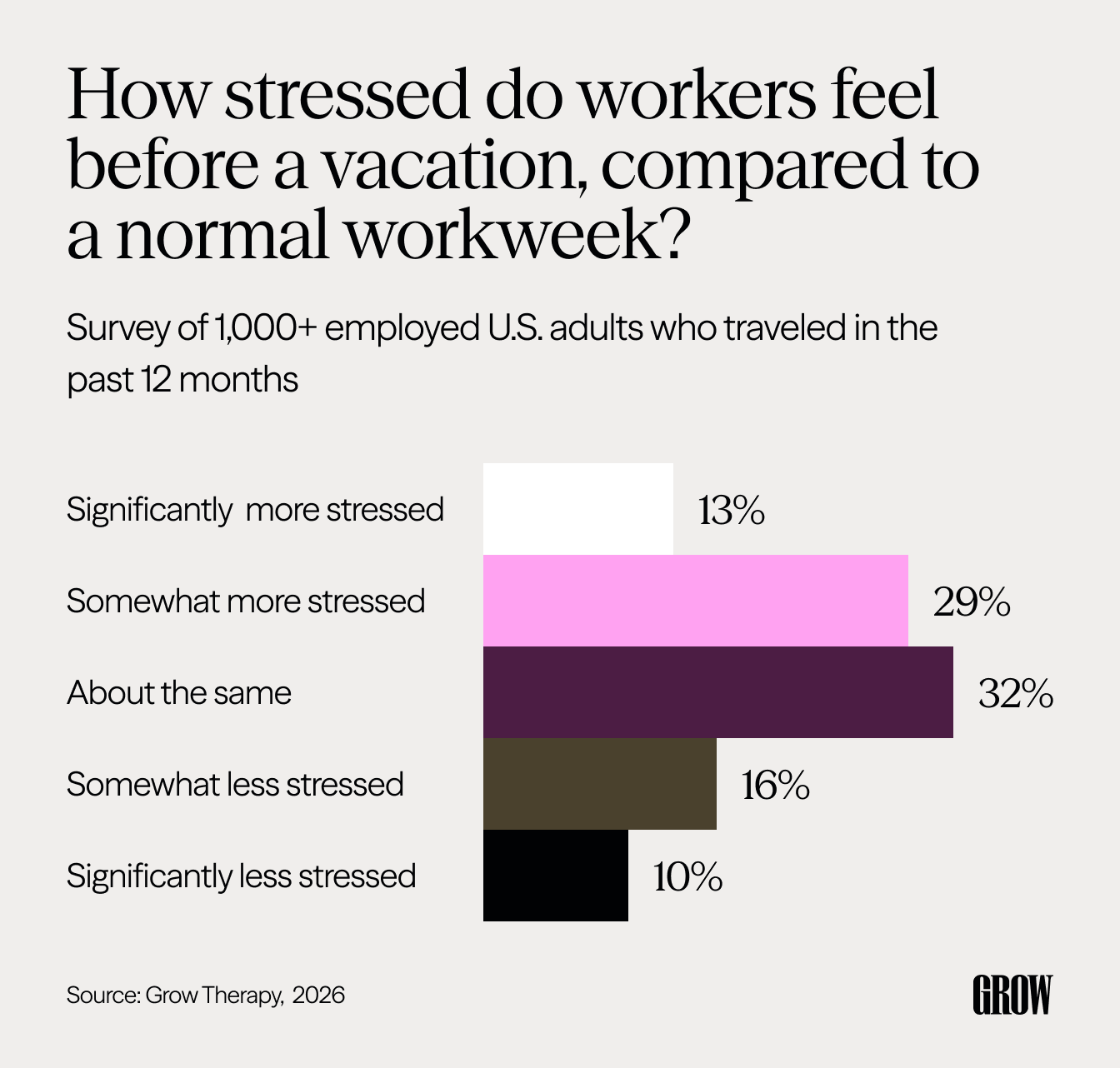
42% feel more stressed before vacation than during a normal workweek
Those financial and family pressures build on top of something even more basic. 42% of workers say they feel more stressed in the one to two weeks before a vacation than during a normal workweek.
Those who said they felt significantly more stressed in the weeks before their most recent vacation were far more likely to have canceled a vacation, cut one short, or done both in the past year, 68% compared to 38% of those who felt only somewhat less stressed.
These aren’t necessarily the same trip, but that’s exactly what makes it notable. It’s the same people showing up on both sides of the data, again and again, suggesting a recurring relationship with time off rather than a one-time coincidence.
Even so, stress and cancellations often appear together enough to suggest a real connection. That stress does not always resolve on its own, and it often carries into the next vacation. That helps explain why 47% of workers return from time off feeling the same, or even more, stressed than before they left.
Who feels this stress the most
Parents feel the stress leading up to PTO more than others. 48% of workers with kids under 18 said they felt more stressed before their last vacation, compared to 36% of workers with no caregiving responsibilities. And that makes sense, since parents are often juggling childcare logistics alongside the same pressures everyone else feels before a vacation.
Caregivers for aging or ill family members report almost identical levels of pre-vacation stress, suggesting the pressure comes from caregiving broadly, not just parenting.
Remote workers are also more likely than hybrid workers to feel significantly more stressed before a vacation, 20% compared to 12%. People often see remote work as the more flexible option, so you would expect it to make stepping away easier, not harder.
Age plays a role, too. 44% of Gen Z workers (ages 18-29) said they felt more stressed before their last vacation, well above the 33% among Gen X workers (ages 46-61). That difference shows up in behavior, as well. Gen Z workers are also far more likely to say they’ve canceled or cut short a vacation in the past year, 58% compared to 34% of Gen X workers. These differences suggest that anxiety about stepping away might ease as people progress in their careers.
The people who need rest the most struggle to unplug
Even when workers do get away, many never really leave work behind. Nearly three in four (74%) checked work messages at least once during their time off, and 40% did so at least once a day. Staying reachable, even briefly, keeps the workday present in the back of someone’s mind, which works against the entire point of taking time off in the first place.
That habit is hardest to break for workers who were already stressed heading into their time off. Those who felt very stressed beforehand checked messages multiple times a day at nearly five times the rate of those who felt only somewhat less stressed, 49% compared to 10%.
Work arrangement plays a role here, too. 85% of hybrid workers checked work messages at least once during their time off, compared with 71% of remote workers and 70% of in-office workers, making hybrid workers the least likely to disconnect fully. Hybrid work is pitched as the best of both worlds, but, in this case, it was the arrangement people have the hardest time leaving behind.
“Do not bring your work phone/Slack/email unless you HAVE to. Set clear boundaries and a plan at work to support [with] feelings of guilt. Taking time to unplug literally takes practice and exposure!”
Alexandra Pelazza, LCSW
68% would consider therapy to learn how to manage workplace stress
A lot of workers already see therapy as part of the answer when caring for their mental health, even if they haven’t tried it yet. 68% would consider working with a therapist on work-related rest, boundaries, and burnout recovery. Interest runs highest among both the workers who felt the most stressed and those who felt the least stressed.
55% of workers who felt significantly more stressed before their last vacation said they’d definitely consider therapy. So did 40% of those who felt significantly less stressed. Compare that to just 18% of workers whose stress level stayed about the same.
There are a few possible reasons for this. Workers under a lot of stress may already know therapy could help, since the need feels obvious. Workers with very little stress may already practice the habits that keep stress low, things like boundaries or downtime, so they already see the value in that kind of support. Workers in the middle may have less reason to think about it either way.
Regardless of where they fall on that spectrum, few workers actually turn to therapy when recovering from work stress. Only 19% said they do, while the leading responses are exercise (48%) and sleep (44%).
Getting genuine rest takes firm boundaries and healthy work habits, which is exactly where therapy fits into the story.
A few ways to protect time off before it starts
Some small boundaries can go a long way before your next trip even starts. Here’s where setting boundaries tends to make the biggest difference.
- Set clear work hours. Decide when the workday starts and ends, then ask coworkers not to reach out beyond that window if your job allows it.
- Treat PTO like part of the job, not something extra. Block it on the calendar and protect it the same way you’d protect a client meeting.
- Say no without a long explanation. A short, clear “no” protects time off just as well as a detailed excuse.
- Set expectations before leaving. Tell the team what messages (if any) will get checked while you’re away, and use an out-of-office reply that gives a return date instead of just saying “I’m out.”
Rest needs more than just a day off
Time off doesn’t automatically turn into rest. The workers we surveyed carried stress into their time off and stayed tethered to their phones the whole time they were away. Most came home just as worn out as when they left, but adding more vacation days won’t fix that. What actually could help is changing how people treat work, both during time off and in the days leading up to it.
Finding a therapist is one place to start
Methodology
The survey was conducted online by Centiment with a total sample size of 1,035 employed U.S.-based adults aged 18 years old and older who have taken a vacation and/or extended time off in the past 12 months. The results are unweighted and have a ±3% margin of error. Fieldwork was undertaken from July 1 to July 9, 2026.