
Whether you’re facing personal struggles, dealing with past trauma, or simply pursuing personal growth, a therapist can provide an invaluable lifeline to help you navigate the complexities of your inner self. However, finding the right therapist can prove daunting since there are so many options and factors to consider.
The reality is that the need for support often peaks during challenging times. According to a recent Grow Therapy holiday stress survey, younger adults (Gen Z and millennials) and women reported higher levels of mental and emotional strain, often putting therapy on the back burner amid year-end obligations.
This highlights the importance of reducing barriers to care, especially during periods when stress is high and time or emotional bandwidth feels limited. Having clear, practical guidance for finding a therapist who ‘gets’ you can make it easier to seek support rather than postponing it.
This article walks through actionable steps and considerations to help you find a therapist and get the most out of therapy when you need support.
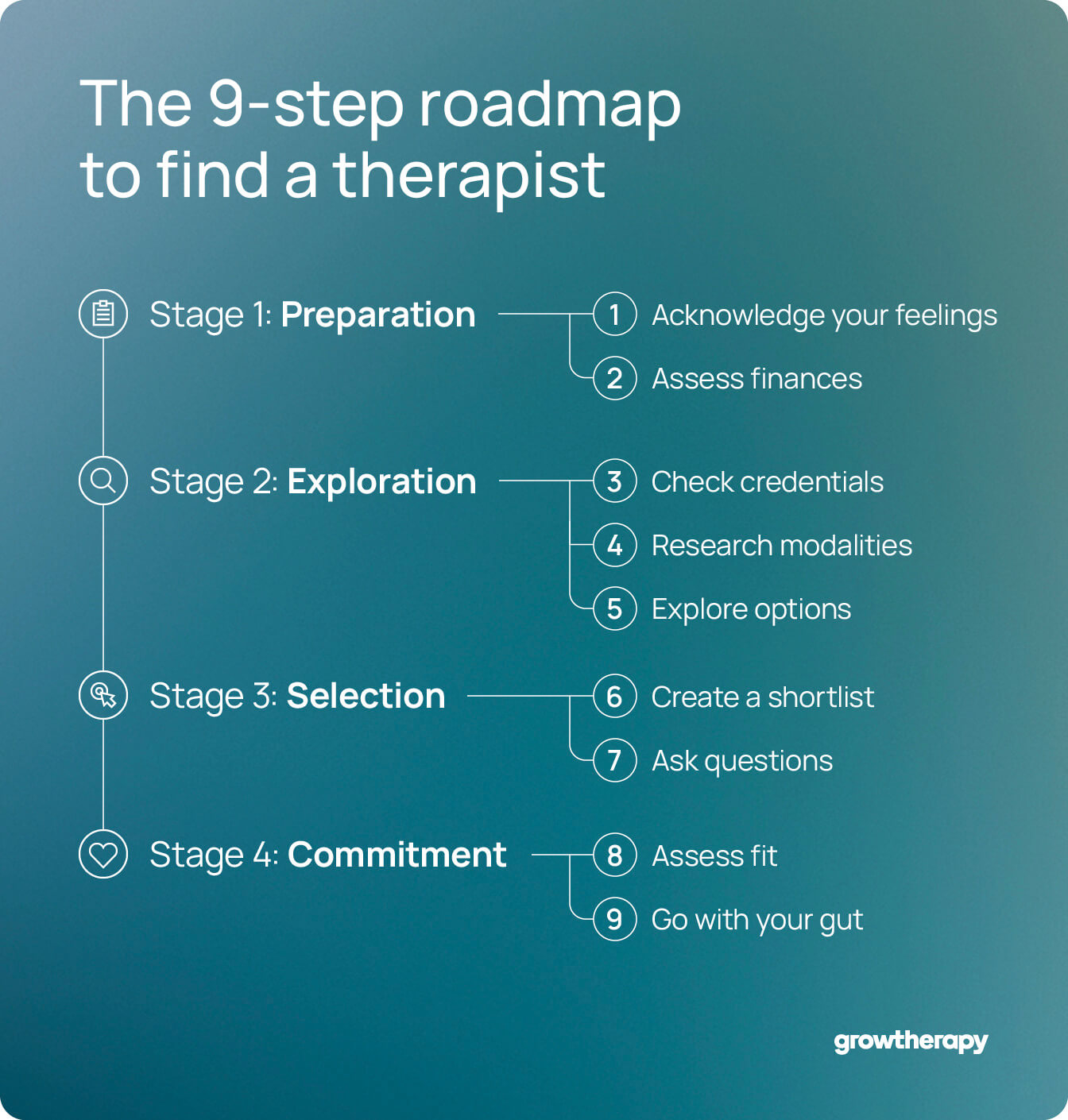
Step 1: Acknowledge your feelings
Before you start clicking profiles, dedicate time to tuning into yourself and acknowledging how you feel. Exploring what’s going on with your feelings can help you define your mental health goals and the specific concerns driving your search.
Even if you’re not sure exactly what you need help with, having a general sense of what’s feeling most pressing can guide your search, whether that means considering a therapist’s background, training, or areas of focus. Therapists are not one-size-fits-all, and the more specific you are about what you need help with, the more effectively you can narrow down specialties.
You might start by noticing what’s been most disruptive lately, such as:
- Trouble sleeping
- Racing or intrusive thoughts
- Difficulty focusing at work, low motivation
- Feeling emotionally disconnected
It’s also helpful to reflect on whether what you’re experiencing feels situational or longer-standing. This context can inform the type of support you explore and can shape early conversations with a therapist, including what to expect in your first session.
Lastly, start to think about what kind of therapist will feel like the right fit for you. Consider factors such as identity, background, and lived experience — for instance, you may want to work with a therapist who shares aspects of your faith, culture, or community.
Reflect on practical details too, like whether you prefer sessions in person, online, or a combination of both, and what areas of specialization or types of therapy feel most supportive for your goals.
Being clear about these preferences early on will make it easier to identify therapists who align with your comfort and needs.
Step 2: Assess your financial situation
You might be thinking that therapy is expensive; however, it’s more accessible than you think. Whether or not you have health insurance, there are convenient and approachable options for almost any budget.
If you have insurance, it can be helpful to check your mental health benefits, either by reviewing your plan details online or contacting your insurer directly.
Coverage can vary depending on your plan type and whether behavioral health services are managed separately. Some plans, such as HMOs, may require referrals or limit you to in-network providers, while others, like PPOs or EPOs, may offer more flexibility. Plan details vary, so checking your specific benefits can clarify your options.
You may ask your insurance provider about your mental health coverage as a starting point, but rest assured that understanding insurance concepts can feel confusing at first. It’s okay if you don’t understand everything right away.
Luckily, finding a therapist covered by insurance is easy using the search filters on Grow Therapy.
If you are uninsured or cannot find an in-network provider, explore sliding scale or low-cost options.
Many private practice therapists offer a sliding scale fee structure based on your income, while community mental health clinics and university training centers often provide highly subsidized care. When you budget for therapy, you should include the session fee plus any necessary transportation or child care costs.
Keep in mind that, when you first start therapy, it typically takes place weekly. Once you build rapport and start making progress, you may want to discuss with your therapist the possibility of switching to every other week. It also usually takes at least 12 sessions to achieve reliable change when treating a mental health issue.
Get a cost estimate
Step 3: Check therapist credentials
Understanding the letters behind a therapist’s name can offer helpful context about their education, licensure, and scope of practice.
While credentials don’t tell the whole story, they can help you understand a provider’s professional background as you explore your options:
- LCSW/LMSW (Licensed Clinical/Master Social Worker): This is a clinician with a master’s degree in social work and advanced clinical training, licensed to provide psychotherapy and diagnose mental health conditions.Social workers are trained to consider individual concerns within broader social, cultural, and systemic contexts.
- LMFT (Licensed Marriage and Family Therapist): This clinician trained to work from a systemic, relational lens, providing therapy to individuals, couples, and families across a range of mental health concerns.
- LCPC (Licensed Clinical Professional Counselor): This person holds at least a master’s degree in counseling or a related field and specializes in psychotherapy. The exact acronym (LPC, LPCC, LCPC) varies according to state-governing licensing boards.
- PsyD/PhD (Doctor of Psychology or Doctor of Philosophy): These providers have doctoral-level education. PsyD programs typically emphasize clinical practice and assessment, while PhD programs often place greater emphasis on research, though many clinicians practice psychotherapy with either degree.
- Psychiatrist (MD or DO): These are medical doctors who specialize in mental health and diagnosing conditions, and can also prescribe medication. Psychiatrists often coordinate care with therapists to provide a combination of medication management and psychotherapy.
- PMHNP (Psychiatric Nurse Practitioner): These advanced practice registered nurses hold specialized training in mental health assessment, diagnosis, and treatment. PMHNPs can prescribe medications, provide therapy, and often collaborate closely with psychiatrists and other mental health professionals to create integrated care plans.
Knowing the difference between these licenses gives you a better sense of a provider’s training background and professional scope, helping you feel more informed as you explore your options.
Step 4: Brush up on therapy modalities
Therapists use various therapy modalities (or approaches and techniques) to help clients address their mental health concerns. Many therapists draw from evidence-based treatments, treatments that have been studied and shown to be effective for certain concerns, while also tailoring their work to each client’s needs.
Some common evidence-based treatments include:
- Cognitive behavioral therapy (CBT): This method’s goals are to spot and change unhelpful thought patterns and behaviors to relieve symptoms. It can be highly effective for anxiety, phobias, and depression.
- Eye Movement Desensitization and Reprocessing (EMDR): This structured approach helps clients process and heal from emotional distress, trauma, and PTSD by activating the brain’s innate healing mechanisms.
- Psychodynamic therapy: This method explores how unconscious thoughts, feelings, and past experiences — especially from childhood — influence current behavior and functioning. It focuses on identifying and changing repetitive, self-defeating patterns.
- Interpersonal therapy (IPT): This is a time-limited approach that focuses on improving current relationships and social functioning. It is highly effective for depression and mood disorders rooted in relationship conflicts, role transitions (like becoming a parent), or grief.
Knowing these evidence-based treatments helps you match your specific concerns with a therapist’s expertise — but by no means do you need to know all of this information before reaching out to a provider. These are simply ways to help you understand how you like to solve problems or explore if there’s a particular method you’re curious to try.
And besides improving therapy outcomes, evidence-based treatment may lower the duration of treatment, consequently lowering your therapy costs.
Step 5: Explore different ways to get help
Once you have a set budget, you can embark on the search. Thanks to concerted efforts to make therapy affordable and accessible, there are now many places to get help:
- Online therapy platforms: Dedicated therapy platforms such as Grow Therapy accelerate the search process by putting thousands of qualified therapists at your fingertips, often allowing you to filter by specialty, insurance acceptance, and more.
- Recommendations: You may lean on trusted friends and family members who’ve had great therapy experiences for referrals.
- Online therapist directories: These are searchable online databases that list licensed mental health professionals and allow you to filter by location, specialty, or credentials.
- Employee Assistance Programs (EAPs): If your employer offers an EAP, you can often receive a set, limited number of free, confidential sessions with a licensed provider. These sessions are best used for short-term issues or to test out the therapy process before committing to a long-term plan.
- Local resources: Colleges, church organizations, and community mental health clinics often offer low-cost therapy services.
- Specialist organizations: If you need specialized help, consider approaching specialist organizations such as the National Center for PTSD and the National Alliance for Eating Disorders.
Comparing these options upfront can help you tailor your search to the care setting that best supports your schedule and your therapeutic goals.
Step 6: Create a shortlist and read reviews
Once you’ve defined your needs in steps one through five — including factors like therapist identity, location, and whether you want in-person, virtual, or hybrid sessions — it’s time to find potential matches. Using a platform like Grow Therapy allows you to filter providers based on insurance, specialty, and modality, quickly creating a manageable list of five to 10 candidates.
| What to do | Questions to ask yourself |
|---|---|
| Read their bio. Look beyond the credentials. A strong profile demonstrates their personality and clinical specialization. | • Does the language used resonate with you? • Do they explicitly mention experience with your specific issue? |
| Get clues about the “fit” by researching their specialties, or if available, patient feedback. This info can provide insight into a therapist’s style. Reviews are a bonus that can help you look for recurring themes. | • Are they described as warm, directive, or challenging? • What are the green flags — do they aim to help patients achieve specific goals? • What are the red flags — were they often late, did they seem not to listen, or were they focused on their own experiences? |
A detailed profile review is essential for assessing a provider’s potential clinical and personal fit before taking the next step.
Step 7: Reach out and ask questions
Once you identify therapists who meets your criteria, you can schedule a 15-minute consultation with your top choices to get an initial sense of their personality and if they’d be a good fit. Most therapists with Grow Therapy have availability within two days.
You should aim to be ready with specific questions to screen for compatibility beyond just checking their specialty and availability.
| Practical questions | Clinical and style questions |
|---|---|
| “What is your typical cancellation policy, and is there a fee for late cancellations?” | “If I came to you with [specific concern, like anxiety], what might the first three sessions look like?” |
| “How often do you usually recommend we meet, especially at the beginning?” | “How do you measure progress in therapy?” |
| “Are you in-network with my insurance?” | “Have you ever worked with what I am looking for help with before?” |
If the therapist responds clearly, professionally, and promptly, that’s a good sign for future communication.
Step 8: Assess whether the therapist is a good fit
After your first session, use that time as an active assessment period.
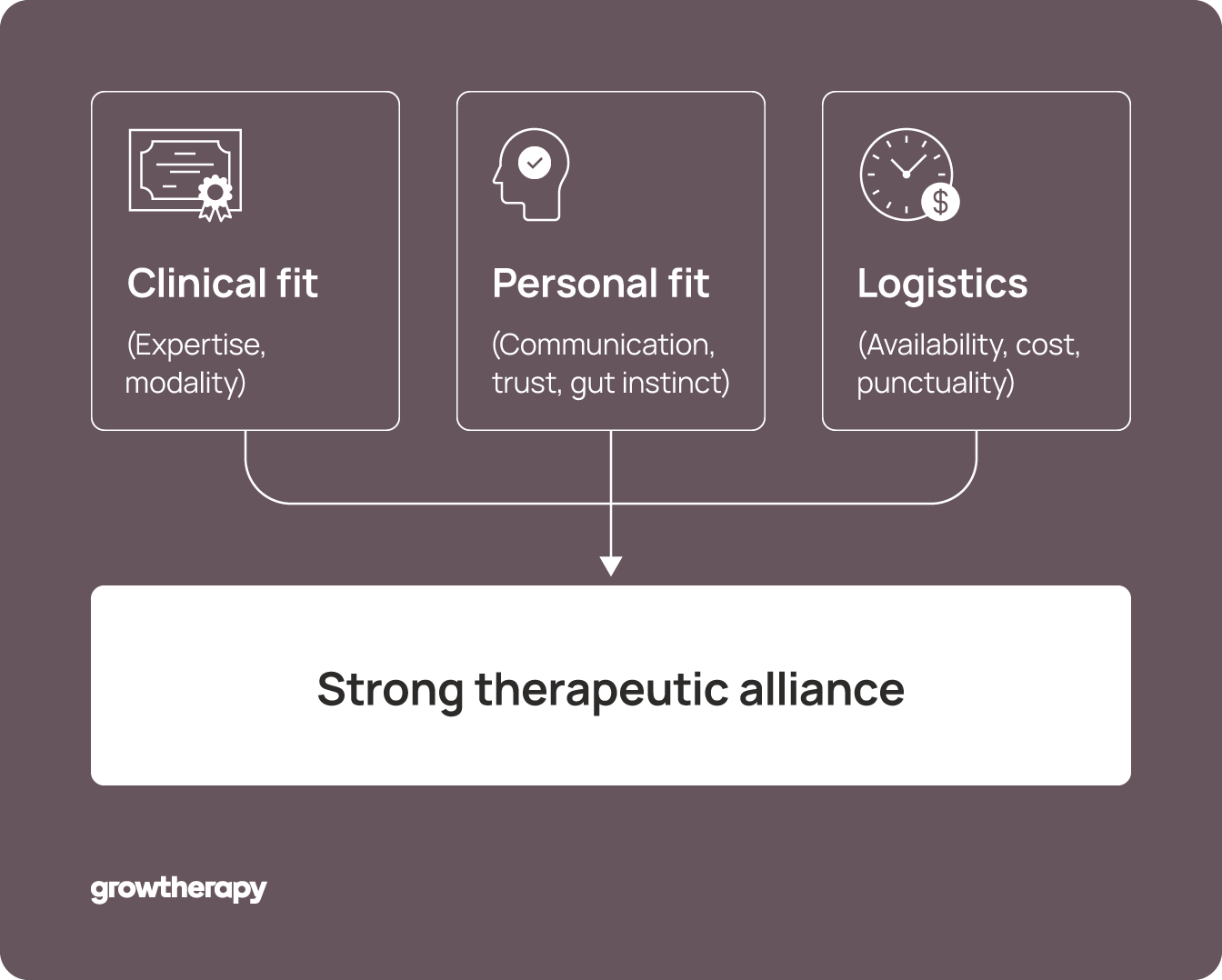
A strong therapeutic alliance is a critical foundation for effective therapy, and feeling like there’s a good fit can play an important role in building that alliance.
Finding the right therapist often involves exploring three key areas: the provider’s clinical approach, how you feel in their presence, and the practical logistics of working together. Over time, as you build rapport and experience sessions, you’ll get a clearer sense of whether the therapist feels like the right fit to help you reach your goals.
| What to do | Questions to ask yourself |
|---|---|
| Evaluate their communication style. Communication is a fundamental part of any therapy relationship, and you should feel comfortable with how your therapist communicates. | • Did they interrupt you or listen patiently? • Did their tone feel empathetic and non-judgmental? • Did they explain complex concepts (like their approach) clearly, or did they use confusing jargon? |
| Focus on their profile and responses. Compare what they said in the session to what you read on their profile. A consistent message indicates professionalism and confidence in their approach. | • Do they seem consistent? • Did they share about their treatment approaches and offer initial thoughts or recommendations based on what you discussed? |
| Check the logistics. Small details like the logistical setup feeling workable, safe, and supportive help you feel more at ease. | • Did the session structure and pace feel manageable for you? • Did the therapist explain logistics clearly (e.g., scheduling, communication between sessions, cancellations)? • Did you feel comfortable with the level of privacy and confidentiality in the session setting? • Did the technology or environment support your ability to focus and feel present? |
Considering these areas can help you get a sense of whether a provider may be a good fit and give you a starting point for deciding whether to continue working together, knowing that clarity and confidence often develop as therapy unfolds.
Step 9: Go with your gut instinct
A strong therapeutic alliance is an important foundation for effective therapy. While guidance can be helpful, your own experience in early interactions matters most. As you speak with a potential therapist, consider how you feel during and after the conversation:
- Do you feel heard?
- Are they empathetic?
- Do you feel comfortable or judged?
- Does their personality feel like a good fit with yours?
Beyond logistics and credentials, consider your gut instinct and use your intuition to answer one primary question: how do you feel when interacting with this therapist?
Working with a supportive therapist who makes you feel comfortable increases the likelihood of successful treatment. A strong and safe therapeutic relationship is an important foundation for effective therapy. If you notice red flags that arise either in the beginning or over time, especially those that affect your sense of safety or trust, it is worth paying attention to them.
Find the right therapist with Grow Therapy
Figuring out how to find a good therapist can feel overwhelming, but having a general roadmap can make the process feel more manageable. Your choice of therapist matters because it shapes how supported, understood, and engaged you feel in therapy. Feeling connected to a therapist who approaches your concerns thoughtfully and uses evidence-informed care can make it easier to stay engaged and experience meaningful change.
Grow Therapy simplifies the search process of finding a therapist by connecting you with a network of verified providers who accept insurance and allowing you to filter by specialty, modality, and schedule. This way, you can more easily find a provider who is the right fit. Most clients pay ~$21 per session with insurance, and some pay as little as $0 depending on their plan.