
Deciding to see a marriage counselor is one of the most meaningful investments a couple can make, especially since 71% of people who have attended couples counseling say it has made a difference in their relationship.
Knowing how to find a marriage counselor, though, is a different challenge entirely, even if you’ve already agreed to attend together. Between understanding licenses, checking insurance, and finding a style that works for both of you, the search can feel overwhelming on its own.
But with the right framework, finding a relationship counselor can be a clear, manageable process that ends with an appointment on the calendar and a path forward for your relationship.
This guide walks you and your partner through the key steps for finding a therapist, from recognizing when you need marriage counseling to your first consultation.
Key takeaways
- Finding a marriage counselor starts with you and your partner aligning on goals, logistics, and preferences before beginning your search.
- Several types of licensed professionals can provide couples therapy — what matters most is their specific training and experience in relationship work, not just their base credential.
- Use a reputable directory to filter by insurance, availability, and specialty, and always conduct a brief consultation before committing to a provider.
- Green flags like a neutral, balanced approach and affirming care matter as much as credentials — and red flags like taking sides or pushing outcomes are worth taking seriously.
- You don’t need to be in crisis to see a marriage counselor. Many couples seek support proactively, before small issues become larger ones.
1. Agree on your preferences and goals
Before looking at your provider options, take time with your partner to align on your goals and what you hope to get from therapy. Starting the search with shared expectations makes it easier to evaluate providers and increases the chances that your decision will be mutually beneficial.
Consider discussing:
- What to work on: Consider specific issues, like trust or emotional distance, and broader patterns you’ve both noticed.
- Successful outcomes: While these may look different for each partner, it’s best to surface these expectations early.
- Logistics and preferences: Know your preferred session frequency, availability, therapist background, cultural or religious considerations, and appointment location (especially in-person vs. online therapy).
One or multiple partners may need to compromise on some of their preferences, but most therapy goals (and each individual) should be respected.
Online or in-person?
Whether you’re looking for in-person or online marriage counseling, Grow Therapy’s platform has options for you. Search licensed providers by location, insurance, and availability to find a provider who fits your life, not just your schedule.
2. Use a reputable directory to evaluate options
Once you’ve agreed on your preferences and goals, a quality directory is the most efficient way to find a marriage counselor near you.
Platforms like Grow Therapy allow couples to browse licensed therapists and find online options that take insurance through a clear filtering process. Plus, you can book a session while reviewing a provider’s listing, simplifying appointment scheduling.
On whichever directory you choose, consider these features when evaluating your options:
- Extensive training in couples therapy or experience with a modality specific to partner work, like Imago or the Gottman Method.
- An explicit mention of couples work in their bio rather than a mention of “couples therapy” in a list of specialties.
- Insurance compatibility with your current plan (if applicable).
Starting with a referral?
Personal recommendations from friends or family can be a helpful starting point, too. Once you have a name, use an online directory like Grow Therapy to confirm whether they’re in-network and to check their availability.
3. Look for providers with specific training
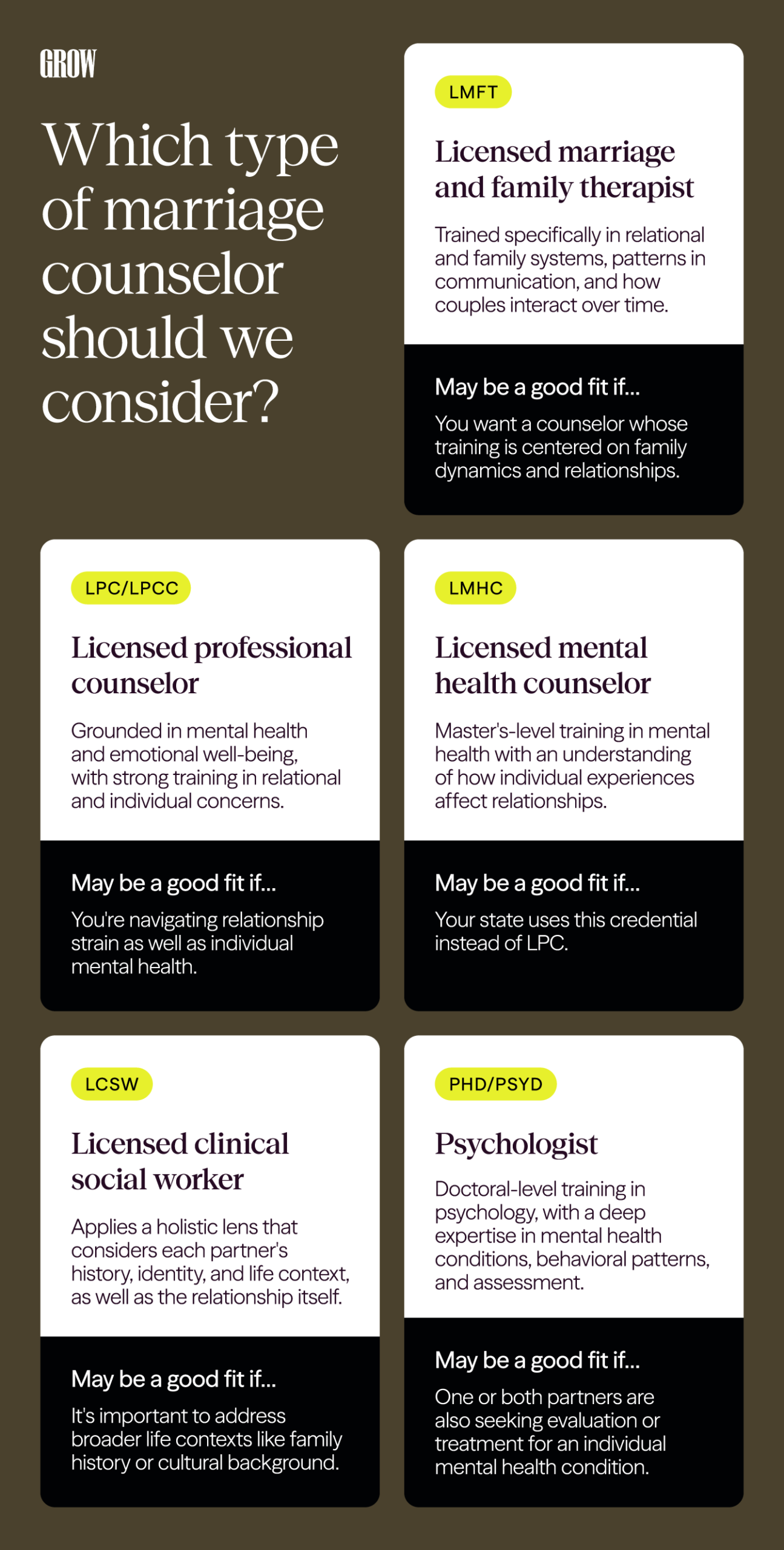
“Marriage counselor” is a broad term, and several different licensed professionals can provide this type of care. The credential matters less than the training and experience behind the title, but knowing what you’re reading in a listing helps you evaluate providers more confidently.
Common credentials that many marriage counselors may have include:
| Provider | Acronym | What they do |
|---|---|---|
| Licensed Marriage and Family Therapist | LMFT | Identify and understand relationship patterns, family systems, and communication dynamics. |
| Licensed Professional Counselor | LPC / LPCC | Use a grounding in mental health, emotional, and relational concerns, as well as individual needs, to understand relationship dynamics. |
| Licensed Mental Health Counselor | LMHC | Use master’s-level training to understand how mental health conditions and individual situations affect relationships. |
| Licensed Clinical Social Worker | LCSW | Use a clinical social work lens to find how each partner’s history, identity, and broader life context affect relationships. |
| Psychologist | PhD / PsyD | Use doctoral-level training to help couples understand how individual mental health conditions and attachment styles affect relationships. |
Beyond the base license, many marriage therapists hold additional specialized certifications in couple-specific frameworks. These are add-ons to a foundational license, not replacements for one.
When reviewing your options, consider verifying their license with your state’s professional licensing board or asking about additional training directly during a consultation.
4. Conduct initial consultations
Before booking the first session, most therapists offer a brief consultation call. The therapeutic relationship is foundational to each session’s success, and a few minutes of conversation can tell you a lot.
During a consultation, consider asking:
- What is your specific approach to couples therapy?
- Have you worked with couples facing [specific issue]?
- What is your availability and recommended frequency?
- Do you accept [insurance plan] or offer sliding-scale fees (if applicable)?
- How would you describe your approach?
- How would your other clients describe you?
If you leave a consultation feeling understood and like the therapist grasps your situation, that’s a meaningful signal that they may be a good match for your needs.
Signs it might be time to see a marriage counselor
Couples seek marital counseling for a wide range of reasons, from specific events to slow relational drifts. While a crisis isn’t necessary to see a therapist, there are some common relationship issues, experiences, and patterns that prompt couples to seek support, including:
- Recurring arguments that cycle through the same issues or concerns without resolution.
- Emotional distance, where couples may describe themselves as feeling more like roommates than partners.
- Withdrawal or the silent treatment after conflict, where one or both partners go quiet and stay that way.
- A major stressor or loss, like a job change, addition or loss of a child, health diagnosis, or grief, that strains the relationship.
- A communication breakdown where it feels like you’re not speaking the same language about needs, values, or future plans.
- Infidelity or a breach of trust that you both want to work through together.
- Proactive support, including the desire to build skills before small issues become larger ones.
While many partners may consider seeking marriage counseling for interpersonal violence, abuse, or coercive control, these are often better addressed through individual therapy or safety planning. Marriage counseling may increase the risk in these scenarios, making it an unsafe environment for both partners.
If you need immediate support
If you or someone you know may be experiencing abuse, contact the National Domestic Violence Hotline at 1-800-799-7233, by texting START to 88788, or through online chat at thehotline.org. If there is immediate danger, call 911.
What to look for in a good marriage counselor (beyond licenses)
Even therapists with identical credentials can offer very different therapeutic experiences. Personal fit, style, and the way they hold a room all matter, and these factors are worth evaluating as carefully as someone’s licensure.
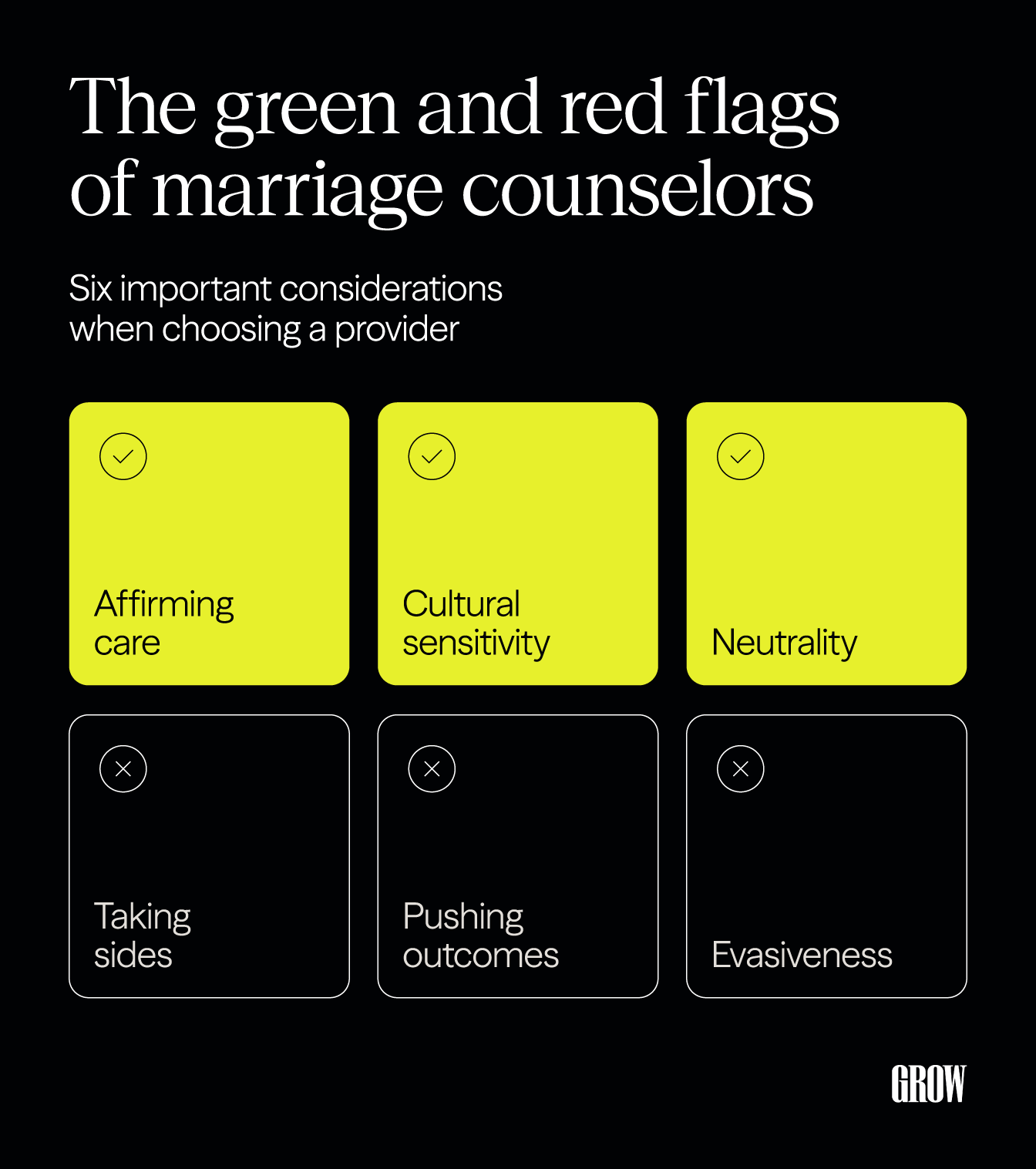
Green flags to consider
A strong therapeutic match often shows up early. Look for a counselor who demonstrates:
- Experience with specific issues like infidelity, grief, or life transition counseling, not just general couples work.
- A balanced approach to conflict by facilitating hard conversations without escalating them.
- A neutral approach where each partner feels equally challenged, heard, and respected.
- Clear communication about goals supported by the structure of the framework(s) they intend to follow.
- Affirming, inclusive care for couples and relationships of all identities, structures, and backgrounds, including LGBTQIA+ couples.
- Cultural and religious competence or culturally sensitive therapy if your relationship involves navigating cultural differences or faith.
Red flags to consider
These therapeutic approaches and patterns may suggest a poor fit or, in some cases, a more serious concern. In more serious cases, a mismatched therapist can deepen existing conflict between partners, making it harder, not easier, to move forward together.
Look for these characteristics during your consultation or early sessions:
- Taking sides by regularly advocating for one partner’s position over the other or failing to address concerns about imbalance when they are raised.
- Discouraging questions about their approach, training, or how sessions are structured.
- Pushing specific outcomes, whether it’s staying together, separating, or some other outcome.
- Unclear or evasive answers about licensure, insurance, or billing.
Find the right marriage counselor with Grow Therapy
To find a good marriage counselor, you need to be clear about your needs, know what to look for in a listing, and take time to vet your options before committing. When approached intentionally, the search process itself can be the first collaborative step a couple takes together toward improving their relationship.
With a platform like Grow Therapy, you can move toward a better connection by finding a licensed therapist who accepts your insurance and offers flexible scheduling.